
Why Don’t We Have 13 Months? The True Story of the 13-Month Calendar
Imagine a calendar with thirteen months, each exactly four weeks long. Every month starts on a Sunday and ends on a Saturday. If your birthday fell on the ninth, it would be a Monday every year. And every thirteenth would be a Friday: thirteen Friday the thirteenths, every single year.
That calendar was real. A railway clerk designed it, a camera company ran its books in four-week periods, and the League of Nations studied the idea in Geneva. So why are our months still lumpy?
Prefer to watch? The animated version tells the same story in about ten minutes.
A railway clerk with a problem
Moses Cotsworth was an English railway clerk from Yorkshire. Part of his job was explaining why the railway’s earnings rose or fell from month to month.[29] His problem was that months don’t compare. One has 28 days, the next has 31. One has four weekends, the next has five. A busy-looking month might just be a long one.

His fix, first set out in his book The Rational Almanac in the early 1900s and refined over years of campaigning, was to start again with months that all match.[1] Give each month four weeks, 28 days. Repeat that thirteen times and you get 52 weeks, or 364 days. He wasn’t the first to try: a thirteen-month plan was printed in The Gentleman’s Magazine in 1745, and the philosopher Auguste Comte published one in 1849.[26]
In the version Cotsworth campaigned for, the International Fixed Calendar, the new month was called Sol and sat between June and July.[1][2] Because every month starts on a Sunday, the thirteenth always lands on a Friday.

The day with no weekday
There was a catch. A year isn’t 364 days; it’s about 365 and a quarter.[24] So the plan needed one more day every year, and two in leap years.
The answer was Year Day, added after 28 December. It had a date but no weekday: not a Monday, not a Sunday, part of no week at all. In leap years a Leap Day, also outside the week, went after 28 June.[2] It looked like a tidy fix. It would become a major point of dispute.
Kodak keeps the books
The idea won a powerful supporter. George Eastman, the founder of Kodak, wrote in 1926 that uneven months made business comparisons harder.[2] At his own company he didn’t wait. A Kodak executive reported that from 1 January 1928 the company used thirteen four-week periods “for all factory records and accounts”.[4] Kodak reportedly kept a thirteen-period year until 1989, though we haven’t seen a Kodak document for the end date.[6][7]
The appeal was simple: a four-week period has 28 days and four Mondays, so one period compares fairly easily with the next. By 1930, supporters counted more than a hundred companies keeping their books the same way.[5][3] Eastman also put money behind the campaign.[3] The idea never quite went away: thirteen-period accounting survives today, and Costco, for one, normally reports on thirteen four-week periods.[28]
Could one company’s system work for whole countries? In December 1928, a committee of the US House of Representatives began hearings on a resolution asking for a world calendar conference. It never came to a vote.[8][9]
Geneva studies it
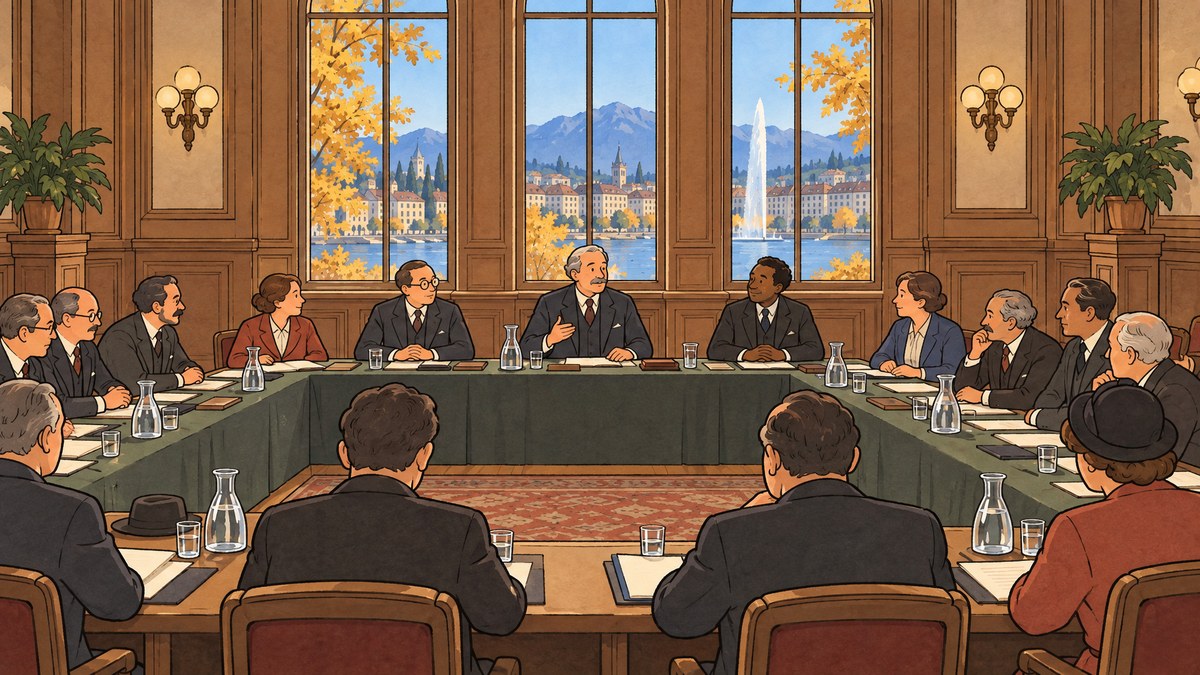
The bigger stage was Geneva. The League of Nations, the international body that came before the United Nations, had set up a committee to look into calendar reform in 1923.[11][13] More than 180 proposals poured in from around the world.[10][13] By 1926, the committee had narrowed the calendars that repeat every year down to two kinds: thirteen equal months, or twelve months in equal quarters.[10][11]
Then, in October 1931, a League conference in Geneva gave its answer. It was “almost unanimous” that “the present is not a favourable time” for changing the Gregorian calendar, taking the state of public opinion into account, and it adopted neither plan.[12] In the discussion, the thirteen-month plan was even described as theoretically more perfect. But the conference also recorded another big obstacle: those days without a weekday, which had roused the opposition of religious communities.[12]
The week that would not break
Here is why that day mattered. The seven-day week runs on without a break. As far as historians can tell, the Jewish and Christian weekly cycle has run unbroken for about two thousand years.[20][21]
Picture the end of the year. Saturday. Then Year Day: one day later. Sunday is two days later, Monday three, and so on until Friday, seven. A whole week has passed, but the new calendar calls that seventh day Friday. For anyone who keeps every seventh day, the count carries on, but its weekday name shifts back: once each ordinary year, and twice in a leap year.
For observant Jews, and for Christians who keep a Saturday Sabbath, such as Seventh-day Adventists, the Sabbath comes every seventh day, without exception, and renaming the weekdays can’t change that.[13][14] Many Christians who keep Sunday objected too. Britain’s Chief Rabbi, Joseph Hertz, campaigned hard against the blank days, and so did Adventist and Sunday-observance groups.[13][14] Some warned that a Sabbath falling on a working day could cost people their jobs.[11]
Supporters expected easier planning and accounting, and argued that the benefits for most people outweighed the difficulties for some. Opponents saw a weekly rhythm their communities had kept for centuries.[11] Both sides took the question seriously.
The rival: the World Calendar
Meanwhile, a rival plan was rising. In 1930 an American campaigner, Elisabeth Achelis, founded the World Calendar Association, inspired, by her own account, by a talk from Melvil Dewey, the man behind the Dewey Decimal System.[15] Her plan kept twelve months, arranged in four equal quarters of 31, 30 and 30 days, with every quarter starting on a Sunday. Four equal quarters of whole months are something thirteen equal months can’t give you. And February gets thirty days, every year.[15][16]
Twelve months didn’t solve the missing-day problem, though. Her plan needed a Worldsday after 30 December and, in leap years, a Leapyear Day after 30 June, both outside the week.[15][16]
The United Nations says not now
Achelis campaigned for decades. In 1953, India’s government asked the United Nations to take up her plan, reportedly proposing a start on Sunday, 1 January 1956.[16] In 1954, the UN’s Economic and Social Council asked governments for their views.[16][17] By May 1955 only about thirty of eighty had replied.[16]
In March 1955, the United States came out against it. It saw no sign of strong public support through Congress, and it said many Americans objected to breaking the weekly Sabbath cycle.[18] Pakistan raised religious objections too.[16] Gerald Ford, then a congressman and later president, wrote in his newsletter that “Congress is in no mood to tamper with the calendar.”[19]
The council put the question off for a year and, in April 1956, set it aside with no date to return to it.[16][17] By then, 1 January 1956 had come and gone: an ordinary Sunday.
Where the lumpy months come from
So where did our uneven months come from? Rome. September means “seventh month”, because Rome’s year once began in March.[23] Julius Caesar’s reform, in force from 45 BC, gave us basically today’s month lengths.[22][24]
You may have heard that Augustus stole a day from February so his month could match July’s. That story only shows up more than a thousand years later, and historians don’t accept it.[21][22] In 1582, Pope Gregory’s reform adjusted the leap years but left the months alone.[24] Even that change took centuries to spread: Greece only switched its civil calendar in 1923.[25]
The result is months of 28 to 31 days, and a birthday that moves forward one weekday each year, or two when a leap day falls in between.
Why the lumps survive
Changing the calendar on your own wall is easy. Now picture your school, your job, every shop and every country switching together, with contracts, holidays and holy days to sort out. No world body can simply order that; governments would have to act together.[8][16]
Some newer proposals, such as the Hanke-Henry Permanent Calendar from Johns Hopkins University, try to fix the months without breaking the week, by adding a whole extra week every five or six years instead of a blank day, so the seven-day cycle never breaks.[27]
So the thirteen-month calendar reached an international shortlist, and Kodak’s books. Its twelve-month rival reached the United Nations. Neither won agreement to switch. What stopped them wasn’t one villain, but several things at once: too little public demand, the trouble of everyone switching together, and a day that broke a rhythm many people keep holy, the week. Next time February runs short, or your birthday lands on a different weekday, you’ll know why.
Sources
- Cotsworth, M. B. The Rational Almanac (first printed 1902; edition of 1905).
- Eastman, G. (May 1926). “The Importance of Calendar Reform to the Business World.” Nation’s Business 14(5).
- Ackerman, C. W. (1930). George Eastman. Houghton Mifflin.
- Folsom, M. B. (24 January 1929). “Revision of Present Calendar Badly Needed.” Paper Trade Journal.
- Printers’ Ink (3 April 1930). “The Thirteen Month Calendar.”
- Rinaldo, P. M. (1989). The Five-Day Weekend. DorPete Press.
- Byrnes, M. (11 December 2014). “The Death and Life of the 13-Month Calendar.” CityLab.
- US House of Representatives, Committee on Foreign Affairs (1928-29). Simplification of the Calendar: Hearings on H.J. Res. 334.
- The Congressional Digest (April 1929). “Should We Have a Thirteen Month Calendar?”
- League of Nations (1927). Classification and Summary of Proposals for Calendar Reform. C.167.M.49.1927.VIII (Annex to the 1926 Report on the Reform of the Calendar, A.33.1926.VIII).
- League of Nations (1931). Fourth General Conference on Communications and Transit. Preparatory Documents, Vol. I: Calendar Reform. 4th C.G.C.T.1.
- League of Nations (1931). Fourth General Conference on Communications and Transit. Official Instruments approved by the Conference. C.785.M.380.1931.VIII.
- Hertz, J. H. “The Battle for the Sabbath at Geneva.” Paper read 16 December 1931. Transactions of the Jewish Historical Society of England 13 (1932-35).
- Maxwell, A. S. (September 1931). “The Calendar Question.” Inter-American Messenger 8(9).
- Achelis, E. (1959). The Calendar for the Modern Age. Thomas Nelson & Sons.
- United Nations, Economic and Social Council. India’s letter on world calendar reform (E/2514, 1953); summary records E/SR.753 (1953), E/SR.848 (1955) and E/SR.905 (1956); resolution 555 (XVIII) (1954).
- United Nations. Yearbook of the United Nations 1954 and 1956.
- US Department of State Bulletin 32 (11 April 1955), p. 629. “U.S. Opposes Action by U.N. on Calendar Reform.”
- Ford, G. R. (5 May 1955). Your Washington Review (congressional newsletter), p. 2. Gerald R. Ford Presidential Library.
- Zerubavel, E. (1985). The Seven Day Circle. Free Press.
- Blackburn, B. & Holford-Strevens, L. (1999). The Oxford Companion to the Year. Oxford University Press.
- Stern, S. (2012). Calendars in Antiquity. Oxford University Press.
- Macrobius. Saturnalia, book 1, chapters 12-14.
- Doggett, L. E. “Calendars.” In Explanatory Supplement to the Astronomical Almanac (1992).
- Tøndering, C. Calendar FAQ: “The Gregorian calendar.”
- The Gentleman’s Magazine (July 1745); Comte, A. (1849). Calendrier positiviste.
- Johns Hopkins University (27 December 2011). “Time for a Change? Johns Hopkins Scholars Say Calendar Needs Serious Overhaul.”
- Costco Wholesale Corporation. Form 10-K, fiscal 2026.
- Eastman, G. (15 August 1927). “Do We Need Calendar Reform?” Reprinted in the Official Publication of the National Association of Cost Accountants VIII(24).