
What Year Was It Before Year 1? The Monk, the Easter Table and the Missing Zero
You write 2026 on forms. But 2026 years since what? And what came before Year 1?
Not year zero. In the usual historical numbering, the year before AD 1 is 1 BC, with nothing in between: 2 BC, 1 BC, AD 1, AD 2.[17] Yet nobody alive at the time called it 1 BC; that label came centuries later.[1] Our count begins with a monk, an Easter table and a starting point no surviving writing explains.
Prefer to watch? The illustrated version tells the same story, from a Roman stone plaque to your phone’s lock screen, in about eleven minutes.
One year, many names
It depended on who was writing, and where. Romans usually didn’t number their years at all. They usually named each year after two officials called consuls.[1][8] To a Roman, the year before AD 1 was simply the year of Lentulus and Piso: Cossus Cornelius Lentulus and Lucius Calpurnius Piso.[8] Long lists of consuls let Romans, and later scholars, work out how many years had passed.[8]
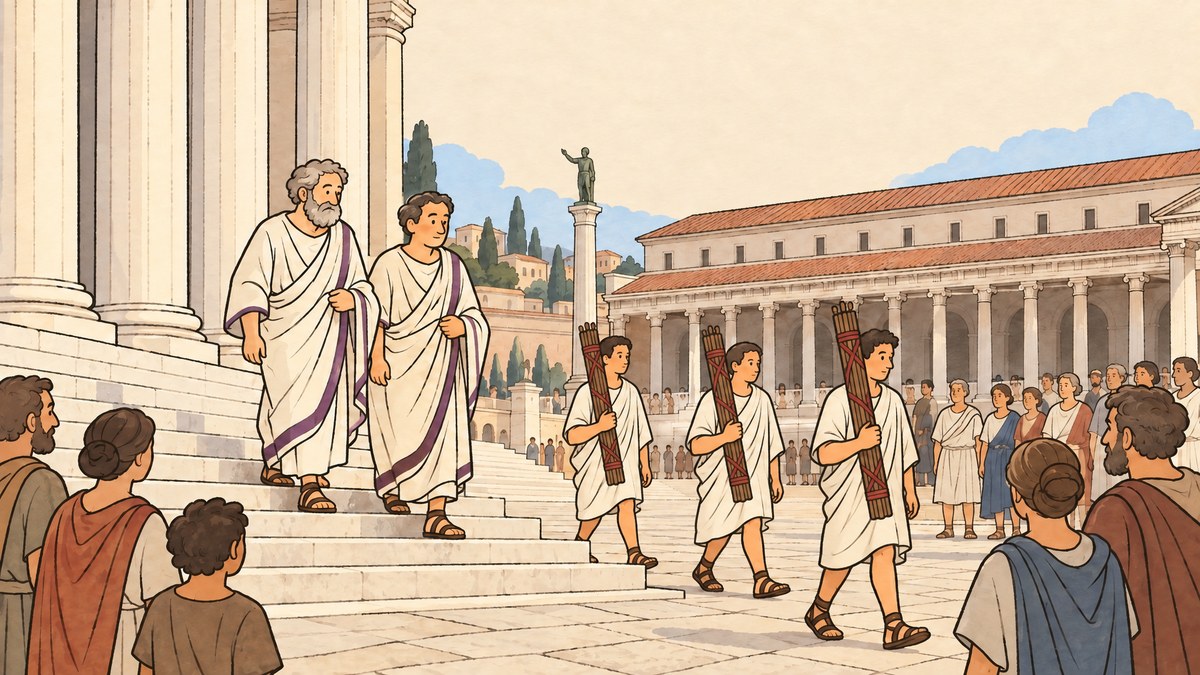
Others counted differently. Many documents counted a ruler’s years on the throne; Luke’s Gospel dates the start of John the Baptist’s ministry “in the fifteenth year of the reign of Tiberius Caesar”.[10] Greek historians used Olympiads, four-year spans counted from the first recorded Games, conventionally 776 BC; our mystery year fell in the 194th.[1] Across much of the Near East, years were numbered in the Seleucid era, counted from Seleucus I taking control of Babylon in 312/311 BC.[9] On Varro’s count from Rome’s legendary founding it was year 753, a count Romans rarely used in daily life.[1][25]
Same year, many names, and none of them “1 BC”.
A monk and an Easter table
Our single count grew out of a practical problem: Easter’s date moves every year. Church rules tied it to a spring full moon and then the Sunday after, so scholars drew up tables of Easter dates for years ahead, and each row needed a year label.[18]
In about 525, in Rome, a monk named Dionysius Exiguus took on that job.[2] “Exiguus” means “the Little”; he used the name himself, most likely out of modesty.[7] He was a respected scholar who translated Church law from Greek into Latin.[7] He wrote a new Easter table for a bishop named Petronius, continuing an older table from Alexandria in Egypt.[2]

That older table numbered its years from the reign of the Roman emperor Diocletian, whose era began in AD 284.[2][1] Diocletian had persecuted Christians. In his preface, Dionysius wrote that he did not wish to tie the memory of “an impious man and persecutor” to his cycles, and chose instead to number the years “from the incarnation of our Lord Jesus Christ”.[2] (The Incarnation is the Christian belief that God became human in Jesus.) So the year that had been 248 of Diocletian got a new label in his table: 532.[2]
His column heading read “years of our Lord Jesus Christ”. That is where “anno Domini”, “in the year of the Lord”, comes from. AD does not mean “after death”.[2][18]
The unexplained starting point
No surviving writing tells us how Dionysius chose his starting point.[1] Why 532, and not, say, 530?
Scholars still disagree. Perhaps he worked backwards from Gospel clues about Jesus’ age; perhaps he took over an older count; a third idea links it to a long Easter cycle.[5][6] None is certain.
And he didn’t use his count to date history. Dionysius still named his own year the Roman way, by its consul.[2] AD was simply a label on the rows of a table.
Bede turns a table into history
Two centuries later, another monk helped turn that label into a way of dating history. Bede, a monk and scholar in Northumbria in northern England, wrote The Reckoning of Time in 725, a textbook on time and the Easter calculation that used Dionysius’s method.[3] In 731 he finished his Ecclesiastical History of the English People and dated its events “from the Incarnation of the Lord” throughout.[4]
In the chronology at the end of his History, Bede placed Julius Caesar’s invasion of Britain “in the sixtieth year before the Incarnation”.[4] It’s one of the earliest well-known “before Christ” dates, and a few years off: modern historians date Caesar’s invasions to 55 and 54 BC.[4]
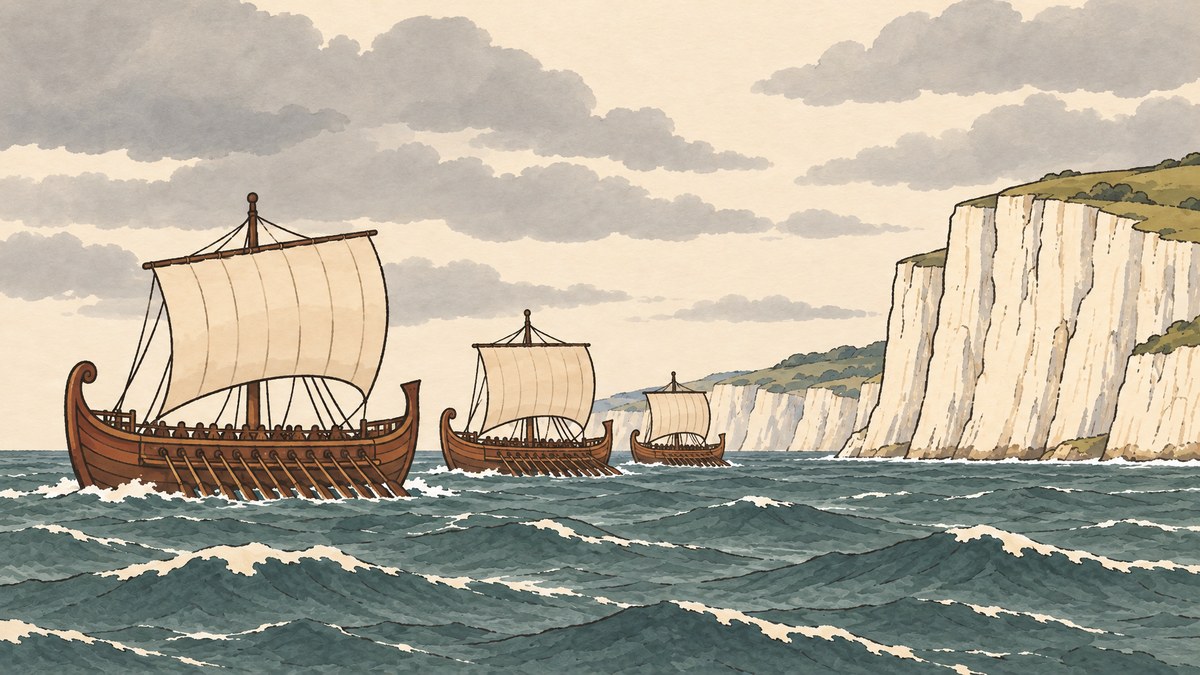
Bede’s widely copied works greatly helped spread AD dating.[1][3] Counting backwards stayed occasional for a long time: printed backward counts appeared in Werner Rolevinck’s chronicle of 1474, but came into widespread use only in the late 1700s.[1][22]
Why there is no year zero
This count numbers years like places in a line: first, second, third.[17] Roman numerals had no symbol for zero anyway, and zero as a number reached Latin Europe only centuries later, spreading from about 1200.[19] So 1 BC comes straight before AD 1, and BCE/CE has no year zero either.
One consequence surprises people. The first thousand years run from AD 1 to the end of AD 1000, so by the strict count the third millennium began on 1 January 2001.[16][17] The change to 2000 was still a real milestone for the digits, and the same argument had already broken out two centuries earlier, when The Times called it “a silly, childish discussion”.[16]
Astronomers sidestep it by calling 1 BC year 0, so their arithmetic works: same year, new label.[18]
Probably a few years off
If the count starts with the birth of Jesus, you might expect that birth in Year 1. Most historians think it came a few years earlier. Here we’re looking only at historical dates and record-keeping.
Two Gospels tell of the birth. Matthew’s Gospel places it in the reign of King Herod the Great.[10] From the historian Josephus, including an eclipse he mentions, most historians date Herod’s death to about 4 BC, though a minority argue for about 1 BC.[11][12] Luke’s Gospel links the birth to a census under Quirinius, which other sources date to AD 6, and historians find the two accounts’ dates hard to line up.[10][11][14]
A common scholarly estimate places the birth around 6 to 4 BC; some scholars allow a year or so earlier, and the exact year is unknown.[13][14][15] Even in the Middle Ages, many writers who used AD, Bede among them, thought the birth fell in 2 BC on that count.[1] The count stuck anyway.
How a habit took over
So who decided the whole world should use it? No one decided it for everyone. It spread over centuries through scholarship, churches, courts, printers and, in places, government decrees.[1]
In the 700s, English missionaries such as Willibrord and Boniface carried AD to the European mainland.[1] At Charlemagne’s court, around 800, the court’s annals numbered every year from the Incarnation,[27] but his charters still counted his years as king and emperor; the chancery of Charles the Fat began adding Incarnation years in 876.[20] Even the popes’ office took centuries to make it routine: ordinary papal letters added AD years only under Eugene IV, from 1431.[7][20]
Iberian kingdoms and territories replaced the Spanish Era at different times, including Catalonia in 1180 and Portugal in 1422.[1][7] Russia counted years from the Creation until Peter the Great switched to AD years: there, the year 7208 was followed by 1700.[21]
Sharing a calendar didn’t always mean sharing year numbers: Japan adopted the Western calendar in 1873 but kept its era names, and Turkey switched its year numbers to AD only in 1926.[1] The People’s Republic of China adopted AD numbering in 1949.[24]
Other years, same day
On 31 October 2026, a Hebrew calendar says 5787.[26] The Islamic calendar says 1448, counting lunar years from the Hijra, the Prophet Muhammad’s migration from Mecca to Medina in AD 622.[25][26] Thailand’s official calendar says 2569; Japan’s says Reiwa 8; India’s national calendar says 1948; Ethiopia’s says 2019.[26] And the Coptic Church in Egypt still numbers years from Diocletian’s reign, now called the Era of the Martyrs in honour of those who died for their faith: its year 1743 began on 11 September 2026.[25][26]
BC or BCE?
BC means “before Christ”; AD, “anno Domini”. BCE and CE mean “before the Common Era” and “Common Era”. The numbers are identical.[1][25] The idea isn’t new: Johannes Kepler wrote of the “vulgar (common) era” in Latin in 1615.[23] Some prefer the Common Era wording because it is less explicitly Christian; others prefer BC and AD for familiarity or historical continuity.[1][13] Either way, it’s the same count.
So, what year was it?
Before Year 1 came 1 BC, or, to a Roman, the year of Lentulus and Piso. And who decided it’s 2026? No one decided it for everyone. It began with a monk in Rome, about fifteen hundred years ago, who relabelled one column of an Easter table, and it’s probably a few years off. Scribes, scholars and printers kept copying it. The next time you write the date, you’re filling in his column.
Sources
- Blackburn, B. & Holford-Strevens, L. (1999). The Oxford Companion to the Year. Oxford University Press.
- Dionysius Exiguus (c. 525). Liber de Paschate: the preface to Bishop Petronius and the Easter table.
- Bede (725). The Reckoning of Time. Tr. F. Wallis (1999). Liverpool University Press.
- Bede (731). Ecclesiastical History of the English People, I.2 and V.23-24; tr. A. M. Sellar (1907), with note 33.
- Declercq, G. (2000). Anno Domini: The Origins of the Christian Era. Brepols.
- Mosshammer, A. A. (2008). The Easter Computus and the Origins of the Christian Era. Oxford University Press.
- Catholic Encyclopedia (1908-1909). “Dionysius Exiguus”; “General Chronology”; “Dates and Dating.”
- Cooley, A. E. (2012). The Cambridge Manual of Latin Epigraphy (lists of Roman consuls). Cambridge University Press.
- Stern, S. (2012). Calendars in Antiquity. Oxford University Press.
- The Gospels of Matthew (2:1) and Luke (2:1-2; 3:1).
- Josephus. Jewish Antiquities, books XVII-XVIII.
- Schürer, E. (rev. G. Vermes & F. Millar, 1973). The History of the Jewish People in the Age of Jesus Christ, vol. I. T&T Clark.
- Sanders, E. P. (1993). The Historical Figure of Jesus. Penguin.
- Brown, R. E. (1993). The Birth of the Messiah (updated edition). Doubleday.
- Dunn, J. D. G. (2003). Jesus Remembered. Eerdmans.
- Royal Greenwich Observatory, Astronomy Information Service. “The New Millennium” (leaflet, c. 1998-2000).
- US Naval Observatory, Astronomical Applications Department. “The 21st Century and the 3rd Millennium.”
- Doggett, L. E. “Calendars and Their History.” NASA; from the Explanatory Supplement to the Astronomical Almanac (1992).
- MacTutor History of Mathematics, University of St Andrews. “A history of Zero.”
- Frenz, T. Urkundenlehre (diplomatics course text). University of Passau.
- Schönle, A. (2021). “Calendar Reform under Peter the Great: Absolutist Prerogatives, Plural Temporalities, and Christian Exceptionalism.” Slavic Review 80(1), 69-89.
- Rolevinck, W. (1474). Fasciculus temporum. Cologne.
- Kepler, J. (1615). Eclogae chronicae. Frankfurt.
- Library of Congress, In Custodia Legis (2016). “Transition from the Lunar Calendar to the Western Calendar under Chinese Law.”
- Tøndering, C. Calendar FAQ (“Counting years” and the Hebrew, Islamic and Chinese calendar pages).
- Year numbers on 31 October 2026: Hebcal (Hebrew); UAE Fatwa Council (Hijri); Thai Ministry of Foreign Affairs; National Astronomical Observatory of Japan; India Meteorological Department; Ethiopian News Agency; the Coptic synaxarium.
- Royal Frankish Annals (Annales regni Francorum), compiled from the late 780s.