
Why Do Some Countries Drive on the Left? The Real History Behind Your Side of the Road
Picture your drive tomorrow morning. Now flip it: every car, every turn, every roundabout, all mirrored. For a little over a third of the world’s people, that mirrored road is simply normal.[17] And most of them aren’t British. About half of everyone who lives where traffic keeps left lives in India.[17]
So why left? The famous answer involves swords. The real story is messier, and much more interesting: a jammed bridge, wagons with no front seat, an empire, and a country that changed sides one Sunday before breakfast.
Prefer to watch? The animated version tells the same story in about ten and a half minutes.
A divided world
Today about fifty-four countries keep left, plus around twenty smaller territories. They stretch from the United Kingdom and Ireland to India, Japan, Indonesia, Thailand, Australia, New Zealand and much of southern and eastern Africa.[17]
It wasn’t always the minority side. By one careful count of the world in 1919, about as many territories kept left as kept right, and more people lived in keep-left places than keep-right ones.[1] Between 1919 and 1986, dozens of keep-left places switched to the right. The most common reason was not safety or technology. It was matching the neighbours.[1][2]
The sword story, on trial
Here’s the story everyone has heard. Most people are right-handed, so a rider kept to the left, with his sword hand toward any stranger coming the other way. It sounds neat, and it might be partly true. But there is very little direct evidence that swords ever set the rule of the road.[8][1]
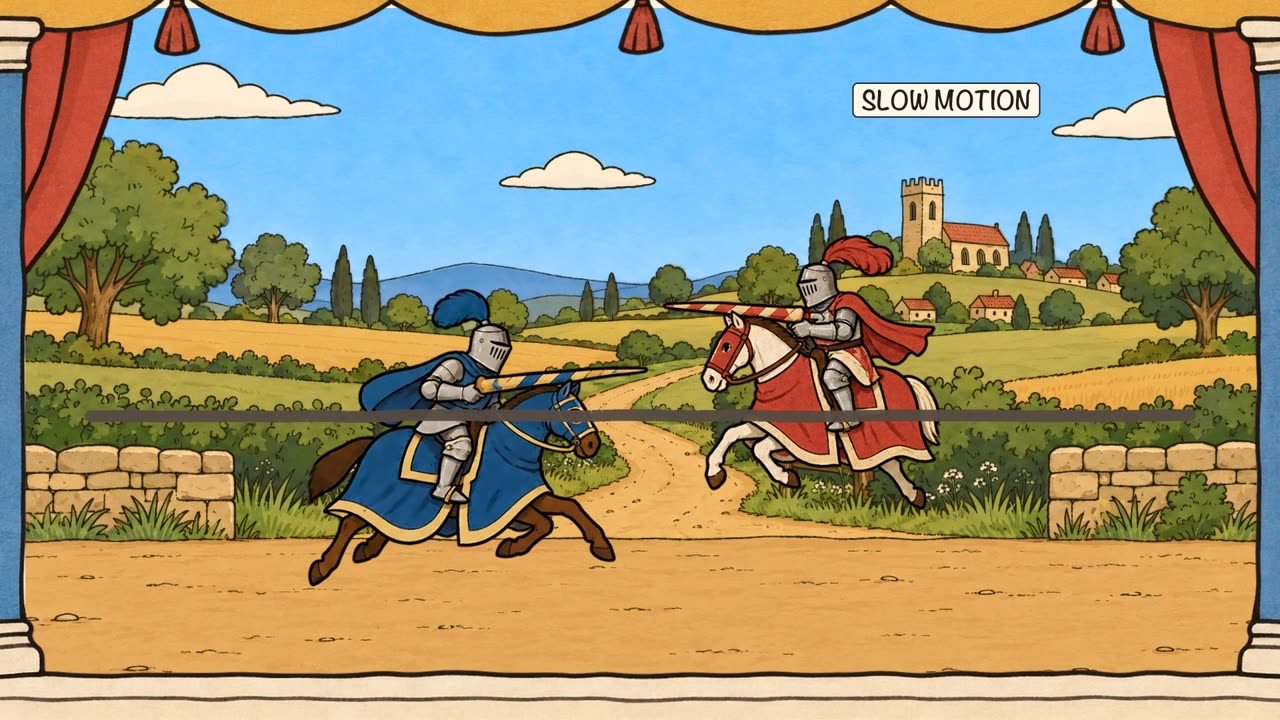
Knights don’t settle it either. In a joust, charging knights usually passed left shoulder to left shoulder, their lances crossing over the horse’s neck toward the opponent on their left.[9] That’s the geometry of traffic that keeps right.
Then there’s a twist. One American roads historian, Albert C. Rose, used the same weapon-hand logic to explain keeping right: colonial travellers carried their guns in the crook of the left arm, so keeping right put the gun toward strangers.[3] When one idea explains both sides, it isn’t proof of either.
Other popular stories fare no better. Some writers say Pope Boniface VIII ordered pilgrims to keep left in 1300; others say right. There’s no known record of either order.[11] Roman clues don’t settle it either. Worn kerbstones in Pompeii hint at keeping right where streets ran both ways. That local evidence does not establish an empire-wide Roman rule.[10]
London Bridge writes it down
If stories can’t solve it, paperwork can at least show us when rules existed. In 1722 London Bridge was badly jammed. Houses and shops still stood on the bridge itself, causing frequent stops. So the City of London posted three men at each end, to make carriages coming from Southwark keep to the west side, and everyone else the other side. In practice: keep left.[5]
In 1756, an Act of Parliament for London Bridge put a keep-left rule into law.[6] And in 1835, the Highway Act told drivers of carts, wagons and carriages in England and Wales to keep to the “left or near side” of the road when they met other traffic.[7]
But notice the order. The 1835 law didn’t start the habit: London’s bridge had a keep-left rule more than a century earlier. How old British left-keeping really is, nobody knows for sure.
Why America kept right
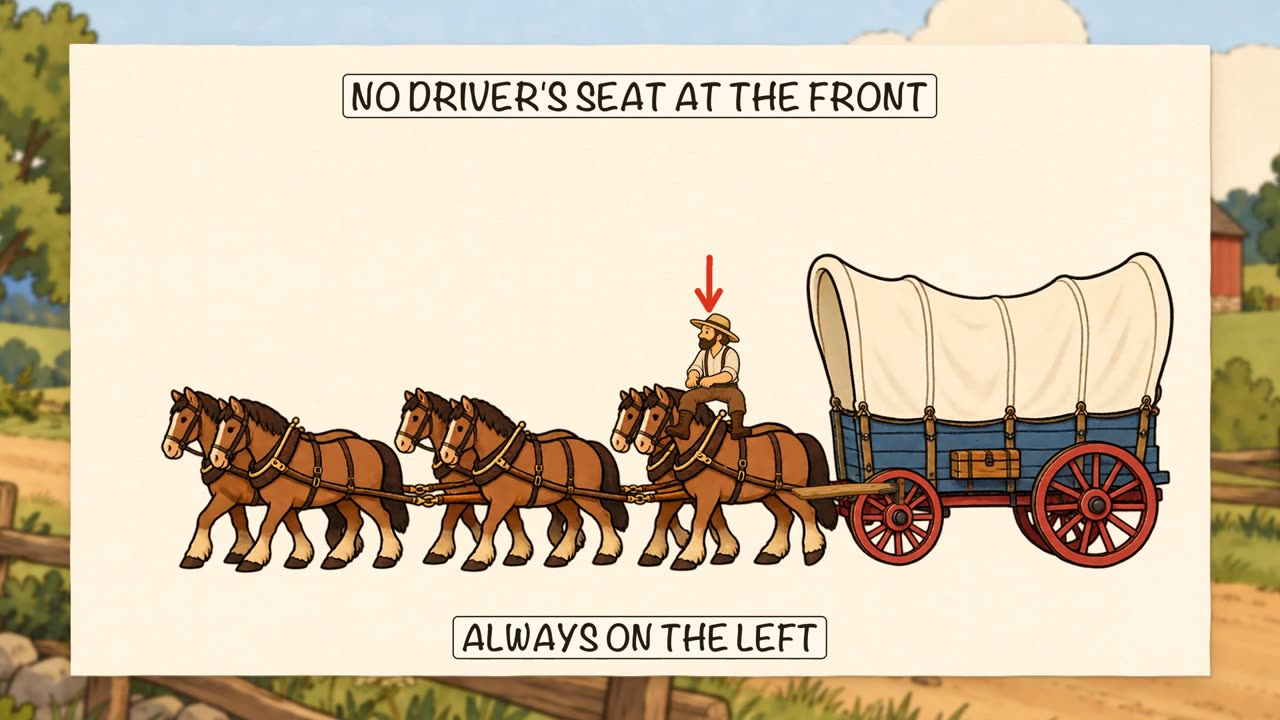
Across the Atlantic, the evidence points the other way. In colonial America, most travellers already kept right.[3] Then came the Conestoga wagon, a big freight wagon from around Lancaster, Pennsylvania, pulled by a team of horses.
It had no driver’s seat at the front. The driver usually rode the horse nearest the wagon on the left, sat on a little “lazy board” on the wagon’s left side, or walked on the left.[3] Now picture two wagons meeting. If you sit on the left, you want the other wagon to pass on your left, so you can watch how close those wheels come. So you keep right. Historians see this as one strong reason the American habit stuck, not the only one.[3][4]
Laws followed. In 1792 Pennsylvania wrote keep-right into the charter of a new toll road, the Philadelphia and Lancaster Turnpike, and in 1804 New York made it the rule on all its public highways.[3] Cars came later. Most early American cars put the driver on the right; Ford’s 1908 Model T put him on the left, and by 1915 most other carmakers had followed.[4] The road rule stayed right. The seat moved.
Was it Napoleon?
You’ll often hear that Napoleon made Europe drive on the right, to move his armies or to annoy the British. The evidence for that is weak, and the standard history of the rule of the road treats the related French Revolution story as a legend.[1][2]
Europe remained a patchwork well into the twentieth century. Some switches came under occupation or during war; matching neighbours was another important pressure.[1]
Empire and neighbours
Most of today’s left-keeping countries were once ruled by Britain: India, Australia, South Africa, Kenya and Jamaica among them. Not all, though. Indonesia, Suriname, Mozambique, Thailand and Japan keep left too.[17]
And neighbours could undo the empire’s habit. Canada’s last left-keeping provinces switched to the right in the 1920s to match the rest of Canada and the United States. In West Africa, Nigeria and Ghana, both once British, switched to the right in the 1970s to match neighbours that already kept right.[1][17]
Japan keeps left, although it was never a British colony.[17] Its origins remain uncertain. Tokyo police made keeping left a rule in 1900, and it became nationwide around 1920.[16] One Japanese island switched twice. After the Second World War, Okinawa was run by the United States and drove on the right. On 30 July 1978, six years after returning to Japan, it switched back to the left overnight. The day is remembered as “730”: seventh month, thirtieth day.[15]
The night Sweden switched
The most famous switch of all happened in Sweden. Sweden kept left while its neighbours Norway and Finland kept right, and most Swedes already drove cars with the steering wheel on the left. In a 1955 referendum, nearly 83 percent of voters said no to switching. Eight years later, Parliament voted to switch anyway.[12]
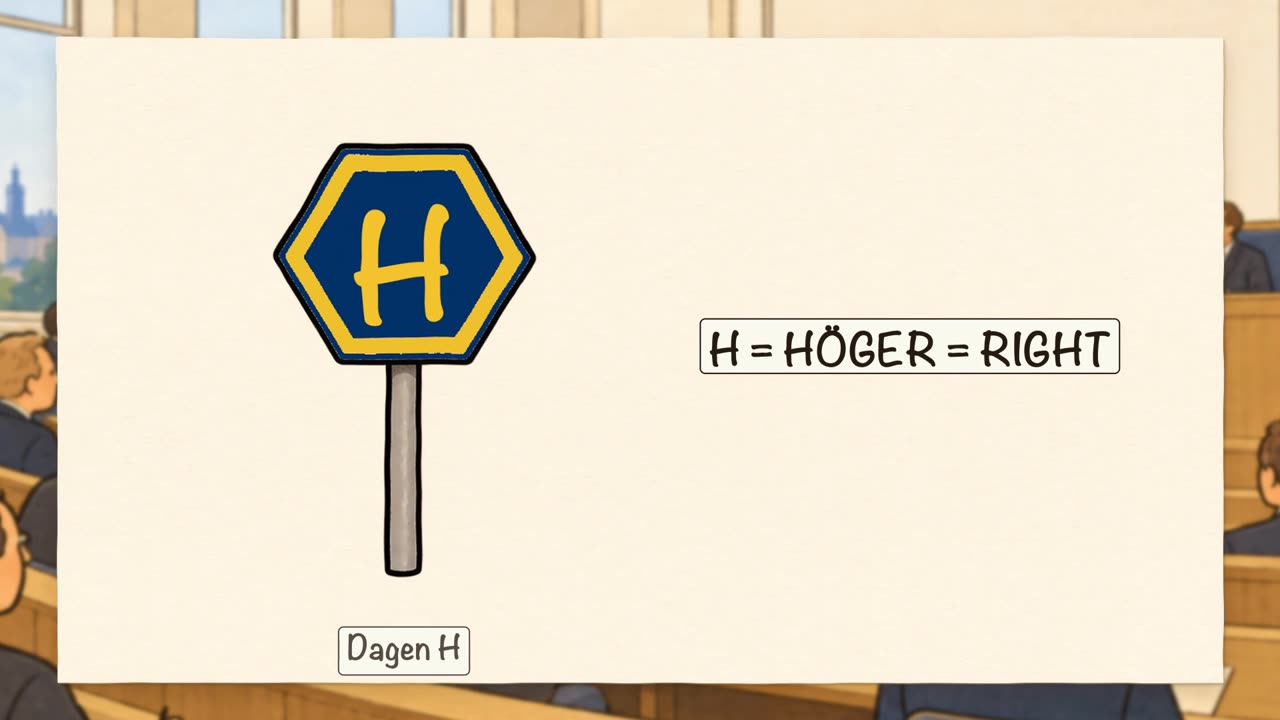
The day came on Sunday 3 September 1967: Dagen H, “H Day”, H for höger, Swedish for “right”. Ordinary driving was banned through the night. At 4:50 a.m. the few vehicles allowed out stopped, moved carefully across to the right, and at 5:00 they carried on.[12]
About 360,000 road signs were replaced, and thousands of buses were rebuilt or replaced with doors on the right.[12] There was even a pop song, “Håll dig till höger, Svensson” (“Keep right, Svensson”).[18]
The crashes everyone feared didn’t arrive. At first accidents actually fell, with lower speed limits and very careful driving; the longer-term effect is harder to untangle.[12] And Sweden’s railways never switched: trains there still normally keep left.[12]
Samoa goes the other way
Most twentieth-century switches went from left to right. Then, on 7 September 2009, Samoa switched from the right to the left, the first country in over thirty years to change sides.[13]
The reason was close to home. Australia and New Zealand keep left, and in 2009 about 170,000 Samoans lived there. The government wanted families to be able to send home cheaper used cars from those countries, built with the steering wheel on the right.[13][14] Protesters tried to stop the change in court and lost. The switch came with a two-day public holiday and three days without alcohol sales.[13]
So which side is better?
Neither, in itself. Road historians find no technical reason to prefer one side of the road to the other. What matters is that everyone around you uses the same one.[3][4]
That makes the world’s road map a kind of fossil. A crowded bridge, wagon drivers, an empire, neighbours and even second-hand cars have each left their mark somewhere. So tomorrow morning, when you pull out and keep to your side, you’re following a choice somebody made for you, maybe centuries ago. And if your country ever decides to switch, Sweden already showed it can be done before breakfast.
Sources
- Watson, I. (1999). “The rule of the road, 1919–1986: a case study of standards change.” Rutgers University.
- Kincaid, P. (1986). The Rule of the Road: An International Guide to History and Practice. Greenwood Press.
- Weingroff, R. F. “On the Right Side of the Road.” US Federal Highway Administration, highway history (quoting A. C. Rose and M. G. Lay).
- Lay, M. G. (1992). Ways of the World: A History of the World’s Roads and of the Vehicles That Used Them. Rutgers University Press.
- Thomson, R. (1827). Chronicles of London Bridge.
- London Bridge Act 1756 (29 Geo. II c. 40).
- Highway Act 1835 (5 & 6 Will. 4 c. 50), section 78.
- Gould, G. M. (1908). “The Rule of the Road.” Popular Science Monthly 72.
- Royal Armouries, learning resources on the joust and the tilt.
- Poehler, E. E. (2017). The Traffic Systems of Pompeii. Oxford University Press.
- McManus, I. C. (2002). Right Hand, Left Hand. Weidenfeld & Nicolson.
- Statens maritima och transporthistoriska museer (Swedish National Maritime and Transport History Museums): “Högertrafik” (Dagen H, 1967).
- Al Jazeera (7 September 2009). “Samoa set to switch road lanes.”
- Samoa Law Reform Commission (2023). Review of the Traffic Laws of Samoa: Discussion Paper, section 2.19; Office of the Attorney General of Samoa (2009). Legislative Drafting Update, vol. 2, issue 3.
- Okinawa Prefectural Archives: the “730” change of traffic side, 30 July 1978.
- 陳芝蓉 (2015). “左極樂,右地獄:日治時期臺灣「左側通行」規則之推行.” 臺灣學研究 18: 53–98.
- United Nations, World Population Prospects 2024; Wikipedia contributors, “Left- and right-hand traffic” (country table and historical overview). Population shares calculated by TopicsYouLike from mid-2024 estimates.
- Wikipedia contributors. “Dagen H” (the public-information campaign and its song).