
Why Did the Titanic Sink in Under Three Hours? The Arithmetic of Her Watertight Walls
At about 11:40 on the night of 14 April 1912, the largest ship afloat was crossing a flat, dark sea on her maiden voyage from Southampton to New York.[1][2] About two hours and forty minutes later, she was gone. The disaster claimed about 1,500 lives.[1][2]
How could a scrape along her side sink her in under three hours? The answer isn’t one giant hole. It’s arithmetic about watertight walls, and a detail that let the water keep spreading.
Prefer to watch? The animated version walks through the same arithmetic in about eleven minutes.
Sixteen boxes, no lids
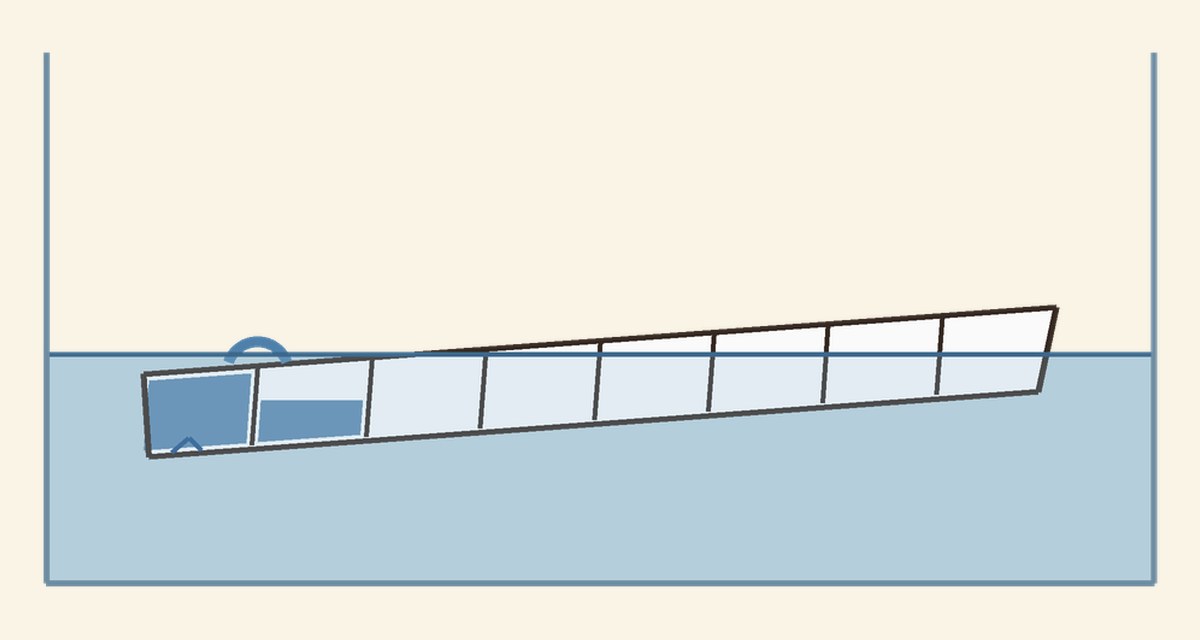
Inside her hull, fifteen watertight walls, called bulkheads, split the lower ship into sixteen compartments, front to back.[1] She was designed to stay afloat with any two neighbouring compartments flooded.[1]
The walls rose well above the waterline, but the compartments generally had no watertight lids. As the bow sank lower, water could pass above the walls into the spaces behind.[1]
Picture an ice-cube tray floating in water, its front cup cracked. Water leaks in, and that end sinks lower. Sink it far enough, and water spills over into the next cup. That picture is most of the answer.
Before she sailed, a trade journal wrote that her watertight doors, closed from the bridge, could make her “practically unsinkable”.[3] The word that matters is “practically”.
Seconds on the bridge
She was going about 22 knots at night, in a region where ice had been reported, and her speed had not been reduced.[1] That day she had received several ice warnings from other ships; at least one, reporting heavy ice ahead, apparently never reached the bridge.[1]
The night was clear, moonless and flat calm; with no waves breaking at its base, an iceberg was harder to spot.[1]
High in the crow’s nest, lookout Frederick Fleet saw a dark shape ahead, rang the bell three times and telephoned the bridge: “Iceberg right ahead.”[1] First Officer William Murdoch ordered “hard-a-starboard”, an old tiller order that swung the bow to the left, and the bridge rang for the engines to stop and reverse.[1] The bow swung about two points to port, so there was no head-on crash. Instead, the iceberg passed down her right-hand side, below the waterline.[1]
The British inquiry blamed “the excessive speed at which the ship was being navigated”, though it found that keeping up speed in clear weather was common practice then, and that she was not chasing a record.[1] The often-quoted “37 seconds” comes from a later turning trial with her sister ship, Olympic; nobody timed it that night.[1]
Not a giant gash
People often picture a long gash torn down her side. The inquiry instead estimated that the damage was spread over roughly 300 feet of the starboard bow, as a row of openings, done in about ten seconds.[1] Edward Wilding, a naval architect with the shipbuilder, Harland & Wolff, worked backwards from how fast the water rose. He estimated that all the openings together came to only about 12 square feet.[1] Roughly the top of a small kitchen table. A sonar survey of the buried bow in 1996 was read as showing six thin openings along the plates, not one big gash.[7]
Why the seams opened is still argued. Steel recovered from the wreck turned brittle in icy water by modern standards, though one study called it probably the best plain carbon ship plate of its time.[4][5] Two researchers argued that slag-rich iron rivets near the bow may have let the seams pop open more easily. The shipbuilder disputed that, saying the materials were normal for the time.[6] Either way, the flooding at the front was already enough to sink her.
The first four, and the fifth
Count the compartments from the bow: the forepeak and three cargo holds make four; the fifth was the forward boiler room; the sixth was the next boiler room.[1] The iceberg opened all six to the sea, and not equally: the sixth had only a small leak at first.[1]
Step one: six compartments were opened. Opened doesn’t mean filled.
Step two: she was designed for any two. After the disaster, the inquiry calculated further: even with the first four flooded, she would have stayed afloat.[1] Some of the forward wall tops would have been under water, but the water would not have spread past the fourth.
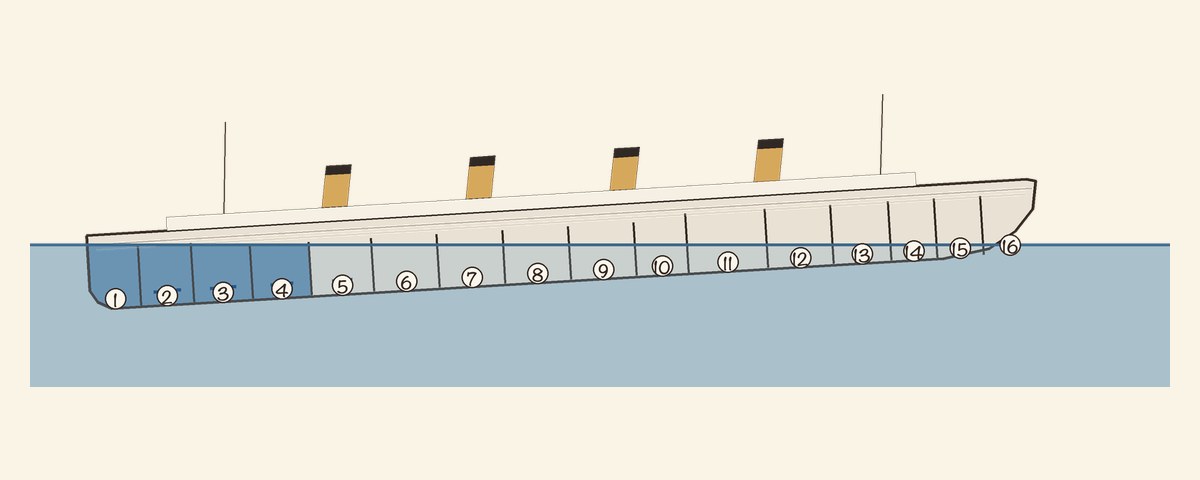
Step three: flood the first five. With the forward boiler room filling too, the bow sinks so low that the top of the wall behind it goes under. In the inquiry’s words, she “could not remain afloat with the four forward compartments and the forward boiler room (No. 6) also flooded.”[1]
Step four: as the bow settled, water reached passages above the watertight walls and spread farther aft.[1]
So the walls didn’t fail. They just weren’t tall enough for this much damage. Six were opened; even five was too many.
Why hours, not minutes
So why did she float for about two hours and forty minutes? Because the openings were small and scattered, and the flooding took time to spread. As the bow settled, the water had to rise high enough to reach the routes above the walls before it could move aft.[1]
Her eight main pumps had a combined rated capacity of about 1,700 tons an hour.[1][3] Wilding estimated that about 16,000 tons came in during roughly the first forty minutes: on average, more than ten times what the pumps were rated to move.[1] The inquiry said they “could not possibly have coped”.[1]
Not enough boats
Time mattered because of the lifeboats. Titanic carried twenty boats, certified for 1,178 people by the British inquiry’s count,[1] about half of the roughly 2,200 aboard.[1][2] Yet that was more boat space than the rules required. The British rules’ table, set in 1894, topped out at ships of 10,000 gross tons and upwards; Titanic measured 46,328 gross tons, more than four times that.[1] The ship followed the rules. The rules hadn’t kept up. Even with every seat filled, about a thousand people would have had no place.
And the places weren’t all used. By the inquiry’s count, the first boat lowered, No. 7, left at about 12:45 am with about 27 people in a boat built for 65.[1]
Distress calls went out soon after midnight, and rockets were fired.[1] On the nearby Californian, the only wireless operator had gone to bed. Officers on her deck saw rockets, but they did not wake him or go to help until morning.[1][2] How close she was is still argued. The 1912 British inquiry thought she might have saved many, if not all; a 1992 UK government review thought she would probably have arrived after Titanic sank, while still saying that “the attempt should have been made”.[1][11]
The Carpathia
The last boat lowered from the davits left at about 2:05 am. Her lights stayed on almost to the end, and at about 2:20 am Titanic slipped beneath the surface.[1]
The Carpathia had heard the call. Captain Arthur Rostron turned her at once toward Titanic’s radioed position, which he calculated was about 58 nautical miles away, roughly 67 ordinary miles. He pushed her far past her usual speed, through the ice.[1][2] She reached the rescue area at about 4 am, roughly an hour and forty minutes after Titanic had gone, took on about 700 survivors and carried them to New York.[1][2]
What the wreck told us
Survivors disagreed about whether she broke apart, and the British inquiry concluded that “the ship did not break in two”.[1][2] In 1985, a joint American and French expedition led by Robert Ballard of Woods Hole and Jean-Louis Michel of IFREMER found the wreck on 1 September.[8] She lies about 3,800 metres (12,500 feet) down, in two main pieces about 600 metres apart, with a wide field of debris between them: she did break apart.[5][9] Exactly how is still debated; one reconstruction suggests the hull may have begun to fail at a much lower angle than older pictures show.[10]
The answer
So why did Titanic sink in under three hours? A glancing blow opened six compartments, and flooding just the first five was more than she could survive. Her walls had no lids, so once the bow settled, water could reach passages above them and spread farther aft. And it took hours, not minutes, because the openings were small and scattered, and the flooding took time to spread.
Why so many died has a different answer: too few boat places, boats leaving partly empty, and no rescue ship arriving before she sank.
After Titanic, the rules changed. The first international Safety of Life at Sea convention, agreed in 1914, called for places in lifeboats or approved rafts for everyone aboard, and for round-the-clock radio watches on specified ships. The First World War kept it from entering into force, but later versions did.[12] An ice patrol began watching the North Atlantic shipping lanes, and the International Ice Patrol still runs today.[13]
She was never truly unsinkable. She was designed for two. She could have floated with the first four. Five was too many, and the iceberg opened six.
Sources
- British Wreck Commissioner’s Inquiry (1912). Report on the Loss of the “Titanic” (s.s.), and minutes of evidence (testimony of Edward Wilding, Frederick Fleet, Joseph Boxhall, Robert Hichens, Frederick Barrett, Charles Lightoller, Cyril Evans and Arthur Rostron).
- United States Senate (1912). “Titanic” Disaster: Hearings before a Subcommittee of the Committee on Commerce, and its Report.
- The Shipbuilder (1911). Special number on the White Star liners Olympic and Titanic.
- Foecke, T. (1998). Metallurgy of the RMS Titanic. NIST-IR 6118, National Institute of Standards and Technology.
- Felkins, K., Leighly, H. P. & Jankovic, A. (1998). “The Royal Mail Ship Titanic: Did a Metallurgical Failure Cause a Night to Remember?” JOM 50(1): 12–18.
- Broad, W. J. (15 April 2008). “In Weak Rivets, a Possible Key to Titanic’s Doom.” The New York Times.
- The New York Times News Service (8 April 1997). “Did small holes in hull doom Titanic?” Deseret News.
- Woods Hole Oceanographic Institution. “1985 Discovery of RMS Titanic.” Ocean Learning Hub.
- NOAA (US National Oceanic and Atmospheric Administration), Office of General Counsel. “RMS Titanic: History and Significance.”
- Woytowich, R. (9 April 2012). “How Did Titanic Really Break Up?” Scientific American guest blog.
- Marine Accident Investigation Branch (1992). Reappraisal of Evidence Relating to SS Californian. UK Department of Transport.
- International Convention for the Safety of Life at Sea (London, 1914); The National Archives (UK), “The Convention for the Safety of Life at Sea”; International Maritime Organization, history of SOLAS.
- United States Coast Guard, Navigation Center. “International Ice Patrol – About Us.”