
Why Do We Have Time Zones? Trains, Two Noons and a French Law
Imagine missing a train because you trusted a perfectly accurate clock. It is 1850, in Bristol, and your train to London leaves at ten. The town clock says ten to ten, so you stroll to the station. The platform is empty. The train left at ten, by the station clock. Neither clock is broken. The town and the railway simply disagree, by about ten minutes.[1][2]
Prefer to watch? The animated version follows the same story, from the missed train to the deleted Friday.
That small gap is where time zones come from. The story runs through a family who sold the time door to door, a Sunday when America had two noons, and a French law that defined Greenwich time without naming it.
When noon belonged to your town
For most of history, time came from the sky. Noon was when the sun stood highest over your town, and the town’s clocks were set to match. The sun reaches its highest point earlier in the east, so when London’s clocks said noon, Bristol’s still said about ten to twelve. Oxford ran five minutes behind London, Leeds six, Barrow almost thirteen.[1]
At the speed of a horse, that was easy enough to live with. In 1784 a fast new mail coach ran from Bristol to London in sixteen hours.[3] After sixteen hours in a coach, ten minutes is the least of your problems. Then, in June 1841, the Great Western Railway opened its line between the two cities. The first trip took about four hours. Suddenly, ten minutes could cost you your seat.[4]
The railway picks a clock
A timetable has a problem the sun can’t solve. One train passes through town after town, each keeping different time, and passengers have to work out which clock their ticket means. From November 1840, before its line was even finished, the Great Western ran its timetable on London time. In 1847 the railway companies’ shared Clearing House recommended Greenwich time at every station.[1]
Now a town had two times: its own, and the train’s. Bristol’s answer is still up there. The clock on its old Exchange has two minute hands, about ten minutes apart.[2] Exeter’s cathedral clock simply held out on local time until 1852.[1]
Then it reached a courtroom. In 1858 a court in Dorchester sat at ten o’clock by its Greenwich clock. The defendant wasn’t there, so the verdict went against him. Then his lawyer came in, and by the town clock it was a minute and a half to ten. The Court of Exchequer ruled that ten o’clock meant ten by local time, and the defendant could defend the case.[5] It took until 1880 for Parliament to make Greenwich time the legal time across Great Britain.[6]
The family who sold the time
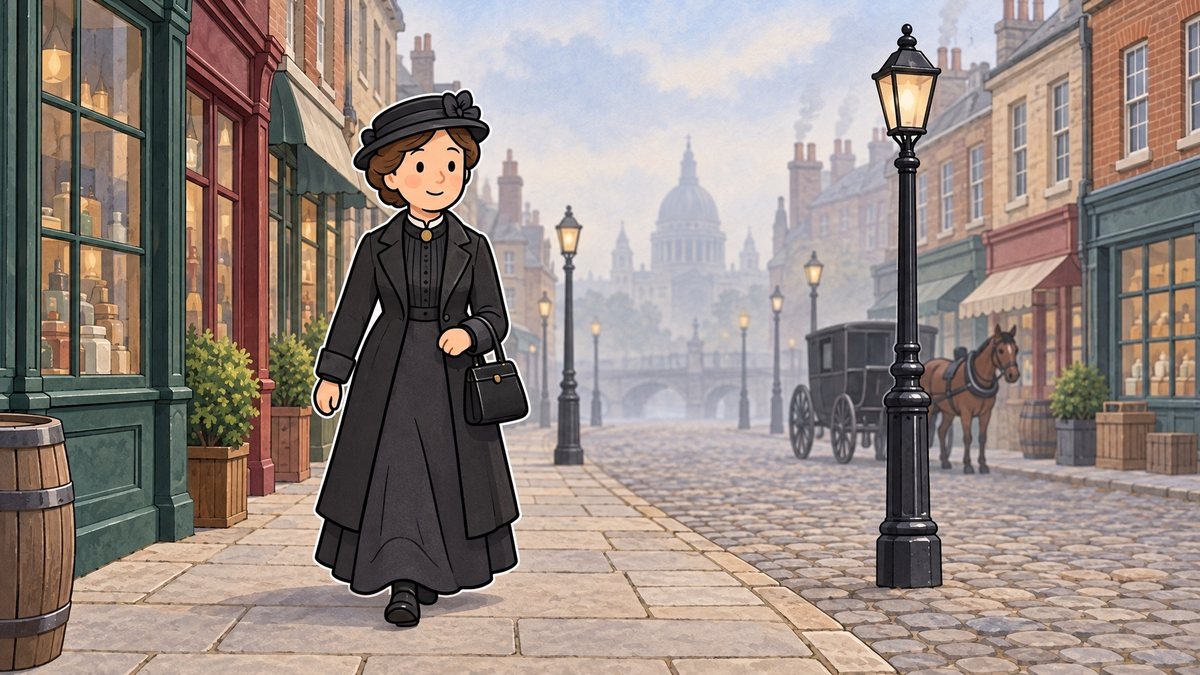
London clock shops needed Greenwich’s exact time.[25] So, by about 1840, an observatory assistant named John Belville was bringing it to paying customers in a pocket chronometer. He set it at the observatory, then carried it round so they could copy the time. When he died, his widow Maria kept the round going for thirty-six years. Then their daughter Ruth took over.[7][8]
Every Monday, Ruth collected a certificate of accuracy at Greenwich, with the chronometer in her handbag. She had about forty customers. The watch even had a name: Arnold. Greenwich was already sending time down telegraph wires, and later came BBC radio and the speaking clock. Ruth kept going anyway, into her eighties, until 1940. Her family had sold the time for about a century.[7][8]
America, multiplied
Britain’s gaps were minutes. America’s were a mess of a different size. When it was noon in Washington, it was twelve past in New York and twenty-four past in Boston. Railroads each chose their own time, and in Pittsburgh trains ran on six different standards. By one count, a passenger going from Maine to California would reset a watch about twenty times.[9][10]
Accurate time mattered for safety, too. In August 1853, two passenger trains met head-on at Valley Falls in Rhode Island, and fourteen people died. One conductor’s watch ran two minutes slow. The inquest faulted him and the missing warning signal. Afterwards, New England’s existing shared railway time became compulsory.[11][12]
But the country as a whole still had no shared time. A New York schoolmaster, Charles Dowd, looked up about eight thousand places and in 1870 proposed four time zones. The railroads did not adopt his plan.[13]
The day of two noons
What helped move them, in the end, was the fear of government doing it for them. William Allen, a railway guide editor, promoted the plan, and in October 1883, at a Chicago hotel, the railroad bosses agreed.[23]
On Sunday, November 18, 1883, railroad clocks across the country were reset, around noon. In Chicago, one office clock reached twelve and was stopped. Nine and a half minutes later it started again, from twelve.[13] That’s why it’s called the day of two noons. And it wasn’t law. A group of railroad companies had told a continent what time it was. Congress only made it official in 1918.[14]
Not everyone was pleased. One Indianapolis paper wrote that “the Sun will be requested to rise and set by railroad time.”[13] In Washington, the Attorney General ruled that government clocks couldn’t change without Congress. One story says he then missed a train to Philadelphia by eight minutes, on railroad time. It may be too neat to be true.[10] Most people simply got on with it. Within a year, most of America’s largest towns were using standard time. Detroit went on arguing about which zone it was in until 1916.[10]
What the world actually agreed
In October 1884, delegates met in Washington to choose one starting line for the world’s maps and clocks. Greenwich won, twenty-two votes to one, partly because most sea charts already used it. France and Brazil abstained.[15]
The conference did not create time zones. Sandford Fleming argued for a worldwide system, but the delegates never voted on zones.[15] Fleming is often called the father of time zones, and the story usually starts with him missing a train in Ireland. In that telling, the timetable printed p.m. instead of a.m.[16] Others had proposed time zones earlier.[24]
Zones spread country by country instead. New Zealand had already set a national time in 1868.[17] Others made their own decisions over the following decades. France kept Paris time until 1911, when its law defined French time as “Paris mean time, retarded by nine minutes and twenty-one seconds.” Do the sum, and that’s Greenwich.[15]
A zone is a decision
A time zone looks like science, but it is really a decision. Dublin ran twenty-five minutes behind London until 1916.[1] In 1940, under Franco, mainland Spain moved onto Central European time, and never moved back. Most of Spain lies south of Britain, yet runs an hour ahead.[19]
China is wide enough for about five zones and uses one. In the far west, the winter sun can rise around ten in the morning, and many people in Xinjiang informally keep a clock two hours behind.[20] Nepal sits fifteen minutes ahead of India, a setting it chose in 1986, close to Kathmandu’s own sun.[21] And at the end of 2011, Samoa hopped over the date line to be closer to its trading partners. Thursday, December 29 was followed by Saturday, December 31. That Friday, there, never happened.[22]
Why not one clock?
So why not put the whole planet on Greenwich time? Tokyo’s nine o’clock office opening would now be called midnight. The date would change in the middle of the morning, and you’d still need to check when your friend was awake. Russia’s railways ran a version of this: until 2018, their long-distance timetables used Moscow time, so in Vladivostok the station clock and the street clock could be seven hours apart.[1]
That’s the compromise. Whole regions share one clock, so a timetable makes sense, and noon stays roughly in the middle of the day. For most people, most of the time, that’s close enough. And since the rules keep changing, your phone leans on a shared database, kept up by volunteers.[18]
Bristol’s clock is still there, two minute hands about ten minutes apart, remembering when a town’s noon and a train’s noon disagreed. You gave up your own noon so that a whole region could agree when the train leaves. And if you miss it now, you can’t blame the clocks.
Sources
- Wikipedia. Railway time.
- Bristol City Council. St Nicholas Markets history.
- Wikipedia. Mail coach.
- Great Western Railway histories, as summarised by Network Rail.
- Curtis v March (1858). Court of Exchequer.
- Statutes (Definition of Time) Act 1880.
- Royal Museums Greenwich. The Greenwich Time Lady: Ruth Belville.
- Royal Observatory Greenwich. Distribution of time by the Belvilles.
- JSTOR Daily. How America Got Its Time Zones.
- America’s Best History. Timeline 1883.
- Harvard Gazette (2011). America’s first time zone.
- Wikipedia. Valley Falls train collision.
- Grossman, R. (2023). In 1883, much of the nation reset its clocks on the day of two noons. Chicago Tribune.
- Standard Time Act 1918. United States Congress.
- Wikipedia. International Meridian Conference.
- Blaise, C. (2000). Time Lord: Sir Sandford Fleming and the Creation of Standard Time. Pantheon.
- Wikipedia. New Zealand Mean Time.
- Wikipedia. tz database.
- Wikipedia. Time in Spain.
- Wikipedia. Time in China.
- Wikipedia. Nepal Standard Time.
- Wikipedia. Time in Samoa.
- Wikipedia. Standard time.
- Wikipedia. Time zone.
- Linda Hall Library. Scientist of the Day: Ruth Belville.