
Why Didn’t Everyone Escape Pompeii? The Long Hours Before the End
Small stones are falling on your street. Behind the mountain, the sky has gone black. Nobody can tell you what comes next. Do you stay indoors, or do you run?
Most people picture Pompeii dying in a flash. It didn’t. Pumice and ash fell on the town for about eighteen hours, and the danger kept changing as they fell.[2][4] So the real question is harder and more human than the legend suggests: with that much time, why didn’t everyone get out?
Prefer to watch? The animated version follows the same hours, from Pliny’s later account of what he witnessed at seventeen to the DNA in the plaster casts, in about ten minutes.
A green mountain and a familiar tremor
Pompeii was a busy trading town of perhaps ten to twenty thousand people, with bakeries, street bars, painted election notices and walls thick with graffiti. One writer scratched a joke that still works: “I’m amazed, wall, that you haven’t collapsed under all the boring writing you carry.”[15]
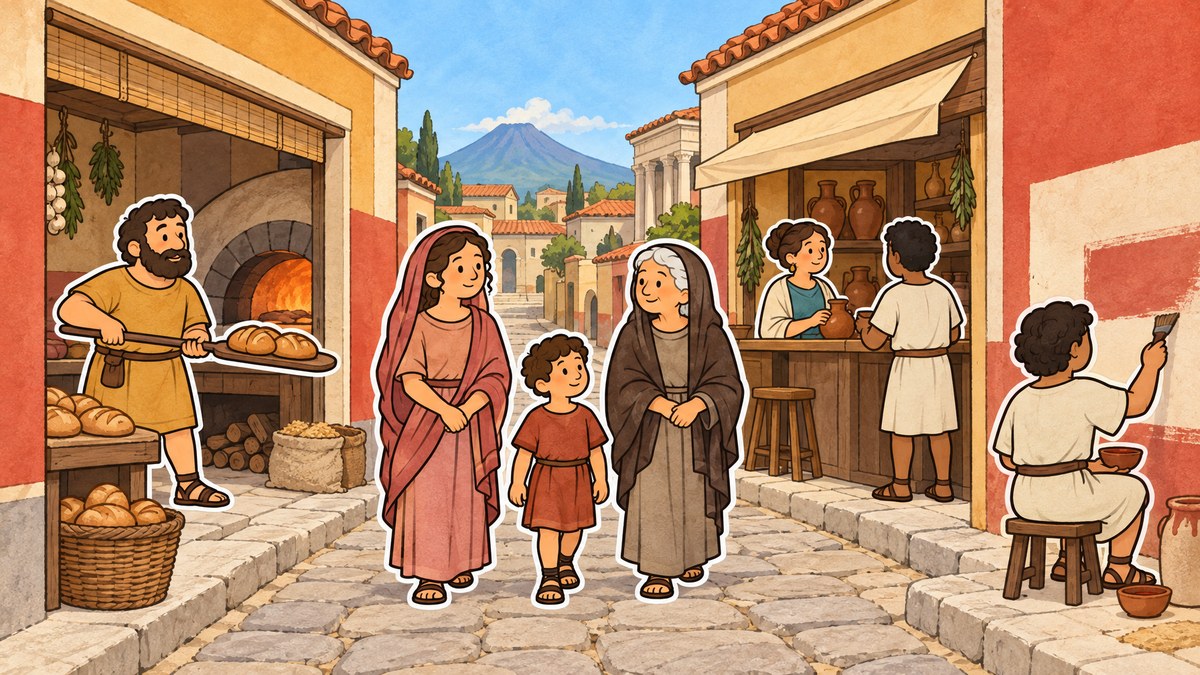
Above the town stood Vesuvius, probably familiar to most residents as a green mountain covered in vineyards. Ancient writers say Spartacus and his rebels camped on top in the first century BC and escaped down the cliffs on ladders of wild vine.[14] Romans knew about volcanoes, including Etna. The geographer Strabo even noticed Vesuvius’s burnt-looking rock and guessed it might once have burned.[13] But the mountain may have been quiet for centuries.
What people did remember was earthquakes. A major one had wrecked much of Pompeii seventeen years earlier, in the year 62, and some of that damage was still being repaired in 79. So when the ground trembled for days before the eruption, it may not have looked like a warning. A young man across the bay, Pliny, wrote that the tremors caused little alarm, because they were common in Campania.[1]
Which day was it?
Even the date is disputed. The oldest copies of Pliny’s letter point to late August. In 2018, archaeologists found a charcoal note on a Pompeii wall dated mid-October, with no year.[8][10] Other clues, including the winds that spread the fall, may also point to autumn.[9] Historians are still arguing, and nothing yet settles it.
The hour is firmer. Pliny puts the first sighting at about one in the afternoon, when his mother noticed a strange cloud from Misenum, across the bay. Pliny was seventeen. His uncle, Pliny the Elder, commanded the Roman fleet there. Years later, Pliny the Younger described the cloud to the historian Tacitus, in letters that remain the only surviving eyewitness account: it looked like a pine tree, with a tall trunk spreading out at the top.[1]
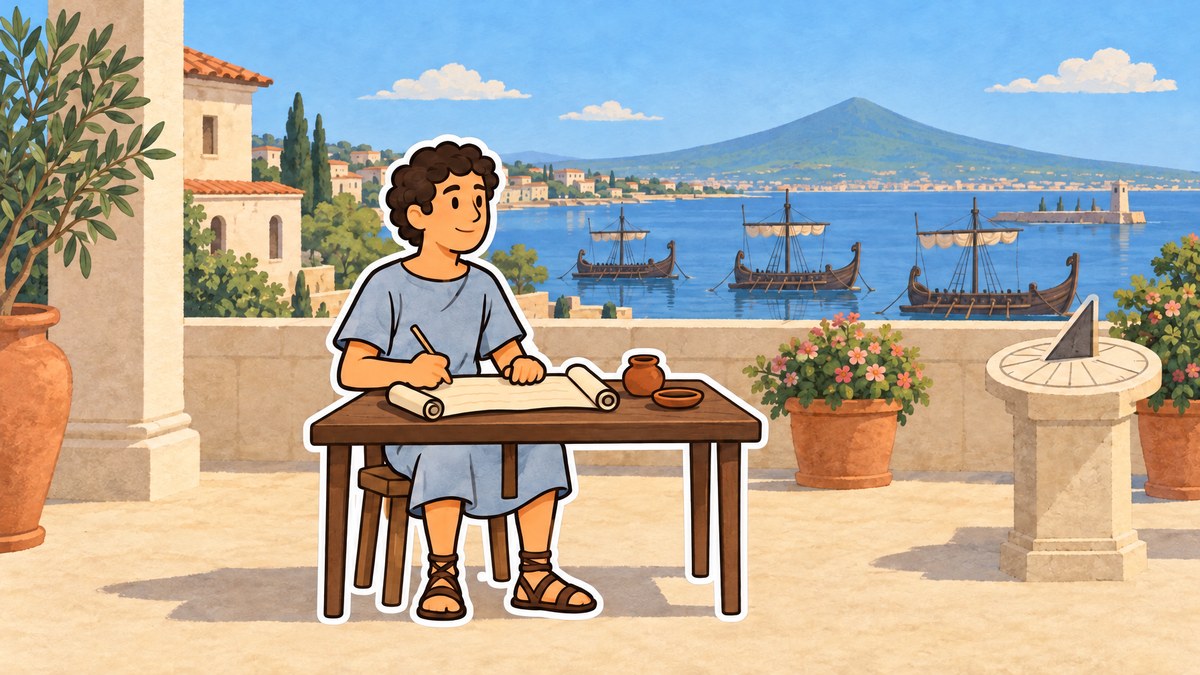
That column probably rose around thirty kilometres. It wasn’t lava. It was gas, ash and pumice, and the wind was carrying it toward Pompeii.[2]
Stay, or go?
What landed on the streets was pumice, volcanic rock full of bubbles. It built up by roughly fifteen centimetres an hour on average, about a hand’s length. Herculaneum, closer to the mountain but out of the wind, received very little at first.[2][4]
Now look at the choice as it appeared that afternoon. Staying meant walls and a roof. Going meant walking out into the dark under falling stone, with no idea how far it reached. Some Pompeians probably did leave early, since carts, horses and valuables seem to be missing from the town.[11] That was probably the best chance anyone had, though it is much clearer in hindsight.
Leaving was also not equally possible for everyone. Age, illness, pregnancy or small children could all make escape harder, and enslaved people could face limits on where they could go. We can’t reconstruct each person’s story, and it would be wrong to pretend we know why any one of them stayed.
Going by sea was no simple exit either. A woman called Rectina, at the foot of the mountain, sent word to Pliny’s uncle that her only way out was by water. He launched his warships, but falling rock and debris blocked the shore. His pilot urged him to turn back. He answered that fortune favours the brave and steered for a friend at Stabiae. There, later that night, he and his companions weighed the houses against the open fields. Pliny calls it a choice of dangers. They tied pillows over their heads and went out. The admiral never came home.[1]
The danger changed in the night
Back in Pompeii, the pumice threatened the roofs by evening, and then roofs began to give way. In one published study, more than a third of the victims recovered at Pompeii lay in this layer, most of them inside buildings.[3] Outside, the fall buried streets and blocked entrances. By morning it was nearly three metres deep in places, so anyone climbing out was walking high above the old pavement.[2][4]
Then came something worse. During the night, parts of the column began to collapse, sending pyroclastic currents down the mountain: hot gas and ash pouring along the ground, faster than anyone can run. The first reached Herculaneum, where about three hundred people were later found in the arched boat sheds on the shore, perhaps waiting for rescue by sea.[2][4]
Pompeii lies further from the vent. Early the next morning, a deadly current reached the town. In that same study, about six in ten of the recovered victims lay in these later layers, and about half of those were outdoors.[3] Researchers still disagree about how much was heat and how much was ash in the lungs.[4][5] Either way, many of these people had survived the night.
That morning the darkness also reached Misenum, which Pliny compared to a closed room with all the lights out. His mother urged him to escape without her, saying her age and body would slow him down. He refused, took her hand, and they both lived.[1]
Near one of Pompeii’s gates, in what is now called the Garden of the Fugitives, more than a dozen people were caught trying to leave. One man carried a small case of tools and a purse of coins, and may have been a doctor.[10] Those objects suggest a profession, not what he was thinking.
What the plaster casts can’t tell us
We know these people through hollows. In the 1860s, Giuseppe Fiorelli began pouring plaster into gaps in the hardened ash, left where bodies had decayed. The casts aren’t statues. They still contain bones and teeth, and they are people’s remains.[7]
We have also told stories about them. One adult wearing a gold bracelet and holding a child was long thought to be a mother. In 2024, DNA showed that the adult was genetically male, with no close biological link to the child. A pair in an embrace, imagined as sisters or as mother and daughter, included at least one male. Several of those tested had roots in the eastern Mediterranean, and restorers may have changed some poses.[7] DNA can tell us who these people weren’t. It can’t tell us why anyone stayed or ran.
Flip the question
So why didn’t everyone escape? As far as the evidence shows, familiar tremors, dangerous escape routes and limits on people’s ability or freedom to move probably all played a part. Buildings failed, and the deadliest stage came hours later, catching some people who were already trying to leave.
But the question also hides something. A 2003 estimate put the recovered victims at about 1,150.[3] The town may have held ten thousand people or more, and about a third of it is still unexcavated. Nobody knows the true toll, yet most residents probably escaped.
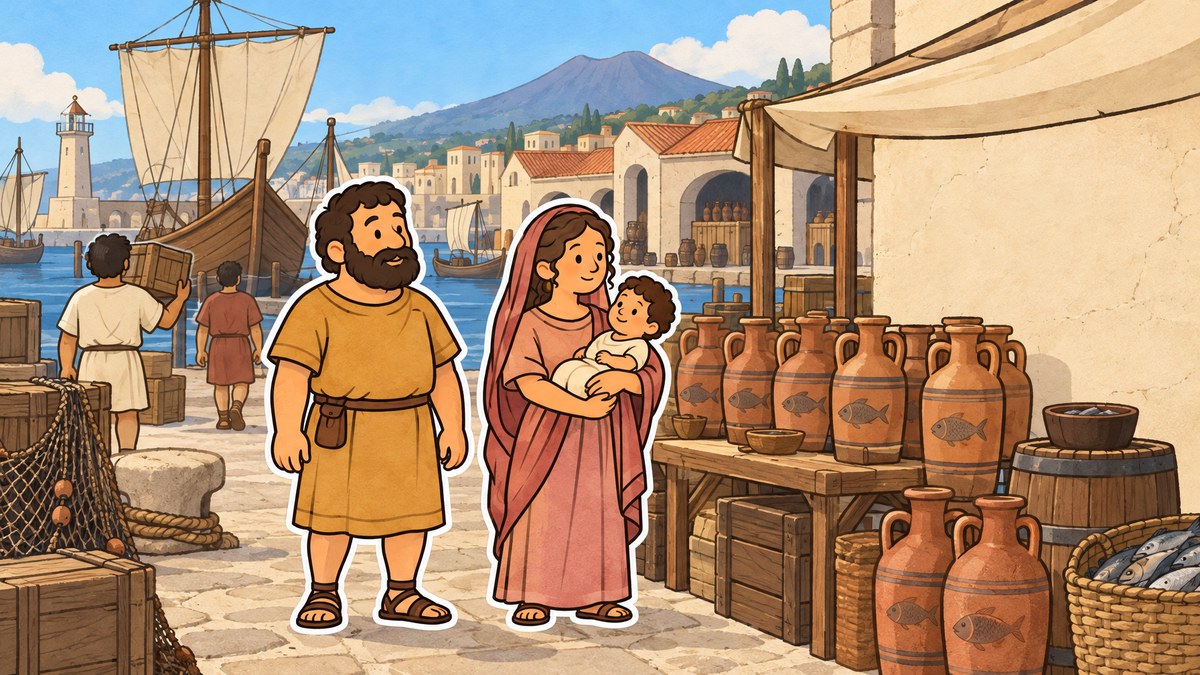
The historian Steven Tuck has identified likely survivors from Pompeii and Herculaneum in about a dozen towns. He links the Umbricius family to Puteoli, where they apparently went on selling fish sauce, and a descendant’s name, Puteolanus, echoes their new home.[11] Emperor Titus sent officials to organise relief.[12] Some people came back, digging into the buried rooms to live among the ruins.[17]
Today hundreds of thousands of people live around Vesuvius, and the volcano is monitored around the clock. The emergency plan allows about three days to clear the red zone once an alarm is declared.[16] Nobody can promise the timing. The point of a plan is that it exists before the first stone falls, so that stay or go isn’t a question anyone has to answer in the dark.
Sources
- Pliny the Younger, Letters 6.16 and 6.20, to Tacitus.
- Sigurdsson, H., Cashdollar, S. & Sparks, R. S. J. (1982). The eruption of Vesuvius in A.D. 79. American Journal of Archaeology 86.
- Luongo, G. et al. (2003). Impact of the AD 79 explosive eruption on Pompeii, II. Journal of Volcanology and Geothermal Research 126.
- Dellino, P. et al. (2021). The impact of pyroclastic density currents duration on humans. Scientific Reports 11.
- Mastrolorenzo, G. et al. (2010). Lethal thermal impact at periphery of pyroclastic surges. PLOS ONE 5.
- Scarpati, C. et al. (2020). Pompeian hiatuses. Geological Magazine 157.
- Pilli, E., Vai, S. et al. (2024). Ancient DNA challenges prevailing interpretations of the Pompeii plaster casts. Current Biology 34.
- Foss, P. (2022). Pliny and the Eruption of Vesuvius. Routledge.
- Rolandi, G. et al. (2008). Journal of Volcanology and Geothermal Research 178.
- Pompeii Archaeological Park. Announcements on the charcoal inscription and on a possible physician in the Garden of the Fugitives (2026).
- Tuck, S. L. Escape from Pompeii: The Great Eruption of Mount Vesuvius and Its Survivors. Oxford University Press.
- Suetonius, Life of Titus 8.
- Strabo, Geography 5.4.8.
- Plutarch, Life of Crassus 9.
- Corpus Inscriptionum Latinarum IV 1904.
- Italian Civil Protection Department. National plan for Vesuvius.
- Imam, J. (8 August 2025). Survivors resettled in Pompeii after volcanic eruption, archaeologists reveal. The Art Newspaper.