
The Year Without a Summer: Why Snow Fell in June 1816
In his 1860 memoir, Chauncey Jerome recalled that on June 7, 1816, walking to work in Connecticut in thick woollens and an overcoat, his hands got so cold that he put down his tools and pulled on a pair of mittens. It snowed for about an hour. Of that year’s harvest he later wrote that “not half enough corn ripened” to furnish seed for the next.[11] The explanation took a century: in 1913, William Humphreys linked volcanic activity to the cold of 1816. The cause lay on the far side of the world, more than a year earlier.
Prefer to watch? The animated version follows the same mystery, from the mittens to the mountain, in about ten minutes.
A summer that kept dying
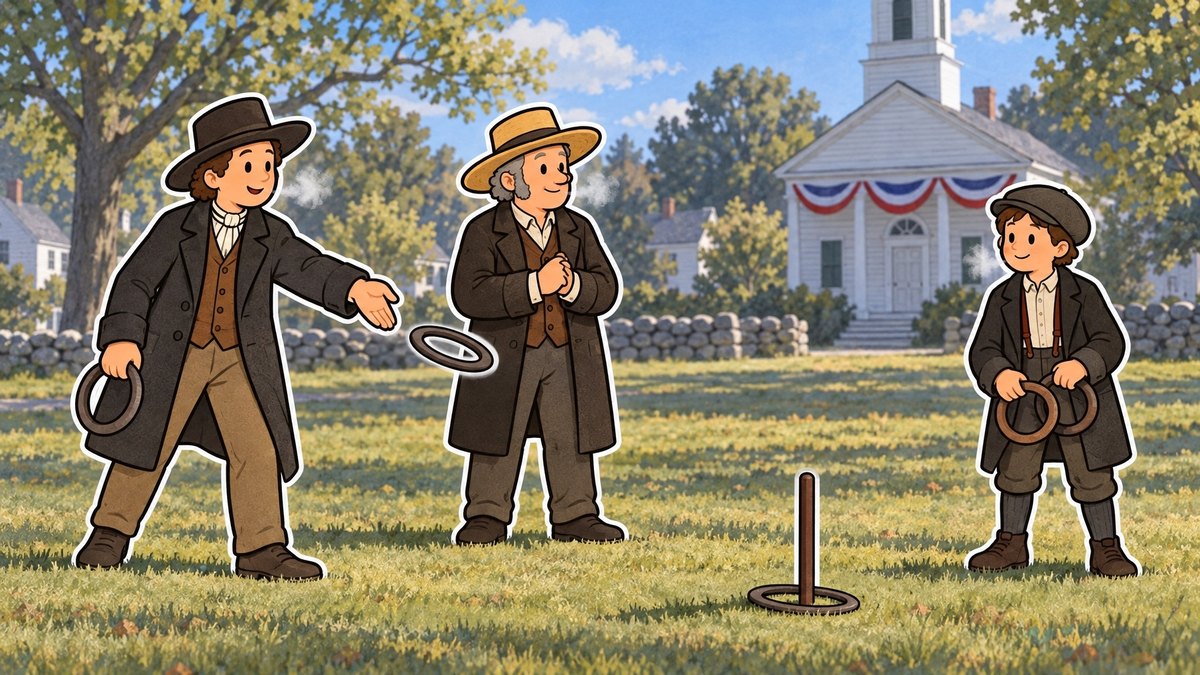
The trouble began in May, when frost hit young crops in the high country of New England and upstate New York. By June, some farmers were planting all over again. Then snow fell at Albany and in Maine.[1] Jerome remembered clothes brought in from the ground, frozen stiff as in winter, and men on the Fourth of July pitching quoits at midday in thick overcoats. “A body could not feel very patriotic in such weather,” he wrote.[11]
It was not one long winter. Warm days came between the cold snaps, and crops started growing again. That made it crueller. In late August, frost returned. People later called the year “eighteen hundred and froze to death”.
Rain across the ocean
In Western Europe, the great problem was cold, relentless rain. Central England had its third coldest summer in a record that goes back to 1659. In Switzerland and southern Germany, grain and hay rotted in the fields, and snow fell on the Swabian hills in July.[5][20] Floods on the Rhine probably disrupted the barges that might have brought food.[10]
But this was not a winter over the whole planet. Scandinavia and western Russia brought in close to normal harvests, and Russian grain was shipped west.[5]
The suspects
People looked for a culprit. A strange dry haze hung over the eastern United States, dimming the Sun so much that sunspots could be seen with the naked eye, and some people blamed the spots.[1] An astronomer in Bologna was said to have predicted that the Sun would go out on July 18. How much panic that really caused is less clear than later retellings suggest, though a Swiss newspaper apparently tried to calm its readers. Geneva’s weather record for that afternoon reads overcast, about 16 degrees Celsius.[19]
The mountain
Fifteen months earlier, on April 5, 1815, people on Java heard booming in the distance. It sounded so much like cannon that troops marched out from Yogyakarta and boats went looking for a ship in distress.[12] The sound came from Mount Tambora on the island of Sumbawa, more than 800 kilometres away.
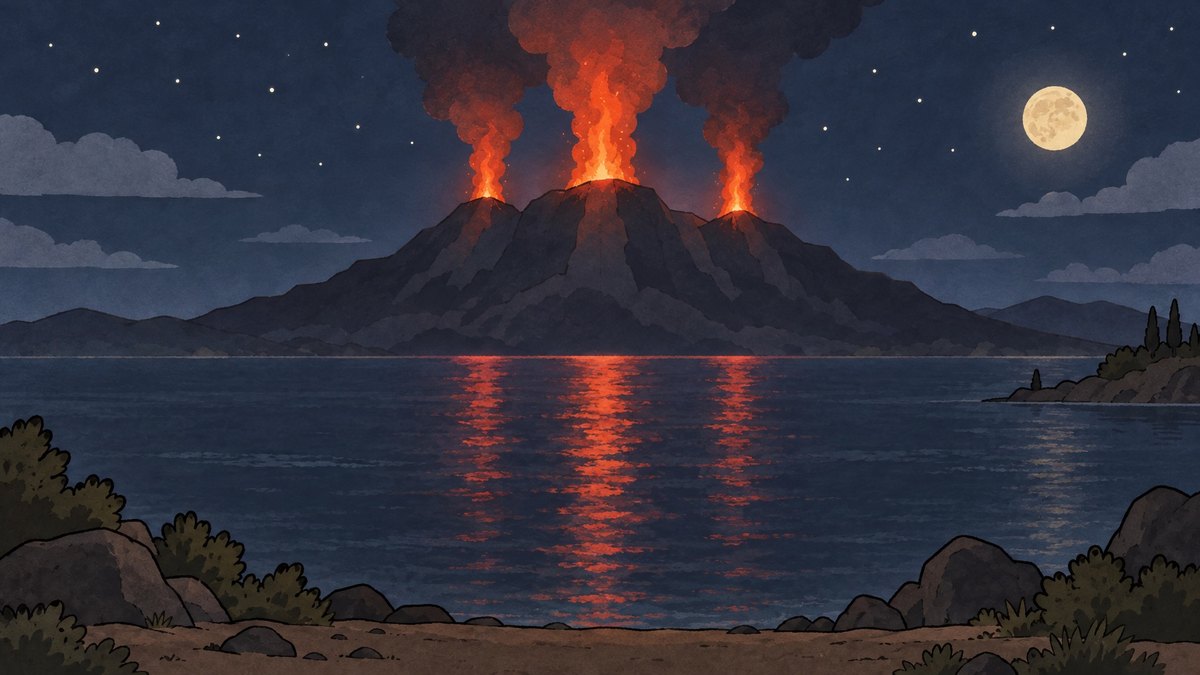
Five days later the mountain tore itself apart. A local ruler described three columns of fire merging, and a mountain that seemed to become “liquid fire”.[12] About 10,000 people were killed by the eruption itself. Ash buried the rice fields of Sumbawa and Lombok, and a British officer sent to the island described extreme misery. Hunger and disease killed tens of thousands more; on some estimates the total passed 70,000.[1] Tambora lost about a third of its height in the largest known explosive eruption in at least 500 years.[2] This was the volcano’s first famine.
The invisible sunshade
Most people picture ash blocking the Sun, but heavy ash falls out of the sky within days or weeks. The real culprit was sulphur gas. It reached the stratosphere, above the weather, and turned into tiny droplets that rain could not wash out. Over months, high winds spread them around the world in a thin veil that reflected a small part of the sunlight back to space.[3][6] Scientists think the dry haze was this veil, so people staring at sunspots were probably looking straight through the real cause.[1]
How much cooler did it get? You will sometimes hear three degrees worldwide. The better estimates are far smaller: across the Northern Hemisphere, about half a degree Celsius on average.[2]
Why half a degree was enough
A crop doesn’t feel an average. It feels one night. One frost at the wrong moment can kill it, however mild the rest of the month was, and in some places the cold ran far beyond half a degree.
The volcano didn’t act alone. The decade was already cold, after another large eruption around 1809. But one study found that unusual weather patterns explain only about a quarter of that European summer’s cold. Without the eruption, in its models, the cold was almost impossible.[4]
Hunger
Many poor families lived one bad harvest away from hunger, and Europe had just finished decades of war. In eastern Switzerland some food prices rose about sixfold; families sold what they had, even their beds, and some people ate grass.[9] In southwest Germany people reportedly tried to make bread from straw and tree bark, and in the kingdom of Württemberg deaths outnumbered births.[20] In England, even before that summer’s harvest, labourers at Littleport rioted over wages and grain prices, and five men were hanged.[15] As typhus spread from Ireland between 1816 and 1819, an estimated 65,000 people died.[22] In Yunnan, in southwest China, cold damaged rice harvests for several years, and a poet named Li Yuyang recorded what he saw.[16]
Leaving, and a monster
Those who could leave, left. By one estimate, 10,000 to 15,000 people left Vermont in about two years.[21] One family, after three bad harvests, moved to western New York; their ten-year-old, Joseph Smith, would later found the Mormon church.[14]
You may have heard that this volcano gave us Frankenstein. That June, Mary Shelley was by Lake Geneva with Lord Byron. She remembered “a wet, ungenial summer”, and Byron’s challenge: “We will each write a ghost story.”[13] So the rain is real, and it probably helped. But no one in that room could have linked their weather to Tambora, and rain doesn’t write novels. The monster was all hers.
Solved, and could it happen again?
In Württemberg, the new king and queen answered the famine with a farm society and a farming school, and in 1818 a harvest fair began at Cannstatt. The fair continues today as the Cannstatter Volksfest.
The case stayed open for almost a century. In 1913 an American scientist, William Humphreys, linked volcanic dust to cold years, including 1816.[7] Later, ice from Greenland and Antarctica showed Tambora’s sulphur. In 1991, Mount Pinatubo put up about a third of Tambora’s sulphur and the planet cooled by a few tenths of a degree for about two years.[3][17]
One published estimate puts the chance of an eruption of Tambora’s size at about one in six this century.[18] We would have satellites, monitoring and global trade. We would also have eight billion people to feed.
So the next time a June day feels unfairly cold, think of Chauncey Jerome pulling on his mittens, and the seed corn his neighbours needed for another year. He died before the cold was linked to the volcano. It began with a sound like cannon fire, on the far side of the world.
Sources
- Oppenheimer, C. (2003). Climatic, environmental and human consequences of the largest known historic eruption. Progress in Physical Geography 27.
- Stothers, R. B. (1984). The Great Tambora Eruption in 1815 and Its Aftermath. Science 224.
- Self, S. et al. (2004). Magma volume, volatile emissions, and stratospheric aerosols from the 1815 eruption of Tambora. Geophysical Research Letters 31.
- Schurer, A. et al. (2019). Disentangling the causes of the 1816 European year without a summer. Environmental Research Letters 14.
- Luterbacher, J. and Pfister, C. (2015). The year without a summer. Nature Geoscience 8.
- Robock, A. (2000). Volcanic eruptions and climate. Reviews of Geophysics 38.
- Humphreys, W. J. (1913). Volcanic dust and other factors in the production of climatic changes. Journal of the Franklin Institute.
- Brönnimann, S. and Krämer, D. (2016). Tambora and the Year Without a Summer of 1816. Geographica Bernensia G90.
- Krämer, D. (2015). Menschen grasten nun mit dem Vieh: die letzte grosse Hungerkrise der Schweiz 1816/17. Schwabe.
- Collet, D. and Krämer, D. (2017). Germany, Switzerland and Austria. In The Palgrave Handbook of Climate History.
- Jerome, C. (1860). History of the American Clock Business for the Past Sixty Years. F. C. Dayton.
- Raffles, S. (1830). Memoir of the Life and Public Services of Sir Thomas Stamford Raffles.
- Shelley, M. (1831). Introduction to Frankenstein.
- Smith, L. M. (1853). Biographical Sketches of Joseph Smith the Prophet.
- Peacock, A. J. (1965). Bread or Blood: The Agrarian Riots in East Anglia, 1816.
- Wood, G. D. (2014). Tambora: The Eruption That Changed the World. Princeton University Press.
- Self, S. et al. (1996). The Atmospheric Impact of the 1991 Mount Pinatubo Eruption. US Geological Survey.
- Cassidy, M. and Mani, L. (2022). Huge volcanic eruptions: time to prepare. Nature 608.
- British Association for Romantic Studies. On This Day in 1816: 18 July, apocalypse, and Byron’s Darkness.
- Deutsches Historisches Museum. The Year without a Summer.
- Stilwell, L. D. (1937). Migration from Vermont. Proceedings of the Vermont Historical Society.
- Post, J. D. (1977). The Last Great Subsistence Crisis in the Western World. Johns Hopkins University Press.