
The Dancing Plague of 1518: Did Anyone Really Dance to Death?
In the summer of 1518, people in Strasbourg were dancing in the streets, day and night, and they could not stop.[1][4] Doctors prescribed music. Hired helpers danced with the sick. Carts carried sufferers to a saint’s shrine in the hills. You may have read that hundreds danced until they dropped dead. Yet according to the historians who have studied them, none of the surviving papers from that summer mentions a single death.[1][4] That doesn’t prove that nobody died. It does mean the famous version of this story deserves a closer look.
Prefer to watch? The animated version follows that summer through the city’s own papers, then traces how the legend grew.
A city that wrote things down
Strasbourg in 1518 was a free city of the Holy Roman Empire, on the Rhine plain in what is now eastern France.[10] Its city secretary was Sebastian Brant, author of the popular satire Ship of Fools, and his annals recorded what happened.[1][3][4] Hieronymus Gebwiler, a Strasbourg teacher, wrote about it too. A few years later he said these events should be remembered “for a thousand years”.[1][3]
People in the region believed that Saint Vitus could strike you with a dancing illness, and that he could also cure it.[3][6] The historian John Waller also points to years of bad harvests and high grain prices before that summer.[6]
Then, around the middle of July, a woman began to dance in the street. The papers from that summer don’t give her name.[1][3][4] Others joined her, and Brant described about fifty people dancing day and night.[1][3][4]
Doctors’ orders: keep dancing
The council turned to the city’s physicians. They called this a natural illness, not a curse, and blamed the summer heat and the position of the stars.[1][4] Their advice sounds strange today: barley water, bread, and music played on stringed instruments and organs. Drums and fifes were out.[4]
The idea was to help the sick dance the illness out of their bodies. They were taken into two guild halls, closed rooms away from the street, where hired helpers danced with them.[4][5]
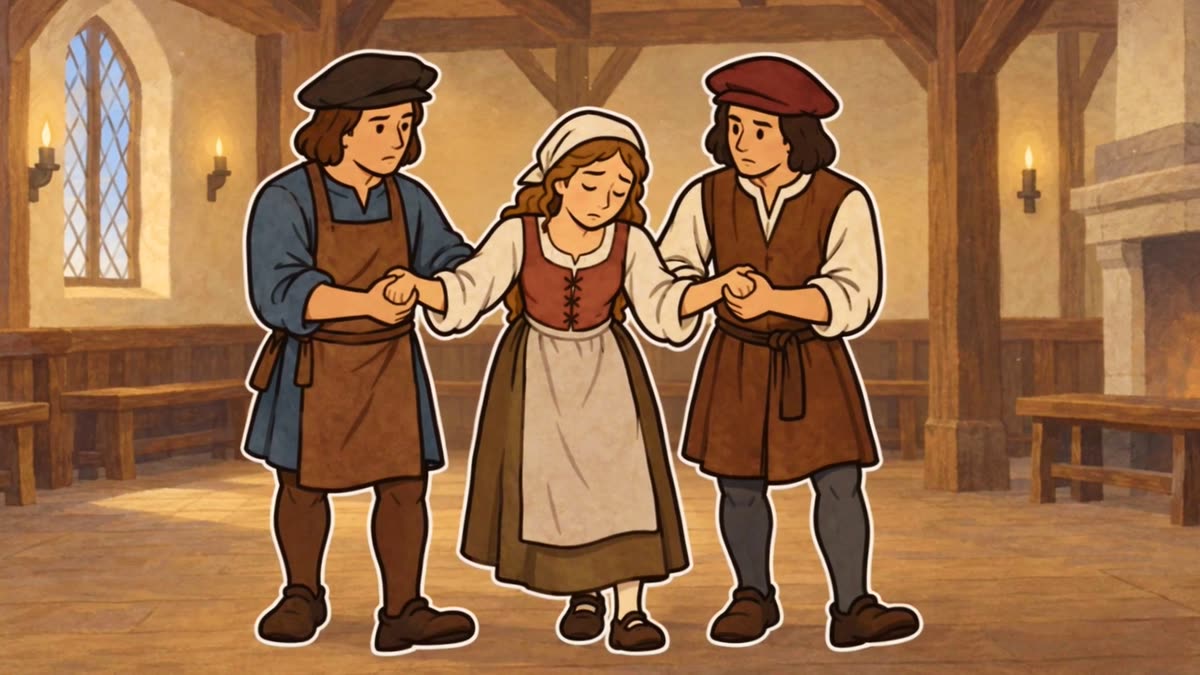
You may have heard that the city built a stage in the market and hired a band. That detail comes from a chronicle written about sixty years later. The papers from that summer describe the closed halls instead.[4][8]
Medicine and faith worked side by side. The vicar agreed with the physicians and told preachers to call for prayer.[4] For people at the time, disease and divine punishment were both ways of making sense of what they saw.[7]
The road to Saint Vitus
From 23 July, the council tried something else. It sent dancers in carts to a shrine of Saint Vitus, in a cave in the hills above Saverne. There, the sufferers heard three masses, were led around the altar and gave alms.[1][3][4][10]

At first, it seemed to work. On 25 July, the council wrote to the bishop that the illness was dying down, and Brant noted that most of the sick had been cured.[3][4]
A ban, and then the return
On 2 August, the council banned public dancing in the city, in an order signed by Brant himself. Drums and fifes were banned for the rest of the summer, although quiet string music was still allowed at weddings and first masses.[3][4]
Why ban dancing after the doctors had prescribed it? The council’s papers don’t explain the change. Some historians think that gathering dancers together may have spread the fear, and with it the dancing.[6]
On 11 August, a new order said the illness had come back. Households were told to look after their own sick children and servants, and guilds their own members. Anyone who kept dancing was to be taken to Saint Vitus.[4]
Here we glimpse the people behind the story. Five sufferers appear in the records one by one, because their families had to ask the city for help: a schoolmaster’s son, a servant’s son, a day labourer’s wife, a beggar’s daughter and the son of a poor journeyman.[4] Five is not a full count. The surviving papers give no total.[4]
On 31 August, the council ordered a candle for Saint Vitus and masses for the sick.[4] By about September the dancing had faded, and the council stopped writing about it.[3][10]
How the story grew
So where did the death toll come from? Not, it seems, from the surviving records of that summer.[1][4] It came from later writers, each adding to the tale.
Paracelsus, the physician, reached Strasbourg about eight years after the outbreak. He later wrote of a woman he called Frau Troffea, who, he claimed, faked a dancing illness to annoy her husband.[3][8] According to the historian Georges Bischoff, that name first appeared in print in 1565, after Paracelsus had died, and was probably invented from a Greek word for turning. It isn’t even certain that Paracelsus meant Strasbourg.[2][3]

Around 1580, the Strasbourg architect Daniel Specklin wrote a chronicle that included stages in the markets, red shoes and deaths.[1][8] Other accounts went further, with up to 400 dancers.[5][8] Today you will often hear of fifteen deaths a day. That figure isn’t in the surviving city papers. It reached modern books through those later chronicles.[1][4][10]
Why did they dance?
The answer you will find most often is ergot, a fungus that grows on rye and can poison the bread made from it. Ergot poisoning was well known in the region, and Strasbourg had a specialised hospital that could have treated it. But ergot cuts off blood flow to the hands and feet and causes painful spasms. That doesn’t look like days of dancing, so many historians doubt it.[4][6]
The most popular modern explanation is a mass psychogenic illness: real physical symptoms that spread through a group by fear and expectation, without a germ or a poison.[6][10] Doctors have seen this kind of outbreak in modern times. In 1962, uncontrollable laughing spread from a girls’ school in what is now Tanzania, and schools had to close.[10]
Waller argues that in a hungry, anxious city, where people believed Saint Vitus could curse them with dancing, fear itself could set bodies moving and pass from one person to the next.[6] For Strasbourg, that remains an interpretation, not a diagnosis. Others see something closer to a ritual, and suggest that many dancers may have been pilgrims.[4][10] No explanation has won general agreement.[10]
Strasbourg wasn’t alone, either. Dancing outbreaks turned up along the Rhine for centuries. A big one began at Aachen in 1374, and in 1463 dancers reached Obernai, near Strasbourg, after travelling about 80 kilometres.[3][10] An engraving dated 1642, after a drawing by Pieter Bruegel the Elder, shows a different dancing pilgrimage, to Molenbeek near Brussels.[9]
What we can say for sure
In the summer of 1518, people in Strasbourg danced in distress, and their city treated it as both an illness and a matter of faith, with doctors, guild halls, carts and candles. We don’t know how many fell ill, why it happened or whether anyone died.
That uncertainty may be the most useful part of the story. When a tale from the past sounds too vivid to doubt, ask where each detail first appears.
Sources
- Clementz, E. (2016). Review of John Waller, Les danseurs fous de Strasbourg. Revue d’Alsace 142.
- Dupeux, C. (ed.) (2018). 1518, la fièvre de la danse. Strasbourg: Éditions des Musées de Strasbourg (chapters by E. Clementz and G. Bischoff).
- Musées de Strasbourg (2018). Press kit for the exhibition 1518, la fièvre de la danse, Musée de l’Œuvre Notre-Dame.
- Rue89 Strasbourg (2018). Report on the exhibition and the 1518 city records.
- Waller, J. (2008). In a spin: the mysterious dancing epidemic of 1518. Endeavour 32 (3).
- Waller, J. (2009). A forgotten plague: making sense of dancing mania. The Lancet 373.
- Miller, L. J. (2017). Divine Punishment or Disease? Medieval and Early Modern Approaches to the 1518 Strasbourg Dancing Plague. Dance Research 35 (2).
- Pennant-Rea, N. (2018). The Dancing Plague of 1518. The Public Domain Review.
- Hondius, H. (1642), after Pieter Bruegel the Elder. Pilgrimage of the Epileptics to the Church at Molenbeek. The Metropolitan Museum of Art.
- Wikipedia. Dancing plague of 1518; Dancing mania; Tanganyika laughter epidemic.