
Why Do We Have Leap Years? The 2,000-Year Fix Behind February 29
Every four years, February gets an extra day. Except when it doesn’t. The year 1900 skipped it, and 2100 will skip it too. And in 1712, Sweden had a February the thirtieth.[11] What looks like one simple rule is really a two-thousand-year-old patch, fixed and refixed by priests, a dictator and a pope, for a planet that won’t do round numbers.
Prefer to watch? The animated version follows the same patch, from a carved stone in Egypt to a pope’s ten missing days.
A year that isn’t a whole number of days
Our day follows the Sun across the sky as Earth turns. Our year follows Earth around the Sun. The two motions are unrelated, so a year doesn’t hold a whole number of days. The year that sets the seasons averages about 365.2422 days: 365 days, 5 hours, 48 minutes and about 46 seconds.[1]
A calendar can only hand out whole days. Give every year 365 of them, and the calendar slips against the seasons by almost a quarter of a day each year. That is about one day every four years, and about 24 days a century. After seven or eight hundred years, the dates would be half a year out. For the northern half of the world, July would fall in winter.
Egypt’s wandering year and a forgotten fix
Ancient Egypt’s civil calendar had exactly 365 days: twelve months of thirty days, plus five extra days, and no leap day at all.[11] So Egypt’s official New Year crept slowly through the seasons, about a day every four years. A full trip around the seasonal cycle took roughly fifteen hundred years.

In 238 BC, Egyptian priests meeting under King Ptolemy III tried to fix it. Their decree, known as the Decree of Canopus and carved on stone in three scripts, ordered one extra day every fourth year so that the festivals would stay in their seasons.[7][11] But it doesn’t seem to have taken hold: Egypt generally seems to have kept its wandering year until the Romans reformed it.[11] The leap day that lasted came from Rome.
Rome’s political calendar
Before Julius Caesar, the Roman calendar year had just 355 days. To keep up with the seasons, Roman priests called pontiffs were supposed to slip in an extra month of 22 or 23 days about every other year, and they had full power to decide when.[2] The extra month went into late February, after the festival of the Terminalia.[3]
The pontiffs used that power for politics. According to the Roman writer Censorinus, a magistrate’s term could be cut short or stretched as the pontiffs willed: adding a month lengthened a term, and leaving one out shortened it.[2] Some extra months were simply skipped, and by Caesar’s time the calendar had drifted far away from the seasons.[5]

Caesar, himself chief priest,[2] worked out a reform with the astronomer Sosigenes.[4] First the calendar had to catch up with the seasons, so 46 BC was stretched to 445 days, the longest year in Roman history. The writer Macrobius called it the last year of confusion.[2][3] From 1 January 45 BC, the new calendar ran 365 days, with one extra day every fourth year.[5][11] The month lengths we use today come from it.
Why February, and why the 24th?
Roman tradition put the start of the year in March, which is why September, October, November and December still carry the Latin words for seven, eight, nine and ten.[2] February had long been where Romans slipped in extra time, so that is where Caesar’s extra day went. But it was not the 29th.
At the end of February, Romans counted the days backwards towards the first of March, and they counted inclusively, with both ends included. So 24 February was “the sixth day before the Kalends of March”. In a leap year, that day was simply counted twice. In Latin, “twice sixth” is bis sextus, which gave English another, rarer word for a leap year: bissextile.[8][11] Writing the extra day as 29 February came much later; it appears in English legal documents in the 1400s, and British law formally adopted it in 1750.[11]
The English name “leap year” probably comes from the weekdays. A year of 365 days is 52 weeks and one day, so a date normally moves on one weekday each year. Across a leap day, it jumps two.[11]
Eleven minutes that added up
After Caesar’s murder in 44 BC, the priests got the rule wrong. They added the leap day every third year instead of every fourth, probably because they counted the starting year as one. Augustus later paused leap days for several years to let the calendar catch up.[3]
Even done correctly, Caesar’s year of 365.25 days was too long, by about eleven minutes a year. That adds up to a whole day about every 128 years.[1][11] The Church noticed, because of Easter. The Church’s rules for working out Easter placed the spring equinox on 21 March. By the 1500s, the real equinox was arriving around 11 March, about ten days early.[1][11]
Gregory’s two fixes
In 1582, Pope Gregory XIII issued a reform in a papal bull known as Inter gravissimas. It was based on a plan by the physician Aloysius Lilius, who had died a few years earlier, and it was worked out and defended by the Jesuit mathematician Christopher Clavius.[6][11]
The first fix was to delete ten days. In the countries that switched first, Thursday 4 October 1582 was followed by Friday 15 October. The weekdays ran on; only the dates jumped.[6][11]
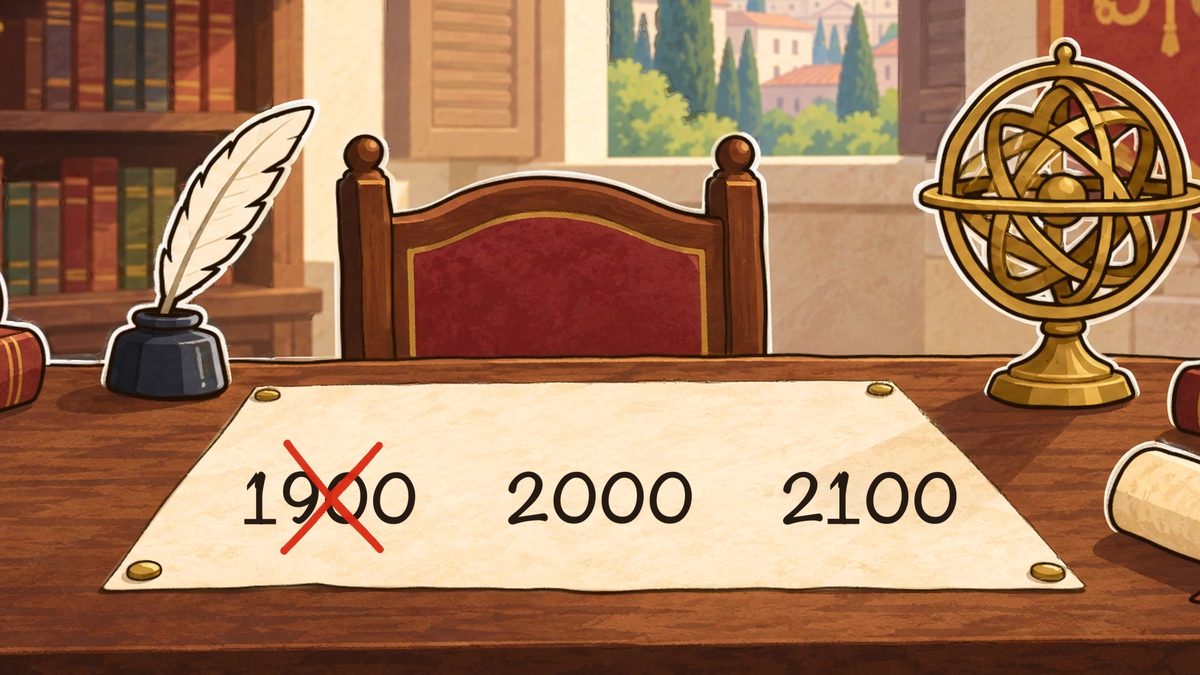
The second fix was a new rule. Years that divide by four are still leap years, but century years are leap years only if they divide by 400. So 1600 and 2000 were leap years, while 1700, 1800 and 1900 were not, and 2100 won’t be either.[1][6] That leaves 97 leap days in every 400 years, and an average year of 365.2425 days, very close to the real one.[1] The leftover error is only about a day every few thousand years; the exact figure depends on which kind of year you measure against.[1][11]
The slow switch
Spain, Portugal, the Italian states and Poland-Lithuania switched that October, and France that December. Many Protestant and Orthodox countries were much slower, and many resisted it as a Catholic change.[11]
Britain and its colonies, including those in America, held out until 1752. That year, Wednesday 2 September was followed by Thursday 14 September.[11] Sweden tried to switch gradually. It left out the leap day of 1700, and the plan was to skip later ones one by one. The later skips never happened, leaving Sweden out of step with both the Julian and Gregorian calendars. So in 1712 it went back to the old calendar by adding two leap days, 29 and 30 February, giving that year 367 days. Sweden finally made the full switch in 1753, when 17 February was followed by 1 March.[11] Russia changed in 1918, and Greece in 1923, the last country in Europe to switch for civil use. Many Orthodox churches still keep the old calendar for feasts, so their Christmas falls on 7 January in this century.[11]
Living with the leap day
Roughly one person in fifteen hundred is born on 29 February. People born on it, sometimes called leaplings, often celebrate on 28 February or 1 March in other years, and the twin towns of Anthony, on the Texas-New Mexico line, call themselves the Leap Year Capital of the World.[11]
Every leap year, a story goes round that in 1288 Scotland passed a law letting women propose. No record of such a law survives, and the queen it names, Margaret, was a girl of about five living in Norway.[11]
Computers need the rule too: 2000 was a leap year because it divides by 400, and software that got this wrong needed fixing. The world’s best-known spreadsheet still treats 1900 as a leap year, on purpose: it copied an older program’s mistake so that dates would match.[9]
Other ways to keep time
The Islamic calendar follows the Moon and doesn’t try to match the Sun, so Ramadan comes about eleven days earlier each year and moves through every season. The Hebrew calendar adds a whole leap month seven times in every nineteen years.[1][11] Iran’s official calendar sets its New Year’s Day by the spring equinox, which keeps it very closely tied to the seasons.[11]
There is even a cousin, the leap second, which fixes a different problem: Earth’s uneven spin rather than its orbit. In October 2026, the world’s timekeeping conference decided that UTC, the basis of world clock time, will run without leap seconds from 20 May 2027.[10]
Almost every four years
So is a leap year really every four years? Almost. Tried in Egypt, made to last by Caesar and refined under a pope, it is still not perfect, just very close. The next leap day comes in 2028. The next skipped one comes in 2100, and somebody’s spreadsheet had better be ready.
Sources
- Doggett, L. E. (1992). Calendars. In P. K. Seidelmann (ed.), Explanatory Supplement to the Astronomical Almanac.
- Censorinus. De die natali, chapter 20.
- Macrobius. Saturnalia, book 1, chapters 13-14.
- Pliny the Elder. Natural History 18.211.
- Suetonius. Life of Julius Caesar, 40.
- Gregory XIII (1582). Inter gravissimas (papal bull).
- The Decree of Canopus (238 BC).
- Merriam-Webster. Bissextile (word history).
- Microsoft Support. Excel incorrectly assumes that the year 1900 is a leap year.
- BIPM. Resolutions of the General Conference on Weights and Measures (2022, 2026).
- Wikipedia. Gregorian calendar; Leap year; Swedish calendar.