
The Great Emu War: Did Emus Really Beat the Australian Army?
On the fourth of November 1932, beside a farm dam in the wheatbelt of Western Australia, three soldiers waited behind a First World War machine gun. More than a thousand emus came towards the water. The soldiers held their fire until the birds were close, about a hundred yards away, and then opened up. After about a dozen birds had been killed, the gun jammed. The rest of the flock scattered.[2][9][10]
Prefer to watch? The animated version tells the same story, from the farm dam to the fence that outlasted the guns.
The newspapers called it the Emu War, and it is often remembered as the war the emus won. The real story is stranger than the joke: struggling farmers, a broken promise, a minister with his own reasons, and a kill count that could never say how much wheat was saved.
Farmers on the edge
After the First World War, Australian governments gave returned soldiers blocks of farmland. In Western Australia, many of those blocks were on marginal land in the wheatbelt.[1][2][10] Campion and Walgoolan, the districts at the centre of this story, lie east of Merredin, roughly halfway between Perth and Kalgoorlie. Campion is about 270 kilometres east of Perth.[3][4][9][10] Aboriginal peoples had cared for this Country for thousands of years. The settlers cleared large areas of it for wheat.
Then came the Great Depression. From 1929, wheat prices kept falling. In 1930 the federal government urged farmers to grow more wheat and promised them a guaranteed price of four shillings a bushel. The Senate rejected the bill that would have paid it, later rescue plans fell short too, and the promised price never came.[2][8][10] By October 1932, Western Australian wheat farmers were threatening to refuse to deliver their wheat.[10]
Twenty thousand visitors
Emus move after the breeding season, travelling hundreds of kilometres in search of food and water. In the wheatbelt, cleared land and the water supplies farmers had built drew them onto the farms.[3][5][6][10] In 1932 an estimated 20,000 emus came into the Campion district.[2][3][9][10]
An emu is bigger than many people expect. It stands about 1.6 to 1.9 metres tall, taller than most people.[5] It can sprint at up to about 50 kilometres an hour. The birds ate and trampled the wheat. They broke fences too, leaving gaps that let rabbits in.[2][10] The state already treated emus as pests and paid bounties for them.[2][10]
Send in the machine guns
A deputation of ex-soldier farmers went to see the Minister for Defence, Sir George Pearce, who was also a senator for Western Australia. They had seen what machine guns could do in the war, and they asked for some.[1][10] Pearce agreed, with conditions. Soldiers would operate the guns. The Western Australian government would pay for transport. The farmers would provide food and lodging and pay for the ammunition.[1][10]
Why say yes? Pearce reportedly saw it as good target practice. Some historians argue it was also political: a way to be seen helping struggling ex-soldier farmers at a time when a movement in Western Australia wanted to leave the federation.[1][2][10] A Fox Movietone newsreel cameraman came along to film it, and one newspaper reported that the soldiers were to collect a hundred emu skins, whose feathers would trim Light Horse hats.[10]
The force was small. Major G. P. W. Meredith of the Seventh Heavy Battery, Royal Australian Artillery, led it, with Sergeant S. McMurray and Gunner J. O’Halloran. That was three men.[2][4][10] They brought two Lewis light machine guns from the First World War and 10,000 rounds of ammunition.[3][9][10]
The first try
Rain delayed the start, and operations began on 2 November 1932. About 50 emus were seen, but out of range. Settlers tried to herd them into an ambush. The birds split into small groups and ran. The first volley missed. Later a few birds were killed, perhaps a dozen that day.[3][9][10]
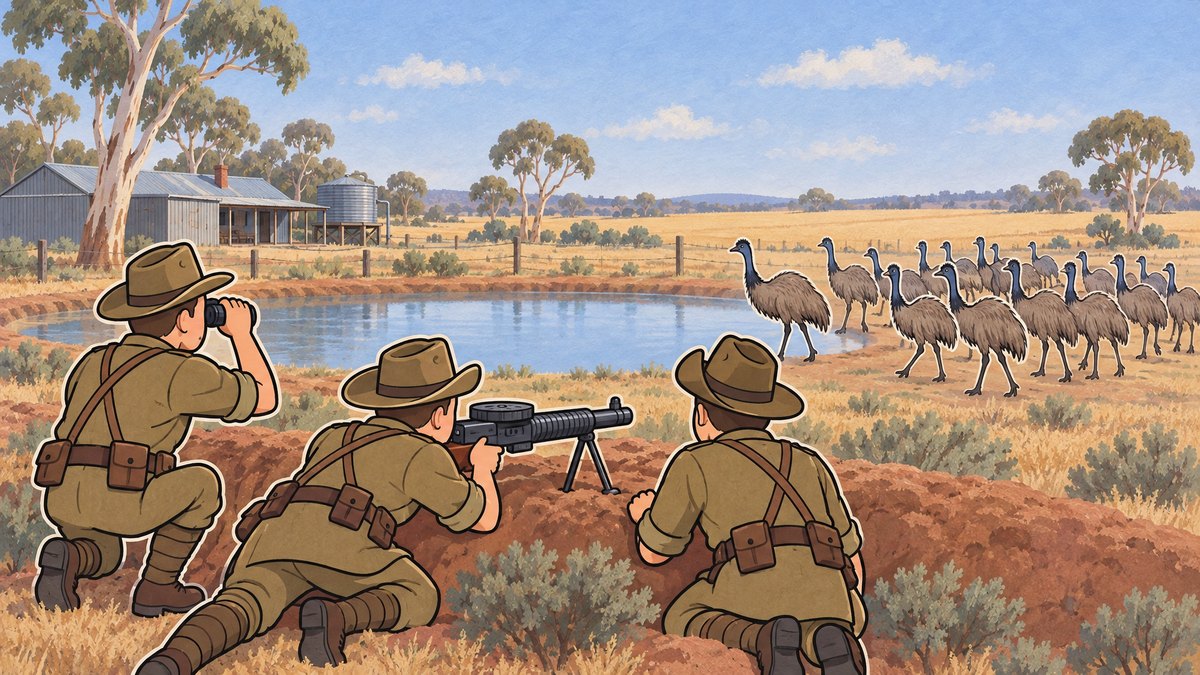
Two days later came the dam ambush, and the jammed gun. Then Meredith tried something new: a machine gun on the back of a truck. The truck could not keep up with the birds, and the ground was so rough that the gunner could not fire.[9][10]
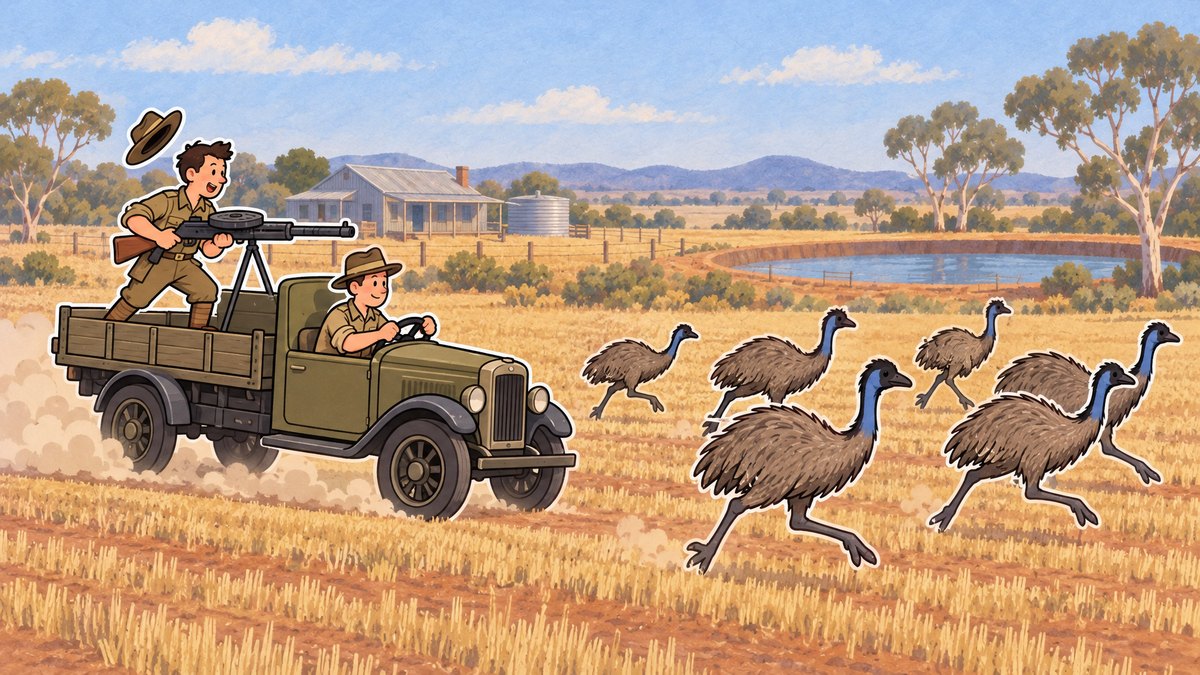
By 8 November the soldiers had fired about 2,500 rounds, a quarter of their ammunition. Reports of the number of birds killed ranged from about 50 to a few hundred, depending on who was counting.[2][3][9][10] Meredith reported no casualties among his men.[3][10]
The press had a field day. In federal parliament, one member asked whether a medal would be struck. Another said the medals should go to the emus, who had “won every round so far”.[2][3][10] Senator James Dunn called Pearce “the Minister of the Emu War”.[3][10] On 8 November, Pearce withdrew the soldiers and their guns.[3][9][10]
Round two
The farmers asked again, and so did the Western Australian premier, James Mitchell. It was hot, there was drought, and the damage went on. Pearce agreed, and on 13 November Meredith was back in the field.[10] Pearce defended the second deployment in the Senate. He argued that it was no more cruel to kill the birds with machine guns than with rifles.[9][10] By December the story had reached Britain, where conservationists protested.[10]
This time the numbers were higher: about 40 birds in the first two days and, by early December, about 100 a week.[2][10] Meredith was recalled on 10 December. Afterwards he reported 986 kills with 9,860 rounds, an average of ten rounds a bird. He also estimated that about 2,500 wounded birds had died later, which was an estimate, not a confirmed count.[2][9][10] Meredith was later quoted as saying that the emus could “face machine guns with the invulnerability of tanks”.[2][3][9][10]
Why the guns did so badly
The soldiers’ best chance came when the birds were bunched together, as they were at the dam. Most of the time, emus were spread out across the paddocks to feed. When shot at, they split into small groups and moved fast over rough ground, where a truck could neither keep up nor give the gunner a steady aim. Running birds at a distance are hard to hit, and at the key moment a gun jammed. The ornithologist Dominic Serventy later wrote, wryly, that the emus seemed to use “guerrilla tactics”, splitting into small units.[10]
There is a bigger point, too. A kill count does not tell us how much wheat was saved. One local paper later claimed that the method “proved effective and saved what remained of the wheat”, but that was one paper’s opinion, not proof.[10]
What came after
Farmers asked for military help again in 1934, 1943 and 1948, and they were refused each time.[10] The state kept paying bounties instead. In six months of 1934, 57,034 bounties were claimed: a count of rewarded kills, not proof that crops were protected.[2][10] In 1950 the federal government released half a million rounds of .303 ammunition for farmers to use themselves.[10]
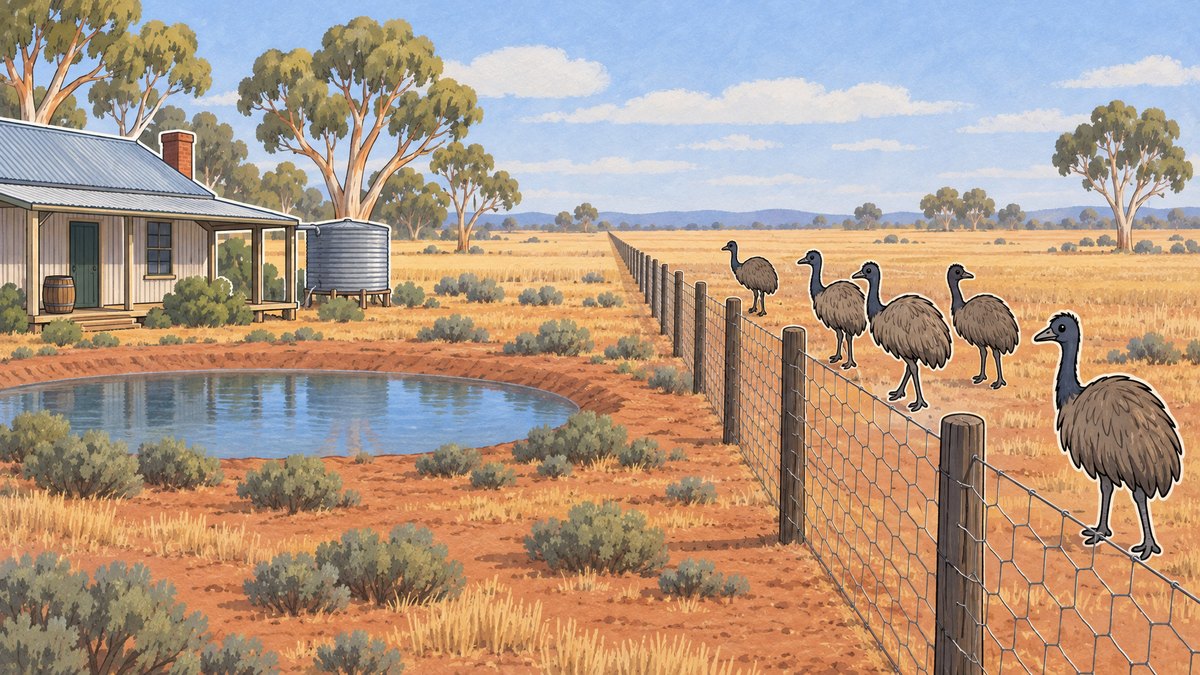
The longest-lasting answer was a fence. The rabbit-proof fences were built between 1902 and 1907. As rabbits mattered less, the fence turned out to limit the periodic emu migrations, and it came to be called the Emu Fence. Today the State Barrier Fence runs about 1,650 kilometres and protects the grain-growing areas from large emu migrations.[6][9][10]
So who won?
Three soldiers, two machine guns, a few weeks of shooting and a disputed count did not end the emu problem. Bounties, ammunition for farmers and a very long fence carried on long after the soldiers went home, and so did the farmers’ troubles with prices and promises. The newspapers called it the Emu War, and one MP joked that the birds had “won every round so far”.[2][3][10] The joke has lasted because it points at something true: a kill count is not the same as saving the wheat.
Emus, meanwhile, are doing fine. Hundreds of thousands of them live across Australia today, and the emu still stands on the national coat of arms, beside the kangaroo.[2][3][7][9]
Sources
- Johnson, M. (2006). ‘Feathered foes’: soldier settlers and Western Australia’s ‘Emu War’ of 1932. Journal of Australian Studies 30 (88).
- Crew, B. (2014). The Great Emu War. Scientific American blog network.
- Garner Gore, J. (2016). Looking back: Australia’s Emu Wars. Australian Geographic.
- Dapin, M. (2023). On the trail of the world’s strangest conflict: the Emu War in WA.
- Australian Museum. Emu.
- Department of Primary Industries and Regional Development, Western Australia. State Barrier Fence overview.
- Department of the Prime Minister and Cabinet. Australian symbols: the Commonwealth Coat of Arms.
- Papers Past (1930) and the Senate Hansard (4 December 1930) on the Grow More Wheat campaign and the guaranteed price.
- Mental Floss (2016). When Australia went to war with its emus.
- Wikipedia. Emu War; Lewis gun; Rabbit-proof fence.