
The Worst Fluid to Drown in: The Great Molasses Flood
“Slow as molasses in January,” the saying goes. On Wednesday, 15 January 1919, just after half past twelve, a steel tank on Commercial Street in Boston’s North End split open. A wave of molasses came down the street at about 35 miles an hour. Twenty-one people died and about 150 were injured.[1][2][12][16]
Prefer to watch? The animated version tells the same story, from the leaking tank to the years-long court case that followed.
How does something famous for being slow turn into a flood? The answer involves a tank tested with only six inches of water, leaks from the very first day, a coat of brown paint, and some surprising physics.
A tank for a war
Molasses is what is left over when sugar is made. It can be fermented and distilled into alcohol, and during the First World War industrial alcohol was in demand for munitions, as well as for liquor.[9][11][12] Ships brought molasses from the Caribbean to a wharf in Boston, where it was pumped into a huge storage tank and then sent on by rail to distilleries.[2][9][12]
The tank was built in 1915 for the company United States Industrial Alcohol. It stood about 50 feet tall and 90 feet across, and it held about 2.3 million US gallons, roughly three and a half Olympic swimming pools.[2][10][16] It sat right beside the elevated railway that ran along Commercial Street.[2][9]
The man in charge of building it was a company finance officer, Arthur Jell. In the words of historian Stephen Puleo, he had “no technical experience, no architectural experience, no engineering experience”.[1][11] When the tank was finished, it was tested with only six inches of water.[11]
Leaks and brown paint
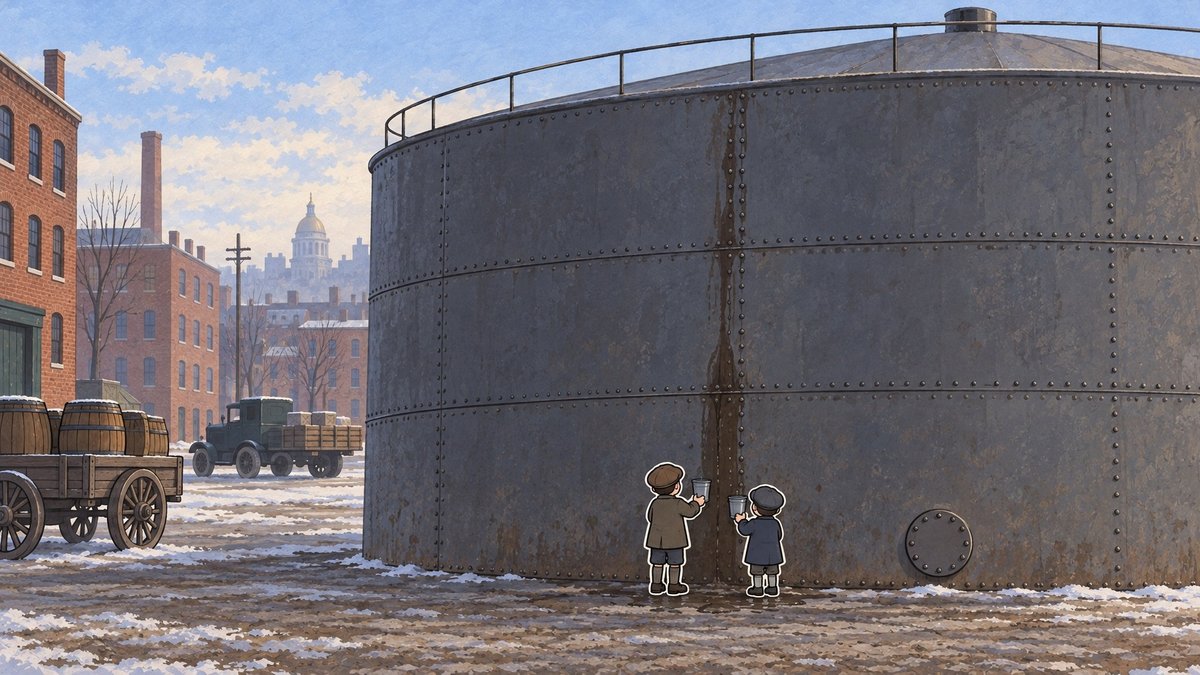
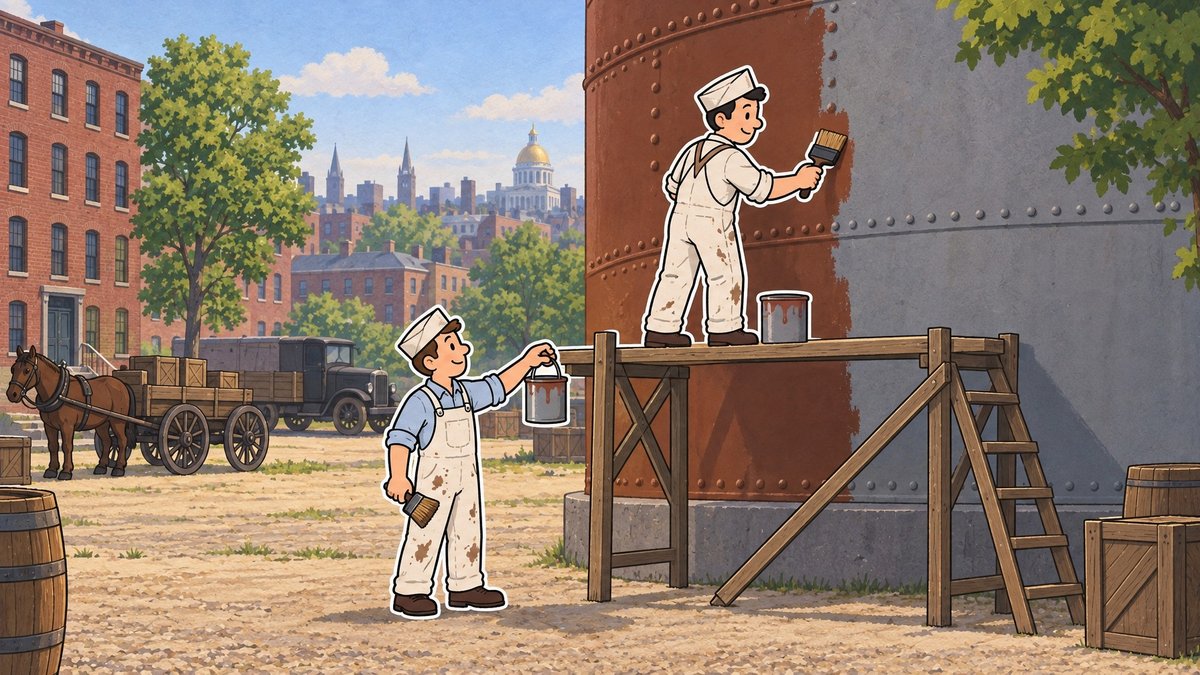
“From the very first day the tank leaked,” Puleo has said.[9][10] Molasses ran down its seams, and children from the North End collected the drips in pails.[2][9] The company’s answer was a labourer caulking the joints.[12][13] In the summer of 1918, the tank was painted brown, which made the leaks much harder to see.[2][9][13]
A warm Wednesday
In the days before the disaster, a ship probably delivered more than half a million gallons of warmer molasses into the tank, in cold weather, and the tank was probably nearly full.[11][13] One theory is that the warm molasses mixing with the cold may have started fermentation and built up gas pressure inside.[11][16] On 15 January the air warmed to over 40°F, after a bitter cold spell.[12][16]
It was lunchtime. Firefighters at the station of Engine 31 were playing cards. Children were gathering firewood. Martin Clougherty, a barman, was asleep at home.[12][13]
The wave
The tank burst. Pieces of its steel hit the elevated railway and buckled its supports.[3][16] By one estimate the wave may have been about 25 feet high at first and about 160 feet wide; sources disagree about the height.[12][13] The molasses flooded several blocks, two to three feet deep.[1][16]
The firehouse of Engine 31 was pushed off its foundation, and firefighters were trapped for hours. One of them, George Layhe, 38, died.[2][12][16] Most of the dead were labourers and drivers working at the North End Paving Yard and Copps Hill Wharf.[2][16] Two of those who died were ten years old: Maria Di Stasio and Pasquale Iantosca.[2][10][16]
Martin Clougherty woke up “in several feet of molasses”. His family’s house had been swept into the elevated structure. He climbed onto a floating bed frame and pulled his sister Teresa to safety. His mother, Bridget, died in the flood, and his brother Stephen died later that year and is counted among the twenty-one.[12][13][16]
Sailors and cadets from the USS Nantucket were among the first to arrive, more than a hundred of them, and the molasses slowed rescue efforts.[2][12][16] Searches went on for days.[16]
Why it was so deadly

In 2016, a Harvard team including Nicole Sharp and Shmuel Rubinstein tested corn syrup in a cold room and modelled the North End.[6][7] They found that for the first minute or so the wave was driven mainly by its momentum (inertia) rather than held back by its thickness, so a speed of about 35 miles an hour was plausible without any explosion.[6][7][11]
Molasses is about 40% denser than water.[11][16] As the surge slowed, its thickness took over and made escape very hard, and as it cooled, especially after sunset, it got thicker still.[6][7] A fluid that rushes in like water and then holds you like glue is a terrible combination.
Everything was sticky
The Boston Post’s front page the next day reported 11 dead and 50 hurt; the true toll was higher. The same page reported 35 states on the dry-law list; the Prohibition amendment was ratified on 16 January 1919.[4][16]
More than 300 workers spent weeks cleaning up, using harbour water pumped by a fireboat, and sand.[2][12][16] “Everything a Bostonian touched was sticky,” one writer recalled.[5] The last victim was found in the harbour nearly four months later.[12][13]
Blame the anarchists
The company blamed anarchists and “evilly disposed persons”. Bombings were real at the time, and there had been a threat in 1918 to dynamite company property.[12][13][16] In all, 119 claims were combined into one case, Dorr v. United States Industrial Alcohol, the largest civil suit in Massachusetts up to then.[9][12][13]
Hearings began in August 1920. Nearly 1,000 witnesses were heard, more than 1,500 exhibits were entered, and the record ran to about 25,000 pages.[9][12][13] In April 1925, the auditor, Hugh W. Ogden, ruled that the company was responsible, not a bomb. It paid $628,000.[2][12][13][16]
Signed and sealed
According to Puleo, after the flood Boston probably began requiring engineers’ and architects’ calculations to be filed with building plans, signed and stamped, and the practice probably spread across the country later.[1][2][9][11]
Today the site is Langone Park, with a baseball field and a small plaque.[2][16] On the hundredth anniversary in 2019, the names of the twenty-one were read aloud at a ceremony.[14][16] “Slow as molasses in January” is still a saying. In Boston, on that warm January day, it was not true.
Sources
- Puleo, S. (2003). Dark Tide: The Great Boston Molasses Flood of 1919. Beacon Press.
- City of Boston Archives. 100 years ago today, molasses crashes through Boston’s North End.
- Boston Elevated Railway photographs, January 1919. City of Boston Archives.
- The Boston Post, 16 January 1919.
- Park, E. (1983). Without warning, molasses in January surged over Boston. Smithsonian.
- Sharp, N., Kennedy, J. and Rubinstein, S. (2016). Presentation to the American Physical Society Division of Fluid Dynamics.
- Live Science (2016). Why this deluge of goo was so deadly.
- Mayville, R. (2014). The great Boston molasses tank failure of 1919.
- WBUR (2019). Interview with Stephen Puleo.
- GBH News (2015). This week in history: the Great Molasses Flood.
- NBC News (2019). The Great Boston Molasses Flood of 1919.
- Andrews, E. History.com. The Great Molasses Flood of 1919.
- Vita Brevis, American Ancestors (2019). The Great Molasses Flood.
- Boston Globe (2019). Remembering the Great Molasses Flood, 100 years later.
- University of Massachusetts Boston, Fiske Center. Survey of the molasses tank site.
- Wikipedia. Great Molasses Flood.