
Why Does ADHD Exist? Testing the Hunter-Farmer Idea
Roughly one in twenty children has ADHD, and so do a few in every hundred adults.[1][3][4] It runs strongly in families, and on average it can make school, work and even driving harder.[1][2] That sets up a real evolutionary puzzle. Natural selection tends to make gene variants rarer when the people carrying them leave fewer descendants. Yet ADHD is found all over the world, and many of the gene variants linked to it are still common.[1][6]
One popular answer says that for most of human history, ADHD wasn’t a problem at all: it was an advantage, for hunters. It’s a memorable story. Here is what the evidence actually says about it.
Prefer to watch? The animated version walks through the whole puzzle, from twin studies to a berry-picking game and ancient DNA.
What ADHD actually is
ADHD is a neurodevelopmental condition: it is about how the brain develops, and it usually shows up in childhood.[22][23] Clinicians look for two clusters of traits. One is trouble keeping attention on things. The other is hyperactivity and impulsivity, such as fidgeting, interrupting or acting before thinking. Some people mostly have one cluster, and some have both.[22][23]
Everyone gets distracted sometimes. ADHD is diagnosed when these traits are persistent, start in childhood, show up in more than one setting and really get in the way of life, and only a licensed clinician can make that diagnosis.[1][22] It isn’t laziness or a lack of willpower. Blaming sugar has been studied, and it doesn’t hold up.[1] Most of the risk comes from many genetic and early-life factors, each with a very small effect.[1]
This article is general education about science and history, not medical advice. If you think you or your child might have ADHD, talk to a qualified health professional.
It runs in families
Twin studies are the classic way to ask how much genes matter. Identical twins share almost all their inherited genetic variants; non-identical twins share about half on average. Comparing how alike the two kinds of twins are gives an estimate called heritability. Across many twin studies, the average estimate for ADHD is about 74 percent, and most estimates fall roughly between 70 and 80 percent.[2]
That number is easy to misread. It doesn’t mean three-quarters of one person’s ADHD is genetic. Heritability describes how much of the differences between people in a whole population line up with genetic differences, not a recipe inside one person.[2]
There is also no single “ADHD gene”. A large 2023 genetic study found 27 regions of DNA linked to ADHD and estimated that about 7,300 common variants are involved, each nudging the odds by a tiny amount.[6] Which sharpens the puzzle: if those variants reduced the number of descendants people left, why are they still common?
The hunter-farmer idea
In 1993 an author named Thom Hartmann offered an answer in a popular book, and it caught on. It became known as the hunter-farmer idea.[24] Before farming, people lived in small mobile groups, gathering, hunting and watching for danger. By this story, a mind that noticed every rustle in the grass, jumped on new chances and got bored of staying put might have done well. Then, about ten thousand years ago, farming began, and success started to mean planting, weeding and waiting, the same jobs in the same field day after day. Today we sit in classrooms and offices.
It’s a tidy story, but Hartmann presented it in a popular book, not a scientific study.[24] It remains a hypothesis. Researchers have tested some of its predictions, including predictions about ancient gene variants.[17]
A debated gene variant
One candidate was DRD4, a gene that builds a receptor for dopamine, a chemical messenger involved in motivation and reward.[8] Its seven-repeat version has been linked in some studies to novelty seeking, although a meta-analysis found no overall association.[13] It is also a little more common in people with ADHD, but that association is small.[12]
In the early 2000s, geneticists traced today’s seven-repeat copies back to a shared ancestor roughly 40,000 to 50,000 years ago and suggested that natural selection helped the variant spread.[8][9] Those dates rest on model assumptions, and a later study found no evidence for strong recent selection in its favour.[10] Another study found that long versions of the gene, including the seven-repeat, are more common in populations whose ancestors migrated farther.[11] These are population patterns, not proof, and they say nothing about whether any one carrier was restless.
Nomads and settlers in northern Kenya

A study published in 2008 looked at the Ariaal, herders in northern Kenya.[14] Some Ariaal live as nomads, moving with their camels and goats; others have settled in a farming village. Same people, two very different ways of life. The researchers checked about 150 men for the seven-repeat version and measured how well nourished they were.
Among the nomads, men with the variant were better nourished than men without it. Among the settled men, the advantage disappeared and, on the main measure, reversed.[14] That fits the hunter-farmer story nicely, but it is one study of about 150 men in one population. It shows a link, not a cause, and nobody in it was assessed for ADHD.[14]
Explore or exploit?

A deeper idea doesn’t need hunters at all. Picture yourself picking berries. The bush you’re on is getting bare. Do you keep picking, or walk to a new bush that might be better, or empty? Stay too long and you waste time on scraps; leave too soon and you waste time walking. This balance is known as the explore-exploit trade-off.[15] Despite the myth, magpies aren’t drawn to shiny things: in one study they were wary of new objects, shiny or not.[16]
In a study published in 2024, several hundred adults played an online berry-picking game.[15] People who screened positive for ADHD traits on a short questionnaire left their bushes sooner, and they collected more berries overall. The researchers suggest that a pull toward exploring may bring foraging advantages in some environments. Still, it was a game on a screen with self-reported traits, not life on the savanna.[15]
The twist from ancient DNA
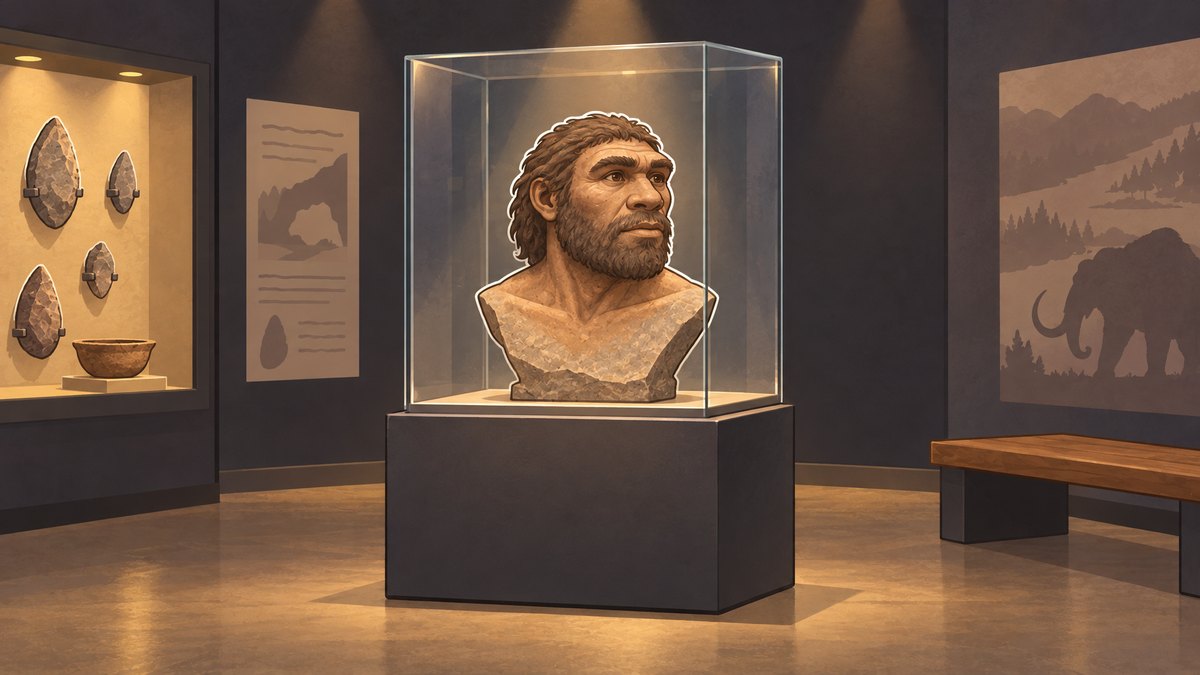
If ADHD traits were so useful in the past, the variants linked to them should have become more common over time. Ancient DNA lets scientists check. In 2020 a team compared many variants linked to ADHD today with genomes from ancient Europeans going back tens of thousands of years, and with Neanderthals.[17]
They found something the hunter-farmer story didn’t predict. Those variants seem to have been slowly getting rarer for tens of thousands of years, long before farming took over.[17] That points to natural selection pushing gently against them, not for them. The team says a mismatch could still be part of the story, just a much older one than the farming turning point.[17] It fits other evidence too: today, ADHD is linked on average with more accidents and injuries.[1][21]
Why are the variants still here?
Several answers are still being studied. One proposed explanation is that selection acts weakly against many variants of tiny effect, while new mutations keep arising; whether this explains ADHD’s persistence remains uncertain.[18] ADHD also behaves like the far end of traits everyone has, such as attention and activity, though that describes the pattern rather than explaining it.[5][7] And computer models suggest a mix of people might help a group even if it costs some individuals: a band with a few restless scouts and a few patient harvesters might do better than a band of clones.[19]
All of these are hard to test, because nobody can rerun the Stone Age. It is easy to tell a story in which a trait was useful once, and much harder to prove it.[20]
What it means today
What we do know is that setting matters. The same person can struggle in one place and do well in another, and support, from changes at school to treatment, helps many people.[1][22] ADHD isn’t a superpower, and it isn’t a character flaw. It is a real difference in how brains work, with real challenges, and it shows up in every kind of person.[1]
So why are these variants still here? We don’t know yet. Being common doesn’t prove they once helped hunters. The evidence points to a messier history than one tidy origin story, and that is exactly what makes it worth studying.
Sources
- Faraone, S. V. et al. (2021). The World Federation of ADHD International Consensus Statement: 208 evidence-based conclusions about the disorder. Neuroscience & Biobehavioral Reviews.
- Faraone, S. V., Larsson, H. (2019). Genetics of attention deficit hyperactivity disorder. Molecular Psychiatry.
- Polanczyk, G. et al. (2007). The worldwide prevalence of ADHD. American Journal of Psychiatry.
- Simon, V. et al. (2009). Prevalence and correlates of adult attention-deficit hyperactivity disorder: meta-analysis. British Journal of Psychiatry.
- Demontis, D. et al. (2019). Discovery of the first genome-wide significant risk loci for attention deficit/hyperactivity disorder. Nature Genetics.
- Demontis, D. et al. (2023). Genome-wide analyses of ADHD identify 27 risk loci. Nature Genetics.
- Larsson, H. et al. (2012). Childhood attention-deficit hyperactivity disorder as an extreme of a continuous trait. Journal of Child Psychology and Psychiatry.
- Ding, Y. C. et al. (2002). Evidence of positive selection acting at the human dopamine receptor D4 gene locus. PNAS.
- Wang, E. et al. (2004). The genetic architecture of selection at the human dopamine receptor D4 (DRD4) gene locus. American Journal of Human Genetics.
- Naka, I., Nishida, N., Ohashi, J. (2011). No evidence for strong recent positive selection favoring the 7 repeat allele of VNTR in the DRD4 gene. PLoS ONE.
- Chen, C. et al. (1999). Population migration and the variation of dopamine D4 receptor (DRD4) allele frequencies around the globe. Evolution and Human Behavior.
- Li, D. et al. (2006). Meta-analysis shows significant association between dopamine system genes and attention deficit hyperactivity disorder (ADHD). Human Molecular Genetics.
- Kluger, A. N., Siegfried, Z., Ebstein, R. P. (2002). A meta-analysis of the association between DRD4 polymorphism and novelty seeking. Molecular Psychiatry.
- Eisenberg, D. T. A. et al. (2008). Dopamine receptor genetic polymorphisms and body composition in undernourished pastoralists (nomadic and recently settled Ariaal men of northern Kenya). BMC Evolutionary Biology.
- Barack, D. L. et al. (2024). Attention deficits linked with proclivity to explore while foraging. Proceedings of the Royal Society B.
- Shephard, T. V., Lea, S. E. G., Hempel de Ibarra, N. (2015). ‘The thieving magpie’? No evidence for attraction to shiny objects. Animal Cognition.
- Esteller-Cucala, P. et al. (2020). Genomic analysis of the natural history of attention-deficit/hyperactivity disorder using Neanderthal and ancient Homo sapiens samples. Scientific Reports.
- Keller, M. C., Miller, G. (2006). Resolving the paradox of common, harmful, heritable mental disorders. Behavioral and Brain Sciences.
- Williams, J., Taylor, E. (2006). The evolution of hyperactivity, impulsivity and cognitive diversity. Journal of the Royal Society Interface.
- Gould, S. J., Lewontin, R. C. (1979). The spandrels of San Marco and the Panglossian paradigm. Proceedings of the Royal Society B.
- Dalsgaard, S. et al. (2015). Mortality in children, adolescents, and adults with attention deficit hyperactivity disorder: a nationwide cohort study. The Lancet.
- World Health Organization. ICD-11, 6A05 Attention deficit hyperactivity disorder.
- Centers for Disease Control and Prevention. About ADHD; Diagnosing ADHD.
- Hartmann, T. (1993). Attention Deficit Disorder: A Different Perception (popular book, not a scientific study).