
Voyager 1 Is One Light-Day Away: How a 1977 Probe Still Talks to Earth
On November 18, 2026, at about 10:16 in the morning UTC, a spacecraft built in the 1970s crossed a line nothing made by people had ever crossed. Voyager 1 reached a distance of one light-day from Earth: about 25.9 billion kilometres, or 16.1 billion miles.[1][23][24] A light-day is a distance, not a time. It is how far light travels in 24 hours, so a radio message to Voyager 1 now takes a full day to arrive, and its answer takes another day to come back.[1][3]
So how does a 49-year-old probe, running on 1970s computers and a fading nuclear power supply, still talk to us? And what will happen when it finally falls silent?
Prefer to watch? The animated version follows the whole trip, from the 1977 launch to the Golden Record and the long goodbye.
A rare shortcut, about once in 175 years
In 1965, Gary Flandro, a Caltech student working at NASA’s Jet Propulsion Laboratory, noticed something rare coming up. In the late 1970s, Jupiter, Saturn, Uranus and Neptune would sit in an arrangement that only comes round about once every 175 years.[7] A spacecraft launched at the right moment could visit them one after another, using each planet’s gravity like a slingshot to reach the next. That trick cut the trip to Neptune from about thirty years to about twelve.[7]
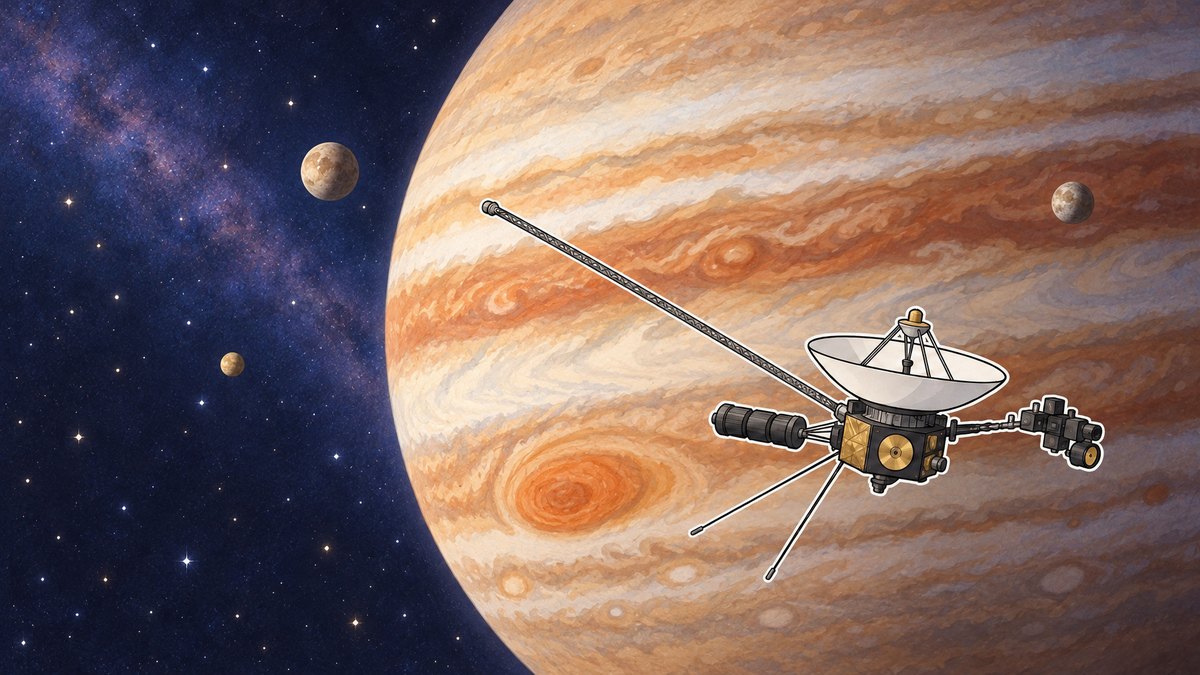
NASA built two identical probes. Confusingly, Voyager 2 launched first, on August 20, 1977. Voyager 1 followed on September 5 on a faster path and soon overtook its twin.[5] Each carries a dish antenna 3.7 metres wide and no solar panels at all: that far from the Sun, sunlight is far too weak, so the probes run on electricity made from the heat of decaying plutonium.[5][18]
Volcanoes, ringlets and a fateful choice
Voyager 1 swept past Jupiter in March 1979 and photographed its giant storms, including the Great Red Spot.[5][11] The biggest surprise came from Jupiter’s moon Io, where the pictures showed plumes rising into space: active volcanoes.[11]
In November 1980 Voyager 1 reached Saturn and revealed complex structure in its rings.[5][11] The team had chosen a route close past Saturn’s hazy moon Titan, and that route carried Voyager 1 up and out of the plane of the planets for good, ending its planetary tour.[5] Voyager 2 carried on to Uranus and Neptune, and it is still the only spacecraft to have visited either one.[5]
The Pale Blue Dot
By February 1990, Voyager 1 was about six billion kilometres from home. The astronomer Carl Sagan pushed NASA to turn its camera around for one last look back.[8][9] On February 14, 1990, it took 60 frames, the first portrait of the Solar System from the outside. In one of them, Earth is less than a single pixel wide, sitting in a streak of sunlight scattered inside the camera.[8] Sagan called it a pale blue dot and wrote: “That’s here. That’s home. That’s us.”[10] Soon afterwards, Voyager’s cameras were switched off for good to save power.[8]
The probe kept going. In 1998 it became the most distant human-made object, passing the older Pioneer 10. In August 2012 it crossed the heliopause, the edge of the bubble of charged particles blowing out from the Sun, and entered interstellar space.[5] That is not quite the same as leaving the Solar System: the Sun’s gravity reaches much farther, and Voyager 1 will not even reach the inner edge of the distant Oort Cloud for about 300 years.[25]
How a 1970s machine still phones home
Voyager’s computers are tiny by today’s standards: its three computer systems together have less memory than a typical photo on your phone.[13] Its transmitter radiates about 22 watts, roughly what a fridge light bulb uses.[16] By the time it reaches Earth, it is unimaginably faint.
To hear it, NASA uses the Deep Space Network: giant dishes in California, Spain and Australia, spaced around the globe so one of them can always face the spacecraft. The biggest are 70 metres across.[17] When science data is flowing, it trickles down at about 160 bits per second, hundreds of thousands of times slower than a home internet connection.[5] And every conversation is slow. At one light-day, a command needs a day to arrive and the reply another day, so engineers wait about two days for every answer.[3]
The repair from 24 billion kilometres away
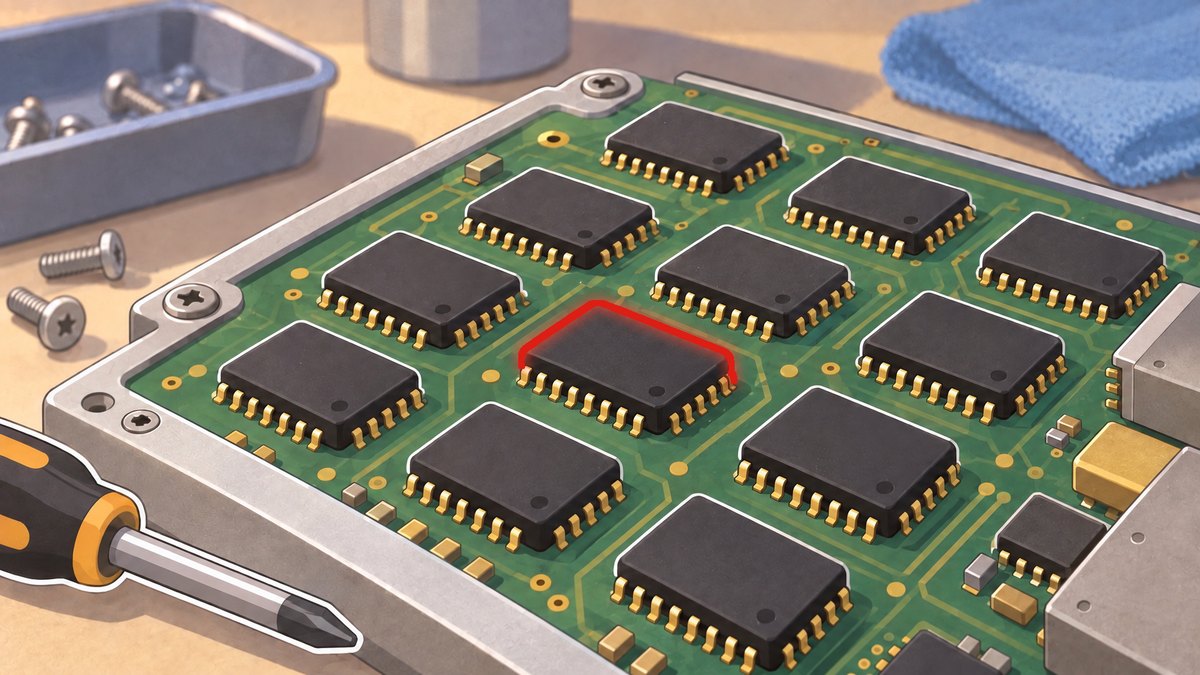
In November 2023, Voyager 1 suddenly began sending back nonsense. Its radio signal was fine, but the data made no sense.[12] After months of detective work, engineers asked the probe to send back a readout of its memory and found the culprit: one failed chip holding part of the flight data computer’s memory.[12]
The chip could not be replaced, and no single free spot was big enough for its code. So the team split the code into pieces, tucked them into other places in the memory, and updated every reference. They sent the fix on April 18, 2024, and two days later Voyager 1 sent back readable engineering data.[12]
It was not the only rescue. When thruster tubes clogged with residue, the team switched to another set of thrusters, and in 2025 revived backup thrusters thought unusable for decades.[14][15] In October 2024, after a fault shut off its main radio, engineers found the probe talking on a backup transmitter that had not been used to talk to Earth since 1981.[15]
A message in a golden bottle
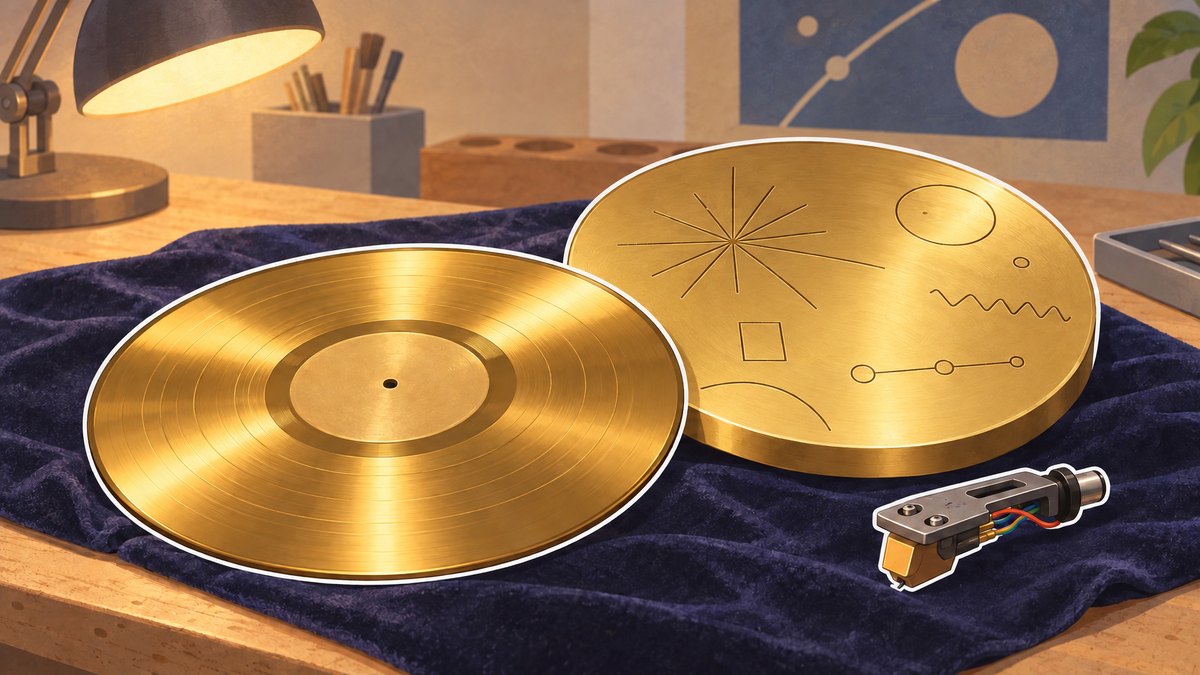
Voyager is also carrying a message. Mounted on each spacecraft is a 12-inch record made of copper and plated with gold: the Golden Record.[19] A committee chaired by Carl Sagan had about six months to decide what it should say about us.[20]
They chose 115 pictures, stored as sound; spoken greetings in 55 languages, from ancient Akkadian to a modern Chinese language, Wu; and the sounds of Earth, from wind, rain and thunder to a heartbeat and a kiss.[19][20][22] There is about an hour and a half of music, 27 pieces in all, including Bach, Beethoven, a Navajo night chant, Javanese gamelan, an Indian raga and Chuck Berry’s “Johnny B. Goode”.[19] There is a printed message from President Jimmy Carter,[19] and the brainwaves of one person, Ann Druyan, recorded while she thought about history, ideas and, in her words, “the wonder of love and of being in love”.[22]
The cover is an instruction manual with no words. It shows how to place the needle, how fast to spin the record and how to turn sound into pictures. Its unit of time is a tiny flip inside a hydrogen atom, the most common atom in the universe. A map shows where the Sun sits relative to 14 pulsars, spinning dead stars that blink like lighthouses, and a speck of uranium works as a clock that could reveal how long ago the record left.[19]
Will anyone ever hear it? Sagan himself said the record would only be played if there are advanced spacefaring civilisations in interstellar space.[19][21] Many people think it says as much about us as it does to anyone who might find it.
When the power runs out
At launch, Voyager’s three nuclear generators made about 470 watts. They lose about four watts every year.[5][6] So the team has been switching things off: heaters, cameras and, one by one, science instruments. Voyager 1 launched with ten. As of November 2026, only two remain powered on.[1][4] In March 2025, NASA estimated that each probe could operate at least one science instrument into the 2030s, although unexpected problems could end operations sooner.[6] One day the power will run out for good.
There is also an open question. Since November 14, 2026, Voyager 1 has been sending only its carrier signal, a plain radio tone that shows it is pointed at Earth and transmitting, but no science or engineering data. In NASA’s November 18, 2026 update, engineers were still working out why, and said it may take weeks or longer.[2]
Even after the silence, Voyager 1 will not stop. It will keep coasting outward at about 17 kilometres a second. In about 40,000 years, NASA estimates, it will drift past a small red star, Gliese 445, still more than a light-year away.[26] And the Golden Record, with almost nothing out there to wear it down, could last a billion years or more.[19][20]
Still here
In November 2026, a probe from the age of disco became the first thing our species has ever made to reach a full light-day from home, and NASA’s November 18 update reported that its faint carrier signal was still reaching Earth.[1][2] Long after the last engineer has signed off, a small machine carrying our music and our greetings will still be out there, drifting between the stars.
Sources
- NASA Science. Where Are Voyager 1 and Voyager 2 Now? (accessed 19 November 2026).
- NASA Voyager blog (18 November 2026). Voyager 1 Engineers Analyze Data Issue, Ready to Confirm Light-day.
- NASA Scientific Visualization Studio / JPL (2026). How Far Away Is Voyager 1? One Light-Day, Explained.
- NASA JPL (2026). NASA’s Voyager 1 Conserves Power, Resolves Brief Communications Pause.
- NASA Science. Voyager 1 and Voyager 2 mission pages; The Voyager spacecraft.
- NASA JPL (2025). NASA Turns Off 2 Voyager Science Instruments to Extend Mission.
- NASA APPEL Knowledge Services. The Grand Tour and Gary Flandro’s alignment.
- NASA/JPL Photojournal. PIA00452 Earth as Pale Blue Dot; PIA00451 Solar System Portrait; PIA23645 Pale Blue Dot Revisited.
- Cornell Chronicle (2020). Iconic ‘pale blue dot’ photo, Carl Sagan’s idea, turns 30.
- Sagan, C. (1994). Pale Blue Dot: A Vision of the Human Future in Space. Random House.
- NASA/JPL Photojournal. PIA00010 Io with Loki Plume; PIA00014 Jupiter Great Red Spot; PIA00024 Saturn.
- NASA JPL (2024). NASA’s Voyager 1 Resumes Sending Engineering Updates to Earth.
- Rak, G. (2024). How NASA Is Hacking Voyager 1 Back to Life. IEEE Spectrum.
- NASA JPL (2024). Voyager 1 Team Accomplishes Tricky Thruster Swap.
- NASA Voyager blog (2024, 2025). After Pause, NASA’s Voyager 1 Communicating With Mission Team; NASA’s Voyager 1 Revives Backup Thrusters Before Command Pause.
- NASA/JPL (2013). PIA17047 Voyager Signal Spotted by Earth Radio Telescopes.
- NASA JPL. Deep Space Network and the Goldstone 70-meter antenna.
- NASA/JPL Photojournal. PIA25782 Voyager’s RTG.
- NASA Science. Voyager Golden Record overview; Golden Record contents; Sounds and music; The Golden Record cover.
- Davis, P. (2002). Howdy, Strangers. NASA.
- Sagan, C., Drake, F. D., Druyan, A., Ferris, T., Lomberg, J., Salzman Sagan, L. (1978). Murmurs of Earth: The Voyager Interstellar Record.
- Radiolab (2010). Looking Up; NPR (2010). Carl Sagan and Ann Druyan’s Ultimate Mix Tape.
- EarthSky (2026). Voyager 1 is 1 light-day from Earth, November 17-18, 2026.
- IFLScience (2026). It’s official: Voyager 1 will cross the 1 light-day threshold on November 18, 2026.
- NASA/JPL Photojournal (2013). PIA17046, on Voyager 1’s distance to the Oort Cloud.
- NASA JPL. Voyager Interstellar Mission: the future (star encounter in about 40,000 years).