
The Mysterious Disappearance of Agatha Christie: What Really Happened in Those 11 Days
On the night of Friday 3 December 1926, a 36-year-old writer drove away from her home in Sunningdale, west of London, and vanished. The next morning her car was found abandoned on a hillside in Surrey, its lights still on. For eleven days, police, reporters and thousands of ordinary people looked for her. Then she turned up at a spa hotel in Yorkshire, signed in under a false name.[1][12][14]
The writer was Agatha Christie, who would go on to become the best-selling novelist of all time.[19] On 3 December 2026 it will be exactly a hundred years since she vanished, and her own disappearance is still the one mystery she never solved for us. Here is what is documented, what was claimed later, and why nobody knows for sure what happened.
Prefer to watch? The animated version follows the eleven days from the empty car to the hotel register.
A rising star in a terrible year
By 1926 Christie was a rising name. Her first detective novel, published in 1920, had introduced a fussy little Belgian detective called Hercule Poirot. The Murder of Roger Ackroyd, published in June 1926, became a breakthrough success, and debate still continues about whether its daring twist plays fair with readers.[16][17] She was married to Archie Christie, a former Royal Flying Corps pilot who worked in the City of London, and they had a seven-year-old daughter, Rosalind. They lived in a large house in Sunningdale that they had named Styles, after her first book.[5][16]
But 1926 had become a terrible year. In April her mother, Clara, died; the two had been very close. Agatha spent months clearing out her childhood home, Ashfield, in Torquay, and biographers describe her as grieving and worn out, and struggling to write her next book.[5][14] In August, Archie told her he had fallen in love with someone else, a younger woman called Nancy Neele, and that he wanted a divorce. Christie later wrote that she held on for a year hoping he would change his mind.[3][12]
The night of 3 December
Accounts describe an argument between the couple that Friday. Archie spent the weekend with friends near Godalming, in Surrey, where Nancy Neele was also a guest.[12][14] That evening Agatha was at home with Rosalind and the household staff. At about a quarter to ten she went out to her car and drove off alone, without telling anyone where she was going.[12][16]
According to later accounts, she left a note for her secretary and a letter for Archie. He read it and burned it, and its exact words were never made public.[12] A third letter, posted in London the next morning, reached Archie’s brother, Campbell. It said she was going away to a spa in Yorkshire. For days, almost nobody took that clue seriously.[13][19]
The empty car at Newlands Corner
Early on Saturday 4 December, a passer-by found her car at Newlands Corner, a beauty spot on the North Downs near Guildford, about fifteen miles from her home. Accounts disagree about exactly who found it. The car had run off the road and down a slope, and stopped nose-first in the bushes above a chalk pit, its headlights still on. Inside were her fur coat, a small suitcase of clothes and even her driving licence. There was no sign of her.[13][14][16]

One of Britain’s biggest searches
The search grew day by day. Police combed the Downs with tracker dogs and dragged a nearby lake, the Silent Pool, afraid she had drowned. Planes were reported flying over the hills too.[14][16]
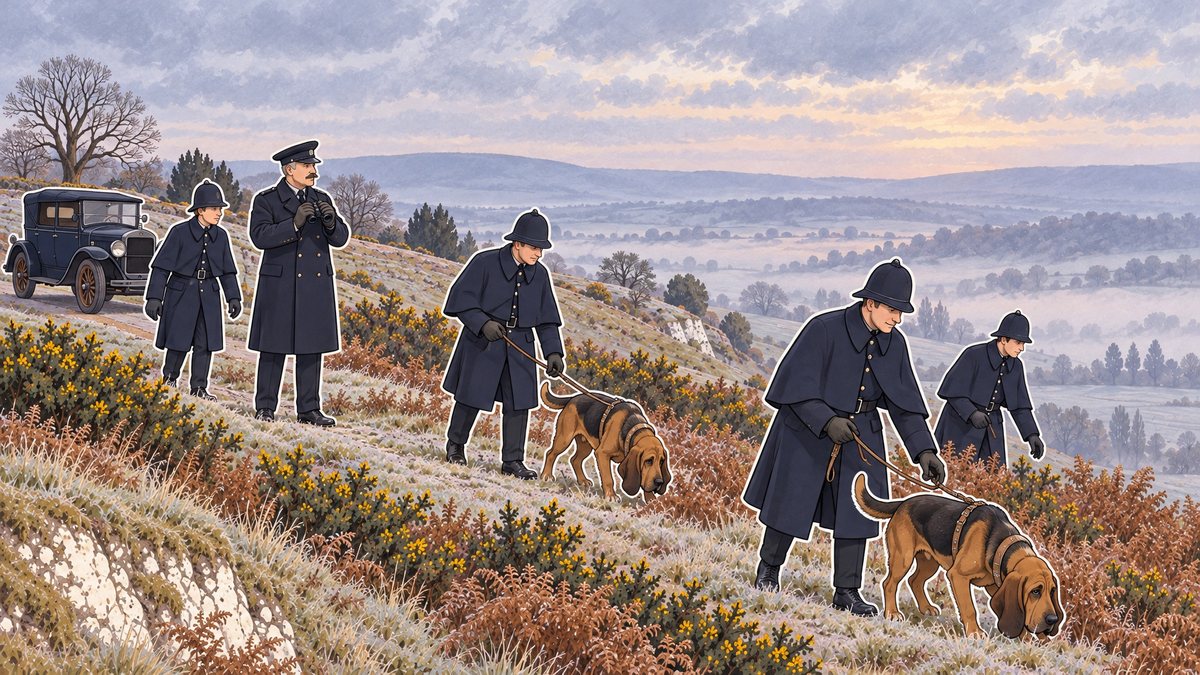
On Sunday 12 December came the biggest search of all. Thousands of volunteers turned up, and cars streamed in from all over.[11][16] Estimates of the crowd varied widely, from about 2,000 to as many as 15,000.[12][14][16]
The newspapers made her disappearance one of the biggest stories in the country, and it reached papers around the world. One paper offered a £100 reward. Sightings came in from all over England, and one rumour even had her disguised as a man. The press began to whisper about her husband, and Archie told one newspaper that she had talked about being able to disappear at will.[13][14][19]
Other writers got involved too. Sir Arthur Conan Doyle, the creator of Sherlock Holmes and a keen spiritualist, took one of her gloves to a medium, who said he thought she was still alive. The crime writer Dorothy L. Sayers joined the search at Newlands Corner and wrote about it for a newspaper.[16]
Mrs Teresa Neele of Cape Town
All this time, she was alive. On the evening of Saturday 4 December, a woman arrived at the Swan Hydropathic Hotel in Harrogate, a spa town about two hundred miles north. Nobody knows exactly how she got there. She signed the register as Mrs Teresa Neele, from Cape Town: the same surname as the woman her husband loved.[14][16]
She went shopping, borrowed library books, played billiards and even danced to the hotel band.[16]

Two musicians in the hotel band became sure she was the missing writer and went to the police. On the evening of Tuesday 14 December, Archie arrived in Harrogate, waited at the hotel, and recognised his wife when she came in for dinner.[1][16]
What happened?
Archie told the Daily Herald that she had suffered “the most complete loss of memory” and said: “She does not know why she is here.”[1] Two doctors issued a statement that her memory loss was genuine.[7] Not everyone believed it. Many people were angry about the wasted effort and called it a hoax or a stunt. In Parliament, the Home Secretary put the cost to the Exchequer at about £12 10s, although other estimates were far higher.[2][15]
Christie gave her own account just once, to the Daily Mail in February 1928. She said she had left home “in a state of high nervous strain”, meaning to do “something desperate”. She said that the car stopped suddenly, that she struck her head, and that she then believed herself to be “Mrs Teresa Neele of South Africa”.[4][19]
Writers still disagree about what that means. Some, such as Andrew Norman and, broadly, Lucy Worsley, think she really did lose her sense of who she was, in what is called a fugue state, which can follow extreme stress.[7][9] Laura Thompson argues that she was in a deep crisis, and that the memory-loss story covered something more painful.[6] Jared Cade’s 1998 book pointed to clues like the Yorkshire letter and a notice in The Times asking relatives of ‘Teresa Neele’ to get in touch, and argued that she planned the whole thing to shame her husband; her family rejected that.[8][16] And while many people at the time called it a publicity stunt, most biographers do not believe it.[6][7] Memory researchers have noted that faking this kind of amnesia convincingly is harder than it sounds, while leaving the case open.[10]
Afterwards
The couple divorced in 1928, and Archie married Nancy Neele soon after. In 1930 Agatha married the archaeologist Max Mallowan and travelled with him to excavations in the Middle East. She kept writing for nearly fifty more years, but she almost never spoke about those eleven days. She died in 1976, and her Autobiography, published the following year, leaves them out. Of that whole period she wrote: “There is no need to dwell on it.”[3][5][18]
Others filled the gap. A 1979 film invented its own version of events, and many novels and television stories have done the same since. They are fiction, not history.[13][16] As of November 2026, the British Library in London is marking her life and work with a major exhibition, Agatha Christie: A World of Mystery, from 30 October 2026 to 20 June 2027.[18]
This December marks a hundred years since those eleven days. The woman who gave the world so many perfect solutions left behind one puzzle she never explained. Maybe she never could.
If you’re struggling, please reach out to someone you trust or a local support line.
Sources
- Daily Herald (London), 15 December 1926, front page: “Mrs. Christie found at Harrogate”.
- Hansard, House of Commons, 10 February 1927 (cost of the search) and 25 February 1927 (written answer).
- Christie, A. (1977). An Autobiography. Collins.
- Daily Mail, February 1928: Agatha Christie’s own account (as reprinted and quoted by later sources).
- Morgan, J. (1984). Agatha Christie: A Biography. Collins.
- Thompson, L. (2007). Agatha Christie: An English Mystery. Headline; and Eleven Days (2026).
- Worsley, L. (2022). Agatha Christie: An Elusive Woman. Hodder & Stoughton.
- Cade, J. (1998). Agatha Christie and the Eleven Missing Days. Peter Owen.
- Norman, A. (2006). Agatha Christie: The Finished Portrait. Tempus.
- de Vito, S. & Della Sala, S. (2017). Scientific American Mind, on Agatha Christie’s amnesia.
- The Spectator, 18 December 1926: The case of Mrs Christie.
- National Geographic (2024). Why did Agatha Christie go missing? Here are 4 theories.
- A&E Crime + Investigation (2026). Agatha Christie’s disappearance.
- Countryfile (2026). Agatha Christie’s disappearance.
- JSTOR Daily (2025). Agatha Christie’s mysterious disappearance.
- Shedunnit podcast. The Lady Vanishes.
- AgathaChristie.com (2019). Playing by the rules: Christie’s unconventional crimes.
- British Library (2026). Agatha Christie: A World of Mystery (exhibition, 30 October 2026 to 20 June 2027).
- Mental Floss (2026). Agatha Christie’s 11-day disappearance may not be such a mystery after all.