
The Great Stink of 1858: How a Smell Gave London Its Sewers
In the summer of 1858, some of the most powerful people in the British Empire were beaten by a smell. It came from the river outside their windows. Lawmakers in the new, still-unfinished Palace of Westminster hung curtains soaked in chemicals over the windows, and there was talk of taking the business of government out of London altogether.[8] Newspapers called it the Great Stink. Within weeks, it pushed Parliament into unlocking the money for one of the biggest building projects of the Victorian age. The strange part: they were wrong about why the smell mattered, and their sewers helped save lives anyway.
Prefer to watch? The animated version follows the smell from the cesspits to the tunnels that still run under London.
A city built on cesspits
In 1801, just under a million people lived in London. By the late 1850s, it was nearly three million.[8] Much household waste went into cesspits, brick-lined pits under or behind houses. London had about 200,000 of them in the 1850s.[1][8] Men known as night-soil men emptied them by hand, after dark, for a fee. When households could not pay, the pits filled up and leaked into the ground around them.[2][8]
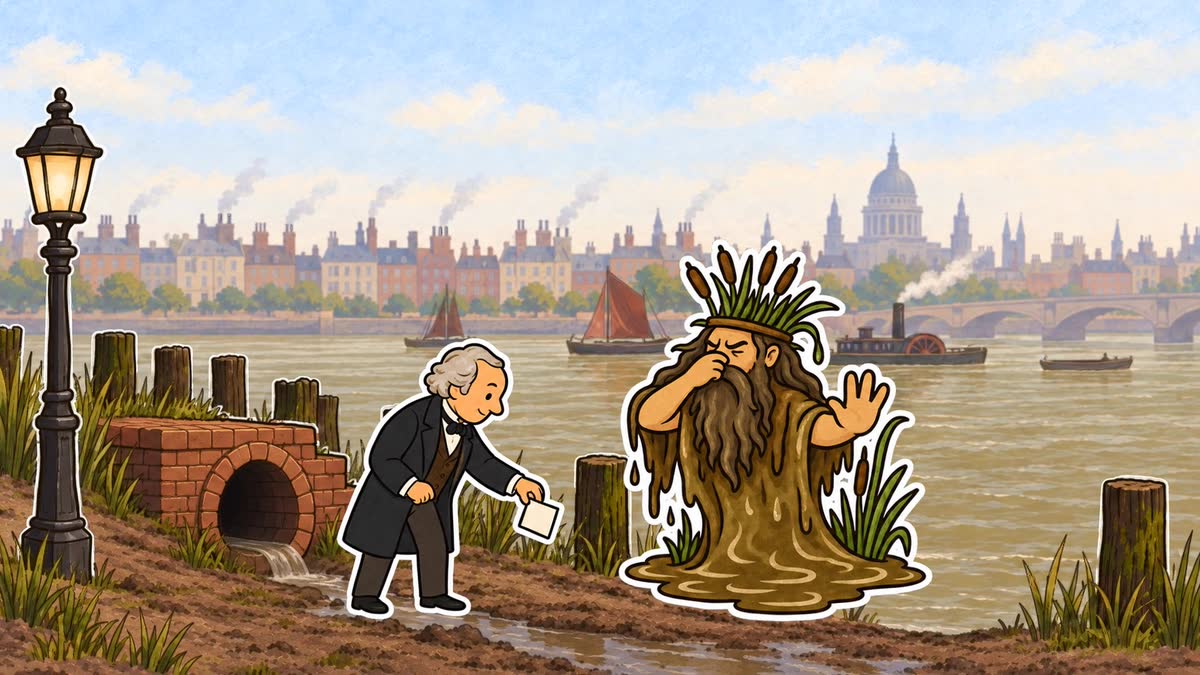
Then the flushing toilet caught on. Water closets spread through the first half of the 1800s and sent far more water into those pits, so they overflowed faster. From the late 1840s, the authorities pushed householders to connect their drains to the sewers instead.[1][8] That sounded like progress, but most of London’s old sewers had been built to carry rainwater, and they ran downhill into the Thames. Connecting homes to them sent the city’s sewage straight into the river, right through the middle of London.[8] And several water companies drew drinking water from the same river, some of it from stretches near sewer outlets.[3][8]
In July 1855, the scientist Michael Faraday took a steamboat along the Thames. At each pier he dropped torn pieces of white card into the water. In a letter to The Times, he reported that they vanished from sight before they had sunk an inch below the surface, even in bright sunshine. The river, he wrote, had become a real sewer.[4] The comic magazine Punch drew him handing his card to a filthy Father Thames.[8]
Cholera and the bad-air idea
London also had a far deadlier problem: cholera. In three epidemics, in 1831-32, 1848-49 and 1853-54, it killed more than thirty thousand Londoners.[1][8]
Most doctors and officials had an explanation. They called it miasma: the idea that diseases spread through bad-smelling air rising from rotting matter. It was a reasonable belief at the time. The idea that germs cause disease was not yet widely accepted.[8] To officials, the smell was the enemy, and flushing waste away into the river looked like a cure. In fact, cholera spreads mainly through water or food contaminated with infected waste.[3][8]
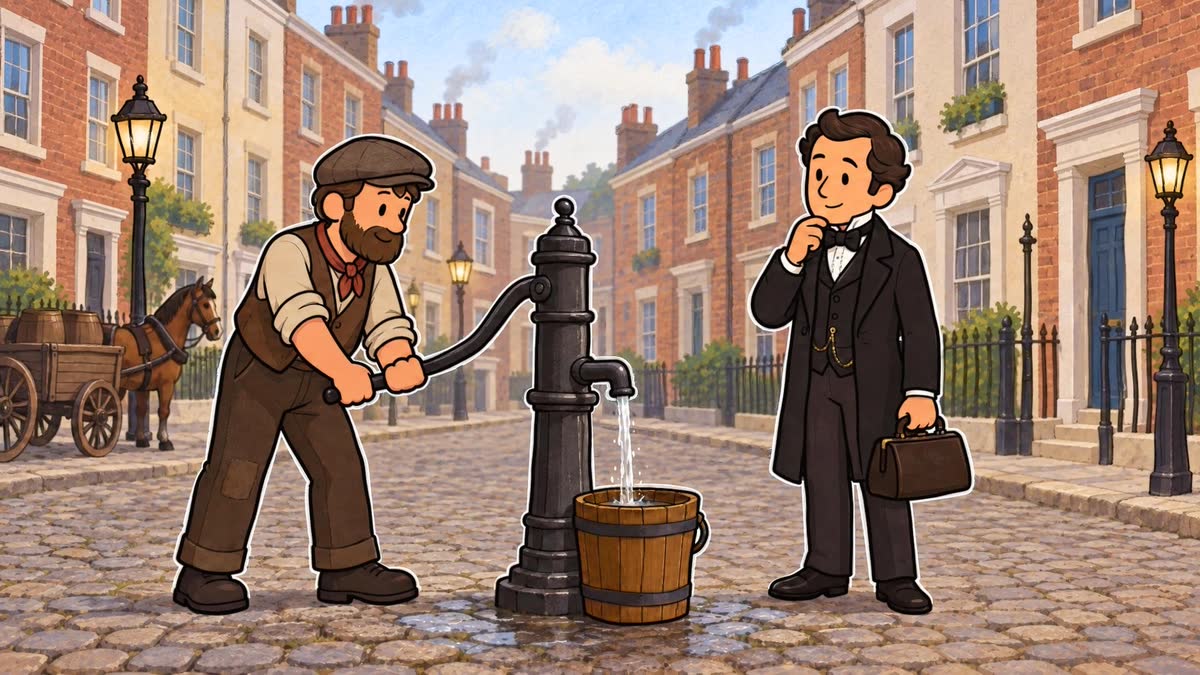
One London doctor disagreed. John Snow argued in 1849 that cholera spread through contaminated water.[3][8] In late August 1854, cholera broke out around Broad Street in Soho, and more than a hundred people on or near the street died in three days.[8] Snow investigated where the victims had drawn their water, and the evidence pointed to one public pump. Workers at a nearby brewery, who drank beer instead, were largely spared. Snow persuaded the local parish guardians to remove the pump’s handle in early September, although deaths were already falling by then. His famous map, published the next year, showed the deaths clustered around the pump.[3][8]
The experts were not convinced. The General Board of Health’s inquiry still blamed bad air, and Snow’s water theory was widely rejected during his lifetime.[8] He died after a stroke on 16 June 1858, aged 45.[8] That same month, the weather turned hot.
Summer 1858: the Great Stink
June 1858 was very hot and dry. Temperatures in the shade reportedly reached the mid-thirties Celsius.[8] The river ran low, and the sewage-soaked mud on its banks baked in the sun. The smell lasted through July and into August.[1][8]
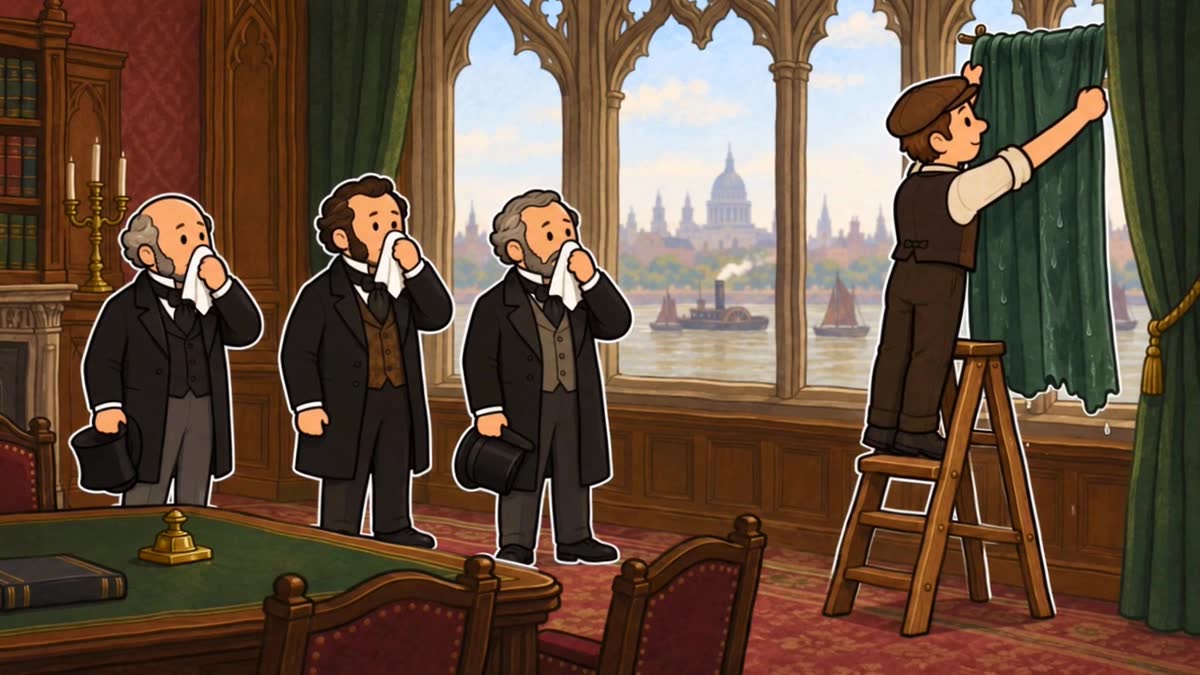
Right on the riverbank sat Parliament, in its new Gothic palace. Members reportedly held handkerchiefs to their noses. Curtains soaked in chloride of lime were hung at the windows on the river side, and workers spread tons of lime around the sewer mouths and along the exposed riverbank, at a cost of about £1,500 a week.[1][8] None of it worked. Because they believed in miasma, many feared the foul air itself could make them ill. There was talk of moving government business to Oxford or St Albans, but Parliament did not relocate.[8]
Sewer plans had been argued over for years. Suddenly, everyone wanted one. On 15 July 1858, Benjamin Disraeli, Chancellor of the Exchequer and Leader of the House of Commons, introduced a bill, calling the Thames “a Stygian pool, reeking with ineffable and intolerable horrors”.[5][8] It became law on 2 August, in about eighteen days. It let the Metropolitan Board of Works borrow three million pounds, to be repaid by a small charge on London households over forty years.[1][5][8]
Bazalgette’s plan
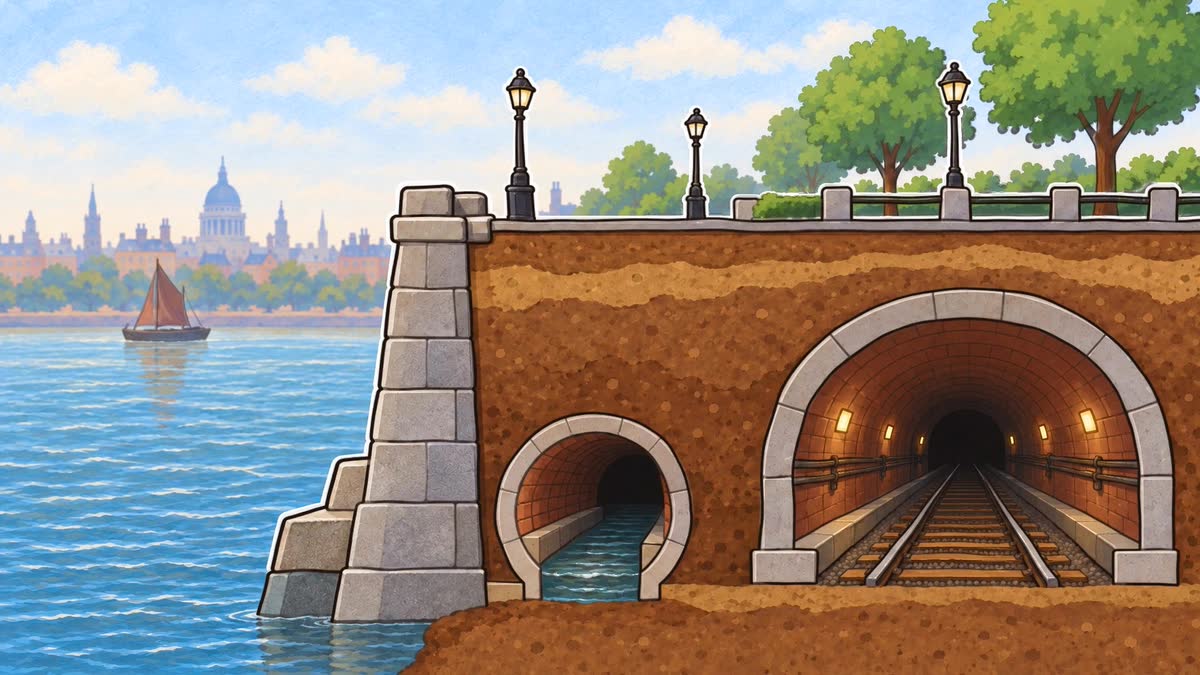
The man with the plan was Joseph Bazalgette, the board’s chief engineer. He had worked on London’s drainage since 1849, and his designs were ready.[1][8] His idea was simple and enormous: do not remove the old sewers, intercept them. New main sewers running roughly parallel to the Thames would catch the old ones before they reached the river, then carry the sewage east, mostly downhill by gravity, to outfalls far downstream of the city. Where gravity alone was insufficient, steam pumping stations lifted the sewage.[1][8]
At first, the sewage was held in tanks at Beckton on the north bank and Crossness on the south, then released into the Thames, untreated, on the outgoing tide. Treating it came decades later.[8] Bazalgette also planned for a much bigger population than London then had, and he was fussy about materials. He used Portland cement, then fairly new for such work, and had every batch tested, which probably helped his tunnels last.[1][8]
Over 300 million bricks
Work began in 1859. Workmen with picks and shovels dug deep trenches across London and lined the tunnels with brick. The system grew to about 130 kilometres of main sewers, fed by about 1,800 kilometres of street sewers, and it took about 318 million bricks.[1][8]
The pumping stations were decorated like palaces. Inside Crossness, painted iron columns and swirling ironwork surround giant beam engines. In April 1865, the Prince of Wales opened it and set its engines running.[1][8] Along the river, Bazalgette built the Albert, Victoria and Chelsea embankments on land reclaimed from the mud. The Victoria Embankment contains a main sewer and an underground railway beneath the road.[1][8] By 1875 the main system was largely complete. Together with the embankments, it cost about six and a half million pounds.[8]
1866: the proof
In 1866, before the system was finished, cholera returned, hitting East London hardest. About 5,600 people died. Investigators traced the outbreak to sewage-contaminated, unfiltered water supplied by the East London Water Company.[8] Even William Farr, a leading statistician who had long favoured the bad-air idea, came to accept that the water had spread it.[8] London never had another cholera epidemic.[1][8]
So the sewers built to end a smell helped stop a killer that the smell never caused. By carrying waste away from homes and away from the water people drank, they cut off the route cholera actually travelled. They were not the only reason. A law of 1852 had already made water companies move their intakes above the tidal river and filter their water, and historians still debate how to share the credit between cleaner water and the sewers.[1][8]
Still flowing
Much of Bazalgette’s system still carries London’s waste today, more than a century and a half later, for a city of about nine million people.[8] But it carries rainwater too, so in heavy storms it can overflow and spill sewage into the Thames. To catch those overflows, London built the Thames Tideway Tunnel, a super sewer about 25 kilometres long, running deep under the river. It became fully connected in 2025. In 2026, Thames Water reported a sharp fall in modelled storm-overflow volumes into the tidal Thames during 2025 compared with pre-Tideway levels.[7]
Bazalgette was knighted in 1875, and a memorial to him stands on the Victoria Embankment. The historian John Doxat wrote that he “probably did more good, and saved more lives, than any single Victorian official”.[6][8] John Snow, who did not live to see any of it, is now remembered as one of the founders of epidemiology, the science of how and where diseases spread.[8]
The Great Stink was a disaster that turned out well. The smell that frightened Parliament was not what had been killing Londoners, but fixing it helped save them anyway.
Sources
- Halliday, S. (1999). The Great Stink of London: Sir Joseph Bazalgette and the Cleansing of the Victorian Metropolis. Sutton.
- Ackroyd, P. (2000). London: The Biography. Chatto & Windus.
- Snow, J. (1855). On the Mode of Communication of Cholera (2nd edition).
- Faraday, M. (1855). Letter to the Editor of The Times, 7 July 1855 (“Observations on the Filth of the Thames”).
- Hansard (House of Commons), 15 July 1858: Metropolis Local Management Act Amendment Bill.
- Doxat, J. (1977). The Living Thames. Hutchinson.
- Tideway / Thames Water: Thames Tideway Tunnel (2025) and 2025 storm overflow figures.
- Wikipedia. Great Stink; Joseph Bazalgette; 1854 Broad Street cholera outbreak; John Snow; Thames Tideway Tunnel.