
Why Are We the Only Human Species Left? What the Clues Say About the Others
Here’s a quick puzzle. Around sixty thousand years ago, how many kinds of human shared the Earth? The best current answer is at least three for sure, and probably four.[3][16][38] Today there is only one: us, Homo sapiens. And some of the others left something behind in people alive today: pieces of their DNA.[24][25][26]
That makes our moment unusual. For most of the last two million years, several kinds of human shared the planet. So where did the others go? There is no single established answer, but the clues are fascinating, and some of them are only a year or two old.
Prefer to watch? The animated version meets the same cast and lines up the same suspects in about eleven minutes.
First, a rule about old bones
The youngest known fossil of a kind of human tells us when it was last seen, not when it died out. Many ages are minimums, and every date comes with error bars. Keep that in mind, because the story below is full of “about”, “at least” and “we don’t know”.
Words matter too. Some of these groups interbred, so scientists still argue about which of them deserve the label “species”. Here we simply say kinds of human.
The longest run: Homo erectus
Homo erectus, or something very like it, appears in Africa about two million years ago, with long legs, a body built much like ours and a smaller brain.[36] It lasted roughly two million years, several times longer than our own species has existed so far.[1][36] Erectus, or a close relative, gives us the earliest known human bones far outside Africa, at Dmanisi in Georgia,[37] and it later reached China and Java.
Its last known home was Ngandong, on Java, about 117,000 to 108,000 years ago.[1] Expanding rainforest has been proposed as a pressure on its habitat, but the cause of its disappearance remains unknown. Our species is documented in the region much later; there is no evidence linking our arrival to its disappearance.
The islanders of Flores and Luzon
In 2003, in a cave called Liang Bua on the Indonesian island of Flores, researchers found the skeleton of a woman about a metre tall, with a brain about a third the size of ours.[2] Her kind was named Homo floresiensis, quickly nicknamed “the hobbit”. Some scientists first argued she was a modern human with an illness, but more finds made that very hard to defend. Her ancestors seem to have been small too: an adult arm bone about 700,000 years old from elsewhere on the island, described in 2024, is shorter than hers.[4]
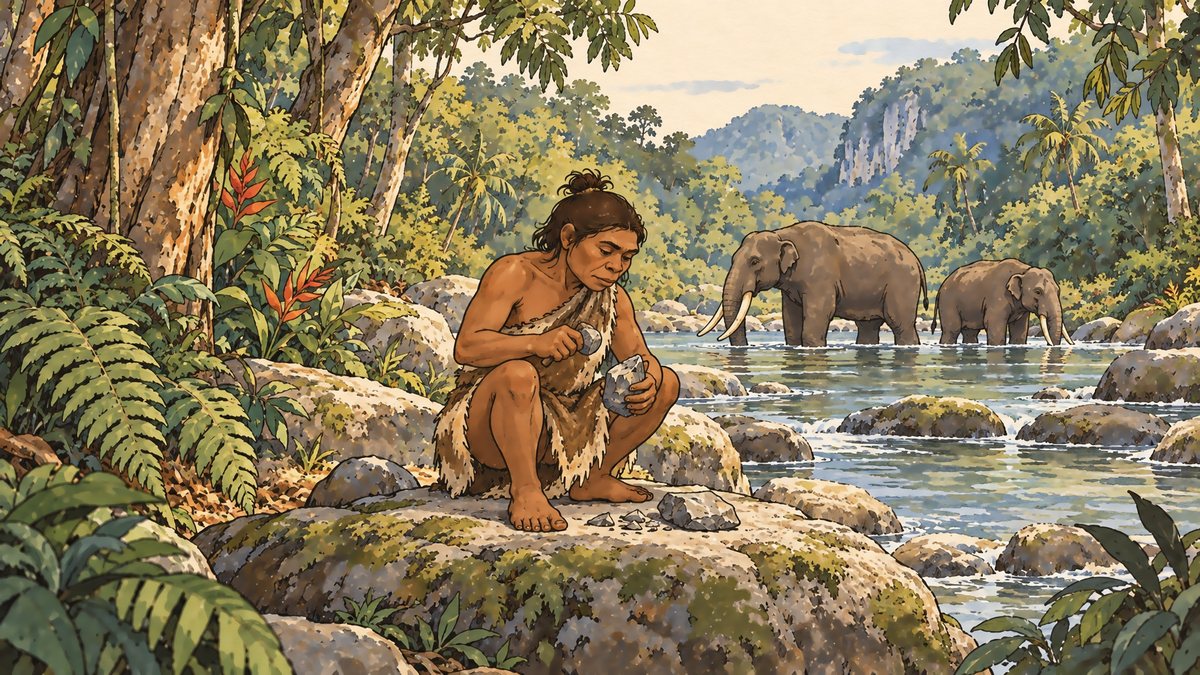
Their bones are about 100,000 to 60,000 years old, and their stone tools run to about 50,000 years ago.[3] A 2025 study reconstructed increasingly dry conditions near Liang Bua.[5] A 2026 study suggests Komodo dragons had first access to Stegodon carcasses at Liang Bua, leaving remains these humans scavenged.[6] What ended them? We don’t know. Our species was moving through the region around their last known traces, but no meeting is documented.
Farther north, in the Philippines, Homo luzonensis left tiny molars and curved finger and toe bones in Callao Cave.[7] A 2023 dating reassessment suggests those fossils may be at least roughly 134,000 years old,[8] so nothing shows the Luzon people were still alive around sixty thousand years ago.
A crowded bush: Homo naledi
Deep in the Rising Star cave in South Africa, explorers recovered more than 1,500 bones of a small-brained human, Homo naledi.[9] The bones are about 335,000 to 236,000 years old,[10] so naledi lived when early members of our own species were already alive in Africa. Its discoverers argue it buried its dead; many other researchers aren’t convinced.[11] Either way, human evolution was not a ladder with us at the top. It was a bush, with many branches alive at once.
The Neanderthals
Neanderthals walked upright, were stocky and strong, and lived from Portugal to the Altai Mountains of Siberia. Their lineage goes back more than 400,000 years. They glued stone points onto handles with birch tar, as on a tool about 50,000 years old dredged from the North Sea.[12] They hunted big animals, cooked plants and, in Portugal, ate shellfish. About 176,000 years ago, deep inside Bruniquel Cave in France, someone, almost certainly Neanderthals, built rings out of broken stalagmites. Nobody knows why.[13]
Their brains were about our size, a little larger on average, but shaped differently. What that meant for thinking is still argued.[14] An older man at Shanidar Cave in Iraq lived for years with serious injuries, including a crushed eye socket and a lost forearm, and probable hearing loss, which suggests others helped him.[15]
The occupations of Neanderthals and our species overlapped in parts of Europe for a few thousand years. Across most of Europe, Neanderthals disappear from the record around 40,000 years ago, at different times in different places.[16] Their genomes indicate small populations with little genetic variety.[24] A 2024 study of Thorin, a late Neanderthal from France, inferred roughly 50,000 years of genetic isolation from other sampled Neanderthals.[17]
The ghost people: Denisovans
In 2010, scientists read DNA from a scrap of finger bone found in Denisova Cave, in Siberia. It came from a kind of human no one had ever named.[18] The same cave later gave us Denny, a girl whose mother was a Neanderthal and whose father was a Denisovan.[19] These branches didn’t only split; sometimes they joined again.
Proteins then identified a jaw from the Tibetan Plateau, found by a monk in 1980, as Denisovan,[20] and in 2025 another jaw, dredged from the sea floor off Taiwan by fishermen.[21] Also in 2025, ancient proteins from a skull reportedly found in Harbin, China, in the 1930s, and mitochondrial DNA from the hardened plaque on its teeth, both matched the Denisovans.[22][23] For the first time we can see a Denisovan skull with a face.
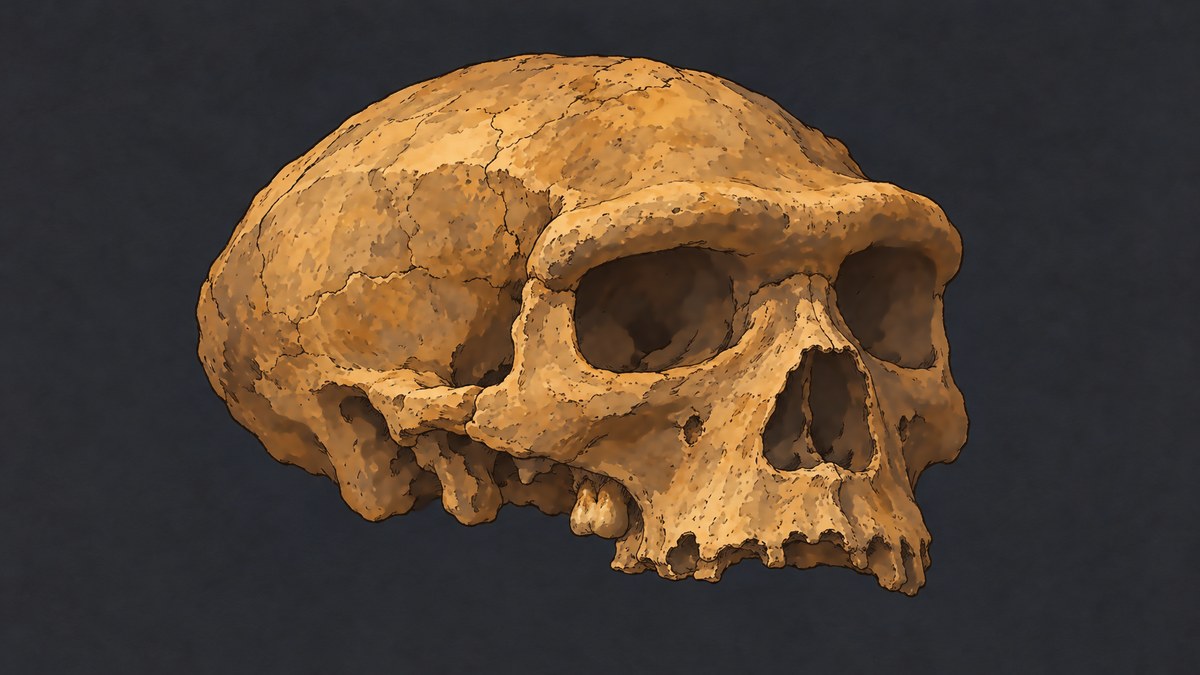
Even their name is debated: Denisovans have no agreed scientific species name, though you may hear Homo longi. And when did they die out? Nobody knows.
Their DNA lives on
Many people with roots outside Africa carry about two percent Neanderthal DNA; the exact figure varies with ancestry and method.[24] Many African populations carry some too, in varying amounts, partly because people moved back into Africa from Eurasia.[25] Denisovan ancestry is especially high among Papuans, Aboriginal Australians and the Ayta Magbukon of the Philippines.[26] Many Tibetans carry a version of a gene called EPAS1 that helps them cope with thin mountain air, inherited from Denisovans or their close relatives.[27]
A 2024 study traced most Neanderthal ancestry surviving today to a major period of mixing about 50,500 to 43,500 years ago.[28] One man from a Romanian cave, about 40,000 years old, had a Neanderthal ancestor just four to six generations back.[29] Some of it still matters: one inherited Neanderthal DNA region is associated with a higher risk of severe COVID-19, another with a lower risk. These are two factors among many.[30]
Being Homo sapiens was no guarantee either. A study published in 2025 found that some early members of our species in Europe, a small group known from caves in Germany and Czechia, left no detectable ancestry in the living people studied.[31]
The suspects
Can one suspect explain every disappearance? Start with us. For Neanderthals, competition for food may have mattered; its role remains debated.[34] And there is no evidence linking our arrival to the disappearance of erectus on Java.[1]
Climate? Neanderthals had survived many cold swings before, and how much climate contributed to their disappearance is debated too.[34] As an illustrative scenario, imagine the same hard winter hitting an isolated camp and another with neighbours it can reach.
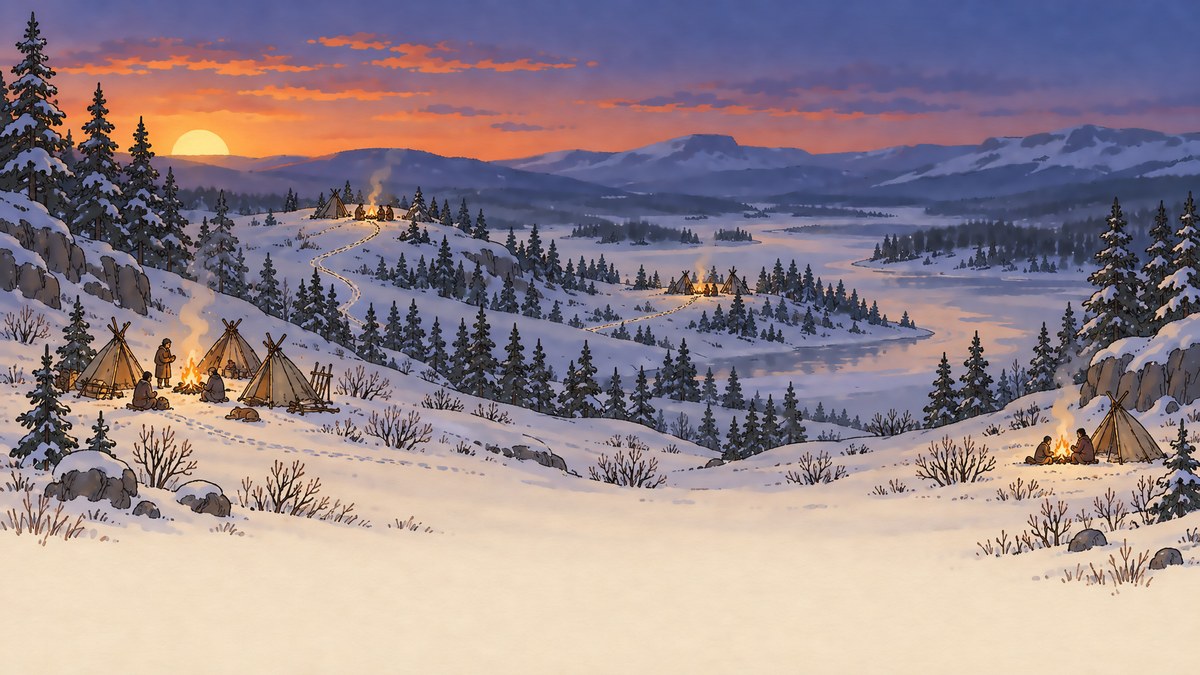
Then small numbers. Models show that small, scattered Neanderthal groups can die out through chance, inbreeding and too few partners.[32] These models show possibilities, not a recovered history. In a 2021 survey of 216 researchers, population size and demography were the leading explanation, while views on climate and competition were divided.[33] Disease models suggest another possibility, but no epidemic has been identified.[39] And interbreeding? Some Neanderthals became ancestors of living people; how much interbreeding explains their disappearance remains debated.[24][35] Archaeology does not establish that they disappeared because they were less intelligent.[35]
So, why only us?
There is no single established answer. For Neanderthals, small populations, a changing climate and competition may have combined, and larger, better-connected populations may have helped our ancestors. For erectus, the islanders and the Denisovans, the clues are thinner, and their endings are still unknown.
So check your guess. Around sixty thousand years ago there were at least three kinds of human for sure, and probably four, and there may be others we haven’t found yet. Today there is just one human species. But pieces of Neanderthals and Denisovans live on in billions of people. We’re the last human species standing, but not the only one in our family tree.
Sources
- Rizal, Y. et al. (2020). Last appearance of Homo erectus at Ngandong, Java… Nature 577.
- Brown, P. et al. (2004). A new small-bodied hominin from the Late Pleistocene of Flores… Nature 431.
- Sutikna, T. et al. (2016). Revised stratigraphy and chronology for Homo floresiensis… Nature 532.
- Kaifu, Y. et al. (2024). Early evolution of small body size in Homo floresiensis. Nat. Commun. 15.
- Gagan, M. K. et al. (2025). Onset of summer aridification and the decline of Homo floresiensis… Commun. Earth Environ. 6.
- Veatch, E. G. et al. (2026). Taphonomic analysis at Liang Bua… Science Advances 12.
- Détroit, F. et al. (2019). A new species of Homo from the Late Pleistocene of the Philippines. Nature 568.
- Grün, R. & Stringer, C. (2023). Direct dating of human fossils… Quat. Sci. Rev. 322.
- Berger, L. R. et al. (2015). Homo naledi, a new species of the genus Homo… eLife 4.
- Dirks, P. H. et al. (2017). The age of Homo naledi… eLife 6.
- Martinón-Torres, M. et al. (2024). No scientific evidence that Homo naledi buried their dead… J. Hum. Evol. 195.
- Niekus, M. J. L. Th. et al. (2019). …a Neandertal tar-backed tool from the Dutch North Sea. PNAS 116.
- Jaubert, J. et al. (2016). Early Neanderthal constructions deep in Bruniquel Cave… Nature 534.
- Schoenemann, P. T. et al. (2026). Neanderthal brain and cognition reconsidered. PNAS 123.
- Trinkaus, E. & Villotte, S. (2017). …hearing loss in the Shanidar 1 Neandertal. PLoS ONE 12.
- Higham, T. et al. (2014). The timing and spatiotemporal patterning of Neanderthal disappearance. Nature 512.
- Slimak, L. et al. (2024). Long genetic and social isolation in Neanderthals… Cell Genomics 4.
- Krause, J. et al. (2010). The complete mitochondrial DNA genome of an unknown hominin… Nature 464.
- Slon, V. et al. (2018). The genome of the offspring of a Neanderthal mother and a Denisovan father. Nature 561.
- Chen, F. et al. (2019). A late Middle Pleistocene Denisovan mandible from the Tibetan Plateau. Nature 569.
- Tsutaya, T. et al. (2025). A male Denisovan mandible from Pleistocene Taiwan. Science 388.
- Fu, Q. et al. (2025). The proteome of the late Middle Pleistocene Harbin individual. Science 389.
- Fu, Q. et al. (2025). Denisovan mitochondrial DNA from dental calculus of the… Harbin cranium. Cell 188.
- Prüfer, K. et al. (2017). A high-coverage Neandertal genome from Vindija Cave… Science 358.
- Chen, L. et al. (2020). Identifying and interpreting apparent Neanderthal ancestry in African individuals. Cell 180.
- Larena, M. et al. (2021). Philippine Ayta possess the highest level of Denisovan ancestry… Curr. Biol. 31.
- Huerta-Sánchez, E. et al. (2014). Altitude adaptation in Tibetans… Nature 512.
- Iasi, L. N. M. et al. (2024). Neanderthal ancestry through time… Science 386.
- Fu, Q. et al. (2015). An early modern human from Romania with a recent Neanderthal ancestor. Nature 524.
- Zeberg, H. & Pääbo, S. (2020; 2021). Neanderthal DNA regions and severe COVID-19 [descriptive label; two studies]. Nature 587; PNAS 118.
- Sümer, A. P. et al. (2025). Earliest modern human genomes constrain timing of Neanderthal admixture. Nature 638.
- Vaesen, K. et al. (2019). Inbreeding, Allee effects and stochasticity… PLoS ONE 14.
- Vaesen, K. et al. (2021). An emerging consensus in palaeoanthropology… Sci. Rep. 11.
- Timmermann, A. (2020). Quantifying the potential causes of Neanderthal extinction… Quat. Sci. Rev. 238.
- Villa, P. & Roebroeks, W. (2014). Neandertal demise… PLoS ONE 9.
- Herries, A. I. R. et al. (2020). Contemporaneity of Australopithecus, Paranthropus, and early Homo erectus… Science 368.
- Lordkipanidze, D. et al. (2013). A complete skull from Dmanisi, Georgia… Science 342.
- Zhang, D. et al. (2020). Denisovan DNA in Late Pleistocene sediments from Baishiya Karst Cave… Science 370.
- Greenbaum, G. et al. (2019). Disease transmission and introgression… Nat. Commun. 10.