
How Did Ancient Humans Survive Winter? Fire, Fat, Fur and Friends in the Ice Age
Imagine you have to get through a winter in central Europe, thirty thousand years ago. It’s minus twenty, the wind is howling across open grassland, and you get about eight hours of daylight. You can take three things. What do you pick?
Most people reach for fire, warm clothes and food. Those are good choices. But the finds from ancient camps add a few surprises: fuel that came out of a skeleton, a tool small enough to lose in the snow, and one survival resource you couldn’t carry at all. Along the way, it helps to keep two piles apart: what has actually been found, and what is still a best guess.
Prefer to watch? The animated version plays the same packing game.
A world of wind
Much of Ice Age Europe was open grassland, with few trees to hide behind.[31] Mammoths, reindeer and woolly rhinos crossed it, and so did people. The wind was the first enemy. At minus twenty degrees Celsius, a thirty-kilometre-an-hour wind makes bare skin feel like about minus thirty-three degrees Celsius.[28]
Two kinds of people faced winters like these. Neanderthals lived through many cold spells over hundreds of thousands of years, until about forty thousand years ago.[7][24] Our own species, already living alongside them, carried on into the coldest stretch of the last glacial period, which came after the Neanderthals were gone.[21]
Some people went much further north. At the Yana site in Arctic Siberia, about thirty-two thousand years ago, people lived at a latitude where winter brings roughly two months without sunrise.[10][30]
Fire on demand
At many Neanderthal sites, archaeologists find the remains of fires.[7] The harder question is whether people could make fire whenever they wanted, or had to borrow it from lightning and wildfires. At Barnham in England, a study published in 2025 reported evidence suggesting that people were making fire about four hundred thousand years ago: a repeatedly burned patch of clay, heat-shattered flint and fragments of pyrite, a mineral that throws sparks when struck with flint.[1] No human bones were found there, so the makers are inferred. They were probably early Neanderthals.
Much later, tiny scratches on some Neanderthal hand axes from France look like the wear you get from striking sparks.[2] Yet the record is not simple. At two French caves, fires become rarer in the colder layers, and experts still argue about why.[3]
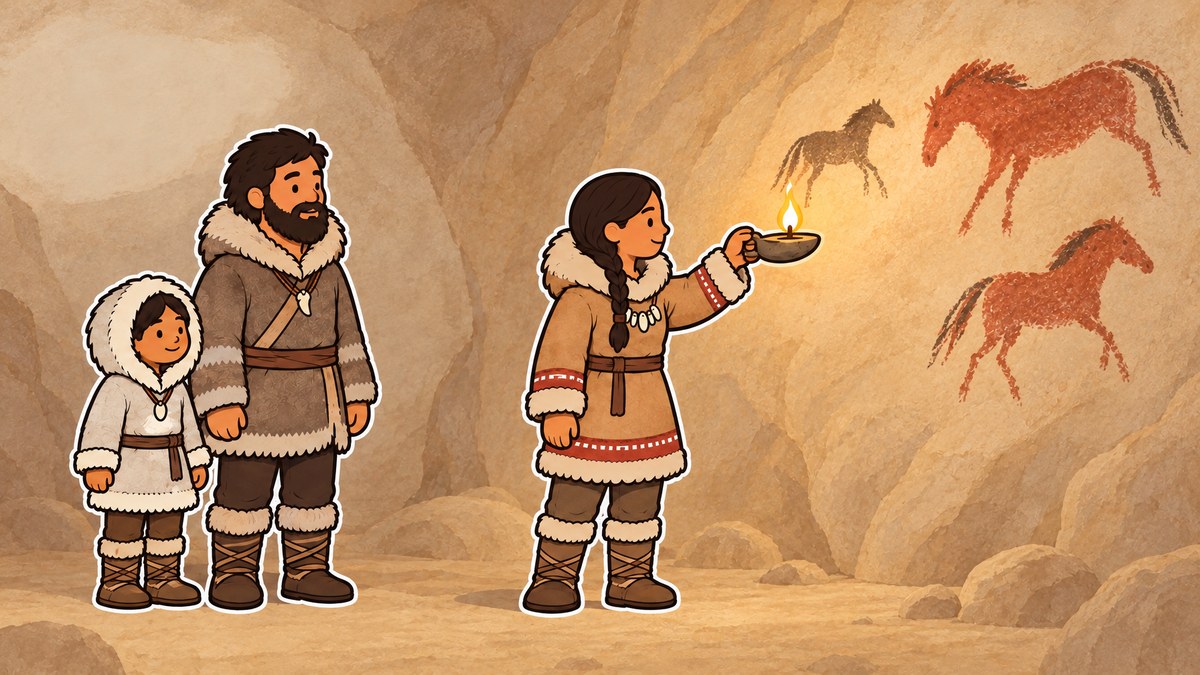
Then there is fuel. On a steppe with few trees, where do you find firewood? Experiments show that fresh bone, full of fat, burns well once a wood fire gets it going, giving a long, steady flame.[4] On the Russian plain, burnt bone and conifer charcoal suggest people stretched scarce wood by burning bone.[5] Later, people also carried little stone lamps filled with animal fat. At Lascaux in France alone, archaeologists found more than a hundred.[6]
The tiny tool
Neanderthals probably lacked a thick coat of body fur, much like us, so in a hard winter coverings would have been vital.[7] But not a single scrap of Neanderthal clothing survives. The clues are indirect: their most common tool is the scraper, a stone edge good for cleaning hides, and they even made smoothing tools from ribs.[7] No eyed needle has ever been found at a Neanderthal site in Europe, so the best guess is cloaks and wraps rather than stitched clothing.[7][8] That is still debated.
The sewing toolkit came in steps. First came sharp bone awls for punching holes. Then came the needle with an eye. The oldest known eyed needles turn up in Siberia, about forty thousand years ago; who made them is still uncertain.[9] At the Yana camp, archaeologists found nearly two hundred needles and needle fragments.[9][10]
Why does a tiny hole matter so much? One influential idea is that awls and needles mark “complex” clothing: fitted, layered garments closed against the wind at the neck, wrists and ankles.[9] Clothes keep you warm by trapping little pockets of air, and getting them soaked can greatly increase heat loss,[32] so drying wet clothing would have helped people prepare for the next day. Birds use the same trick when they fluff up their feathers to trap insulating air.[36]
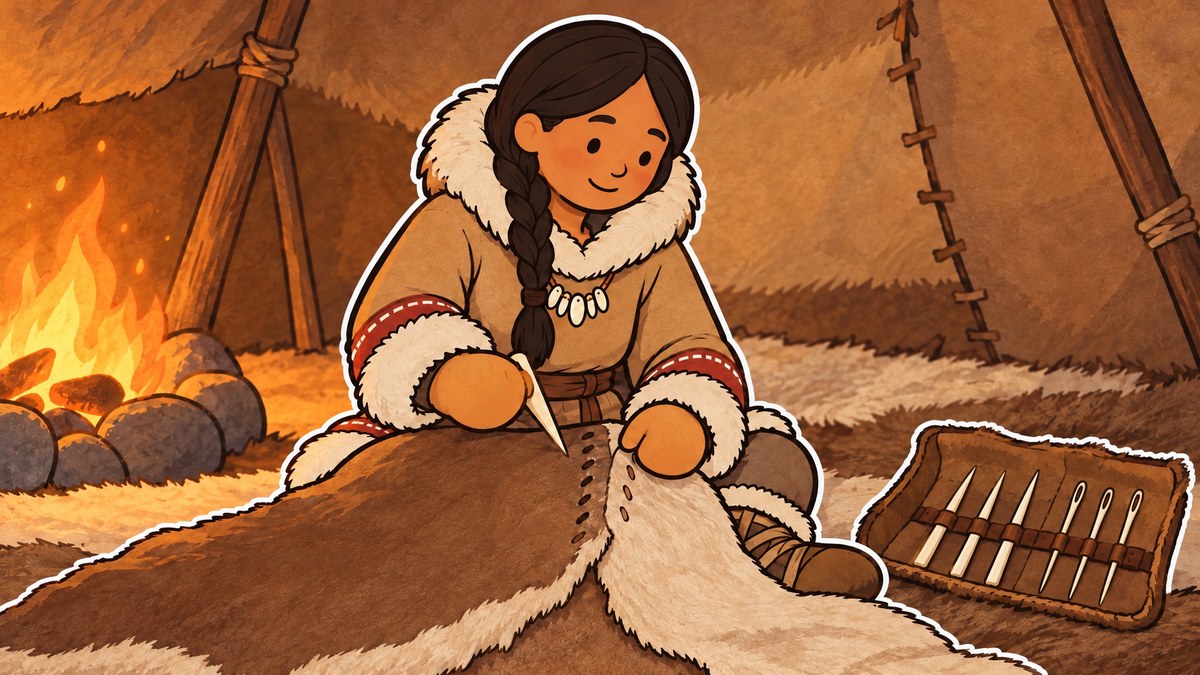
We can even glimpse Ice Age outfits. About thirty-four thousand years ago at Sungir in Russia, a man was buried wearing about three thousand mammoth-ivory beads.[11] They lay in neat rows, as if sewn onto a cap, a shirt and trousers. The clothes rotted away, but their outline survived. Reconstructions of the outfit are interpretations.
Fat, not meat
Food is next, and meat is not just meat. Your body can only handle so much protein,[34] and Arctic explorers reported that people can starve on a full stomach of lean meat.[35] Fat was the real prize: marrow, brains and fatty organs.
The bones tell that story. At Salzgitter-Lebenstedt in Germany, the evidence points to autumn reindeer hunts and selective processing of fat-rich adult bones.[13] At Neumark-Nord, in a warm period about a hundred and twenty-five thousand years ago, Neanderthals smashed huge piles of animal bones, probably heating the pieces to get the fat out: a prehistoric fat factory.[14] Later, people boiled smashed bones and skimmed off the grease, a rich food that could be stored for leaner days.[15]
What about vitamin C with no fruit? Modern analyses find about as much vitamin C in raw caribou liver, gram for gram, as in Arctic blueberries.[16] The hardest time probably wasn’t midwinter but late winter, when animals were skinny and stored food was running out.[12] Pits dug into frozen ground may have worked as freezers, but that is an educated guess.[18]
Not deep caves
Forget the picture of people huddled deep inside dark caves. People camped at sunny cave entrances, under rock overhangs and in open camps.[29] Most homes were probably tents of hide over wooden or bone frames, sometimes with the floor dug into the ground.[33]
Mammoth bones did get used. At Molodova in Ukraine, a Neanderthal site, a ring holds more than a hundred mammoth bones; it may have been the base of a shelter or a windbreak, and nobody is sure.[17] On the Russian plain, at Kostenki 11, another ring is about twelve metres wide, with bones from more than sixty mammoths.[5] Was it a house, a food store or a meeting place? We don’t know. Some of the bones were probably collected from mammoths that had already died, so it needn’t have been one enormous hunt.[5][18]
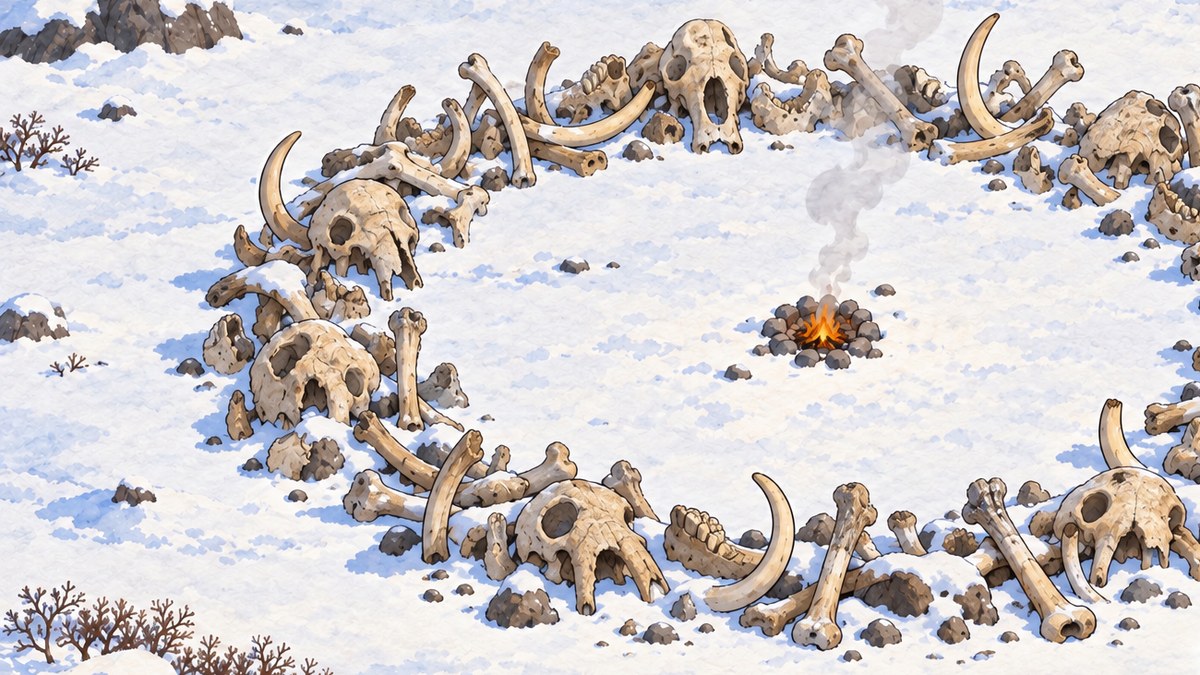
There is no evidence that people lived inside mammoth carcasses. At Mezhyrich in Ukraine, about eighteen thousand years ago, mammoth bones probably formed the bases of shelters.[18]
The answer you can’t pack
Other people were probably a vital survival resource. Shell ornaments turn up hundreds of kilometres from where the shells came from, and good stone travelled far too.[19] Those long-distance ties probably worked like insurance: if your valley’s herds failed in a bad winter, a gift you gave last year could mean a place at someone else’s fire.[20]
Those ties may have been especially valuable in the coldest stretch, around twenty-six to nineteen thousand years ago.[21] Many groups shifted toward more habitable parts of southern Europe. One model suggests Europe’s population fell by more than half.[22] Ancient DNA shows some groups riding out the worst of it in the southwest, while elsewhere some older ancestries disappear from the record.[23] When the ice pulled back, people followed it north again.
The long night
On the longest night of the year in central Europe, the sun stays below the horizon for about sixteen hours. What did people do? There is no convincing evidence that these people hibernated. One team proposed it for much earlier humans in Spain, but the idea remains unproven.[25]
More likely, long evenings were for work and company. Beads and sewing tools survive in large numbers, clues to clothes that rotted away, and making them took many hours. In some living hunter-gatherer communities, people tell stories around the night fire,[26] and Ice Age families may have done the same. People also made flutes from bird bones, so we have the instruments, though not the tunes.[27]
Your kit, checked
Fire, clothes, food and shelter all mattered. But the finds keep pointing past the bag to the people around it: someone who could mend a sleeve, tend a fire, share food when yours ran out, or make a long night feel less empty. You could pack the tools. You couldn’t pack the skill, help and company of a camp. So next time you pull on a coat, think of that tiny hole in a needle. The clothes have changed. The problem hasn’t.
Sources
- Davis, R. J. et al. (2025). Earliest evidence of making fire. Nature.
- Sorensen, A. C., Claud, E. & Soressi, M. (2018). Neandertal fire-making technology inferred from microwear analysis. Sci. Rep. 8.
- Sandgathe, D. M. et al. (2011). On the role of fire in Neandertal adaptations in Western Europe… PaleoAnthropology 2011.
- Théry-Parisot, I. (2002). Fuel management (bone and wood) during the Lower Aurignacian… J. Archaeol. Sci. 29.
- Pryor, A. J. E. et al. (2020). The chronology and function of a new circular mammoth-bone structure… Antiquity 94.
- French Ministry of Culture. Lascaux: lighting (official Lascaux website).
- Holliday, T. W. et al. (2025). Neandertal cold adaptation… Am. J. Hum. Biol. 37.
- Collard, M. et al. (2016). Faunal evidence for a difference in clothing use… J. Anthropol. Archaeol. 44.
- Gilligan, I. et al. (2024). Paleolithic eyed needles and the evolution of dress. Science Advances 10.
- Pitulko, V. V. et al. (2004). The Yana RHS site: humans in the Arctic before the Last Glacial Maximum. Science 303.
- Trinkaus, E. & Buzhilova, A. P. (2018). Diversity and differential disposal of the dead at Sunghir. Antiquity 92.
- Speth, J. D. & Spielmann, K. A. (1983). Energy source, protein metabolism, and hunter-gatherer subsistence… J. Anthropol. Archaeol. 2.
- Gaudzinski, S. & Roebroeks, W. (2000). Adults only: reindeer hunting at… Salzgitter Lebenstedt… J. Hum. Evol. 38.
- Kindler, L. et al. (2025). Large-scale processing of within-bone nutrients by Neanderthals… Science Advances 11.
- Manne, T. et al. (2012). Intensive subsistence practices at Vale Boi… Quat. Int. 264.
- Fediuk, K. et al. (2002). Vitamin C in Inuit traditional food and women’s diets. J. Food Compos. Anal. 15.
- Demay, L., Péan, S. & Patou-Mathis, M. (2012). Mammoths used as food and building resources… Quat. Int. 276-277.
- Chu, W., Shydlovskyi, P. & Maier, A. (2025). A revised radiocarbon chronology… Mezhyrich… Open Res. Eur. 5.
- Anikovich, M. V. et al. (2007). Early Upper Paleolithic in Eastern Europe… Science 315.
- Gamble, C. (1999). The Palaeolithic Societies of Europe. Cambridge University Press.
- Clark, P. U. et al. (2009). The Last Glacial Maximum. Science 325.
- Tallavaara, M. et al. (2015). Human population dynamics in Europe over the Last Glacial Maximum. PNAS 112.
- Posth, C. et al. (2023). Palaeogenomics of Upper Palaeolithic to Neolithic European hunter-gatherers. Nature 615.
- Higham, T. et al. (2014). The timing and spatiotemporal patterning of Neanderthal disappearance. Nature 512.
- Bartsiokas, A. & Arsuaga, J. L. (2020). Hibernation in hominins from Atapuerca… L’Anthropologie 124.
- Wiessner, P. W. (2014). Embers of society: firelight talk among the Ju/’hoansi Bushmen. PNAS 111.
- Conard, N. J., Malina, M. & Münzel, S. C. (2009). New flutes document the earliest musical tradition… Nature 460.
- Osczevski, R. & Bluestein, M. (2005). The new wind chill equivalent temperature chart. Bull. Amer. Meteor. Soc. 86.
- Wragg Sykes, R. (2020). Kindred: Neanderthal Life, Love, Death and Art. Bloomsbury Sigma.
- Pitulko, V. V. & Pavlova, E. Y. (2022). Structural properties of syngenetic ice-rich permafrost… Front. Earth Sci. 9.
- Zimov, S. A. et al. (2012). Mammoth steppe: a high-productivity phenomenon. Quat. Sci. Rev. 57.
- Cuyler, C. & Øritsland, N. A. (2004). Rain more important than windchill for insulation loss… Rangifer 24.
- Hoffecker, J. F. (2004). A Prehistory of the North. Rutgers Univ. Press.
- Bilsborough, S. & Mann, N. (2006). Issues of dietary protein intake in humans… Int. J. Sport Nutr. Exerc. Metab. 16.
- McClellan, W. S. & Du Bois, E. F. (1930). Clinical calorimetry XLV: prolonged meat diets… J. Biol. Chem. 87.
- Purdue Extension. Wildlife Science 2 (4-H-1046-W): how do birds survive the winter?