
Tunguska Explosion: When the Sky Fell to Earth
A little after seven in the morning on 30 June 1908, something exploded in the sky over the forests of central Siberia, near the Podkamennaya Tunguska river. It flattened more than two thousand square kilometres of forest, an area bigger than all of Greater London.[10][7] Yet when scientists finally reached the spot, they found no crater at all.
Prefer to watch? The animated version follows the same clues, from a trading post in the taiga to the long search for a giant meteorite.
A morning in the taiga
The area was extremely remote: thick taiga, bogs and very few roads. The nearest settlement, the trading post of Vanavara, lay about sixty kilometres to the south, and Evenki reindeer herders lived and hunted in the region.[9][10]
At Vanavara, a man named Semyon Semyonov later described the northern sky splitting open and filling with fire. He described heat so strong that he felt his shirt was burning, and then a blast that threw him from his porch. His account was recorded in 1930.[9][10] Evenki herders told of tents blown down, people thrown to the ground and knocked unconscious, and many reindeer killed. A 2019 review of these accounts identified at least three deaths; the full toll is still uncertain.[3]
Hundreds of eyewitness accounts were collected over the following decades. They describe a bright fireball crossing the sky, then booms like gunfire or thunder heard hundreds of kilometres away.[10] The heat flash set fires and scorched trees, and windows broke at Vanavara and beyond.[10]
Felt around the world
The shock was recorded by seismographs as far away as Irkutsk, Tashkent and Jena in Germany, and barographs in Britain, Germany and the United States picked up the pressure wave in the air.[10] For several nights afterwards, the skies over Europe and western Asia glowed unusually bright; reports said you could read outdoors near midnight. At the time, nobody linked the bright nights to Siberia.[9][10]
Kulik goes looking
Because the place was so remote, and Russia then went through the First World War, revolution and civil war, no scientific expedition reached the site for almost twenty years.[9][10] The Soviet meteorite researcher Leonid Kulik gathered accounts in 1921 but couldn’t reach the centre. In 1927 he finally got there, with local Evenki guides.[7][9]
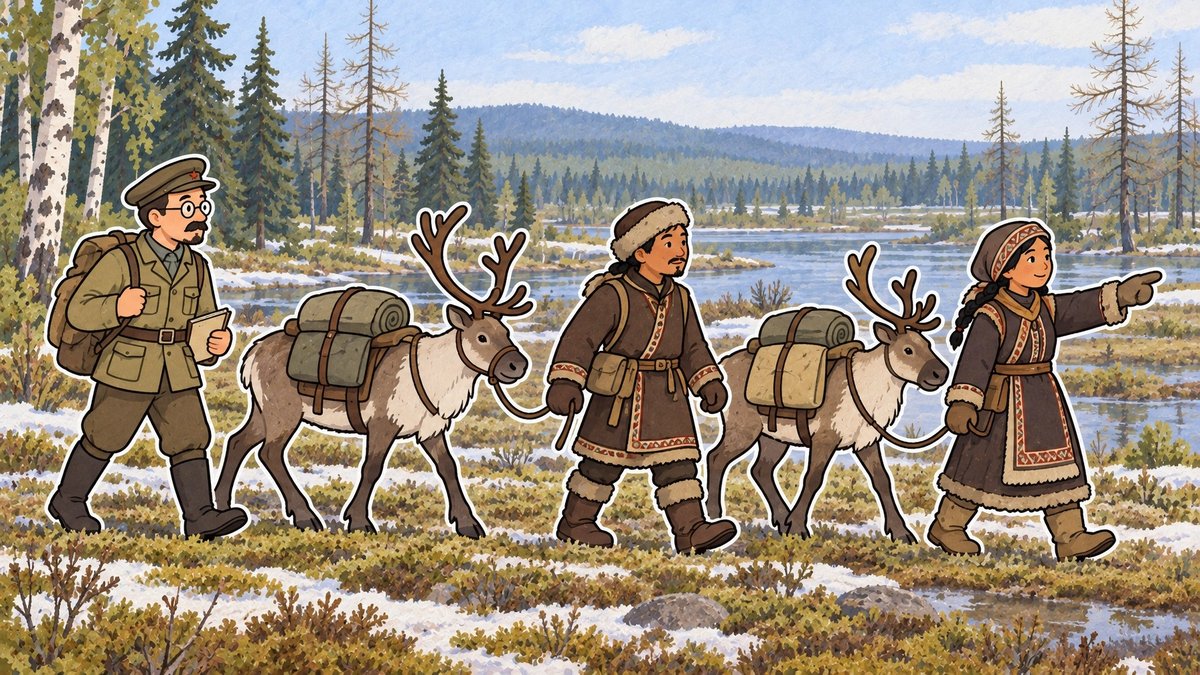
Kulik expected a large crater and a mass of meteoric iron, which he hoped would be valuable. Instead he found millions of fallen trees, lying in a rough butterfly shape about seventy kilometres across, pointing away from the centre.[7][10] You may have heard “80 million trees”, but one researcher argues the true count may be several times smaller: the figure traces back to an early estimate made before an aerial survey showed a smaller fall area.[5]

At the very centre, strangely, trees were still standing, stripped of their branches like telegraph poles.[9][10] Kulik returned on several more expeditions over the next decade, draining and digging into bog hollows he thought might be craters. One of them, nicknamed Suslov’s crater, turned out to hold an old tree stump at the bottom. No large fragment of the object has ever been conclusively identified.[10]
How a rock explodes in the air
The standing trees are the key clue. Objects from space hit the atmosphere at many kilometres per second. The air in front of them is squeezed so hard that the pressure can exceed the strength of rock, so the object breaks apart. The pieces spread out and slow down, turning much of their energy into heat and a powerful blast, high in the air.[1][2][8]
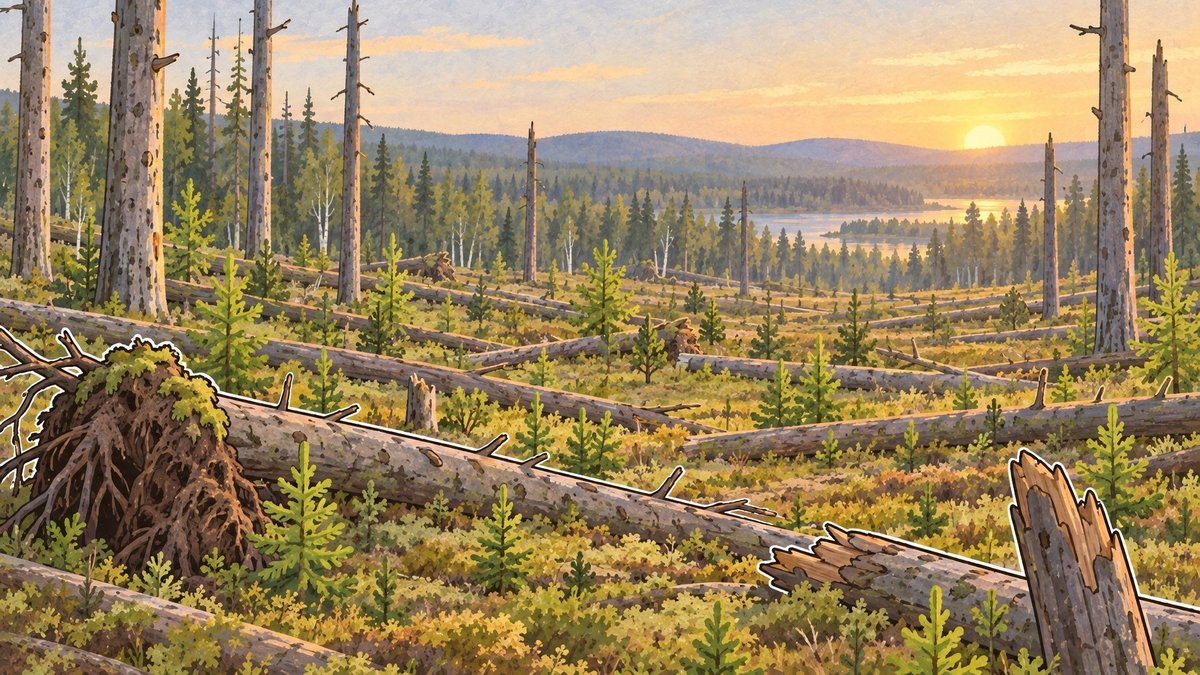
Directly underneath, the blast came down almost vertically, stripping the branches while many trunks stayed upright. Farther out, it hit the trees from the side and knocked them over, pointing away from the centre.[9][10] That pattern points to an explosion in the air, not an impact on the ground. Models put the burst roughly five to ten kilometres up, and estimates of its energy run from about three million to more than ten million tonnes of TNT, depending on the model.[8][10] Because the object blew apart in the air, there was no crater, and models suggest most of it turned to dust and vapour.[1][10]
Asteroid or comet?
Scientists agree it was the airburst of a natural object from space. What that object was made of is still argued over. Most researchers favour a stony asteroid, probably somewhere between thirty and eighty metres across; a minority argue for a comet, a lump of ice and dust.[1][4][10] Supporters of the comet idea point out that no large fragment has been conclusively identified, and an icy body would leave little behind. Against that, models suggest a comet would break up much higher, and a 2001 study of possible orbits put the odds at about 83 per cent that the object came from the asteroid belt.[4]
Myths about Tunguska range from a tiny black hole to a crashing alien spaceship. None of them fits the evidence, and none is needed.[10]
It happened again
On 15 February 2013, a rock roughly twenty metres across exploded about thirty kilometres above Chelyabinsk in Russia. Its shock wave broke windows across the city, and about 1,500 people were hurt, mostly by flying glass. This time, dashboard cameras filmed it.[6][10]
Tunguska-sized airbursts are rare. Estimates range from about once every few centuries to once every few thousand years, somewhere on Earth.[7] Astronomers now survey the sky for near-Earth asteroids. Most near-Earth asteroids over a kilometre across have been found, but many Tunguska-sized ones are still undiscovered.[7] In September 2022, NASA’s DART spacecraft hit the small asteroid Dimorphos and shortened its orbit around its partner by about half an hour, the first test of nudging an asteroid.[7] And since 2016, 30 June, the anniversary of Tunguska, has been marked as International Asteroid Day.[10]
The fallen trees told the story: on that summer morning, something from space exploded several kilometres above the forest, and the sky really did seem to fall.
Sources
- Chyba, C. F., Thomas, P. J., & Zahnle, K. J. (1993). The 1908 Tunguska explosion: atmospheric disruption of a stony asteroid. Nature 361.
- Boslough, M. B. E., & Crawford, D. A. (2008). Low-altitude airbursts and the impact threat. International Journal of Impact Engineering 35.
- Jenniskens, P., et al. (2019). Tunguska eyewitness accounts, injuries, and casualties. Icarus 327.
- Farinella, P., et al. (2001). Probable asteroidal origin of the Tunguska Cosmic Body. Astronomy & Astrophysics 377.
- Boslough, M., & Bruno, B. (2025). Matters Arising on Bunch et al. (2021), including the Tunguska tree count. Scientific Reports 15, 13869.
- Popova, O. P., et al. (2013). Chelyabinsk airburst, damage assessment, meteorite recovery, and characterization. Science 342.
- NASA. 115 Years Ago: The Tunguska Asteroid Impact Event (2023); DART mission results.
- Sandia National Laboratories (2007). Supercomputers offer new explanation of Tunguska disaster.
- APS News (2018). June 30, 1908: The Tunguska Event.
- Wikipedia. Tunguska event; Chelyabinsk meteor.