
Why Does a Circle Have 360 Degrees?
Spin all the way round and you have turned 360 degrees. Half a turn is 180, which is why a U-turn is “doing a 180”, and a right angle is 90. Compass bearings run from 0 to 360, and maps still give positions in degrees, minutes and seconds. But why 360? Why not a tidy 100, or 1,000?
Prefer to watch? The animated version follows the same trail, from ancient account books to the night sky over Babylon.
You may have heard a quick answer: the Babylonians thought a year had 360 days, so they cut the circle into 360 parts, one for each day. It is a neat story, but it doesn’t hold up. The real trail is stranger: the surviving evidence includes account books that used 360 long before it measured a turn.
A year for the sums
In ancient Mesopotamia, roughly today’s Iraq, scribes calculated in base sixty. Nobody knows why they chose sixty, but in that system 360 is a very round number: six sixties.[5]
Some of the world’s oldest writing comes from the city of Uruk, from about 3300 to 3000 BC, and most of those early tablets are not poems or laws. They are administrative accounts of people, livestock and grain.[2] And in those accounts, bookkeepers used a simplified “bookkeeping year”: twelve months of thirty days each, 360 days in all. It made rations and animal feed easy to calculate. In one city, Girsu, even pigs were listed by age on this tidy schedule.[1]
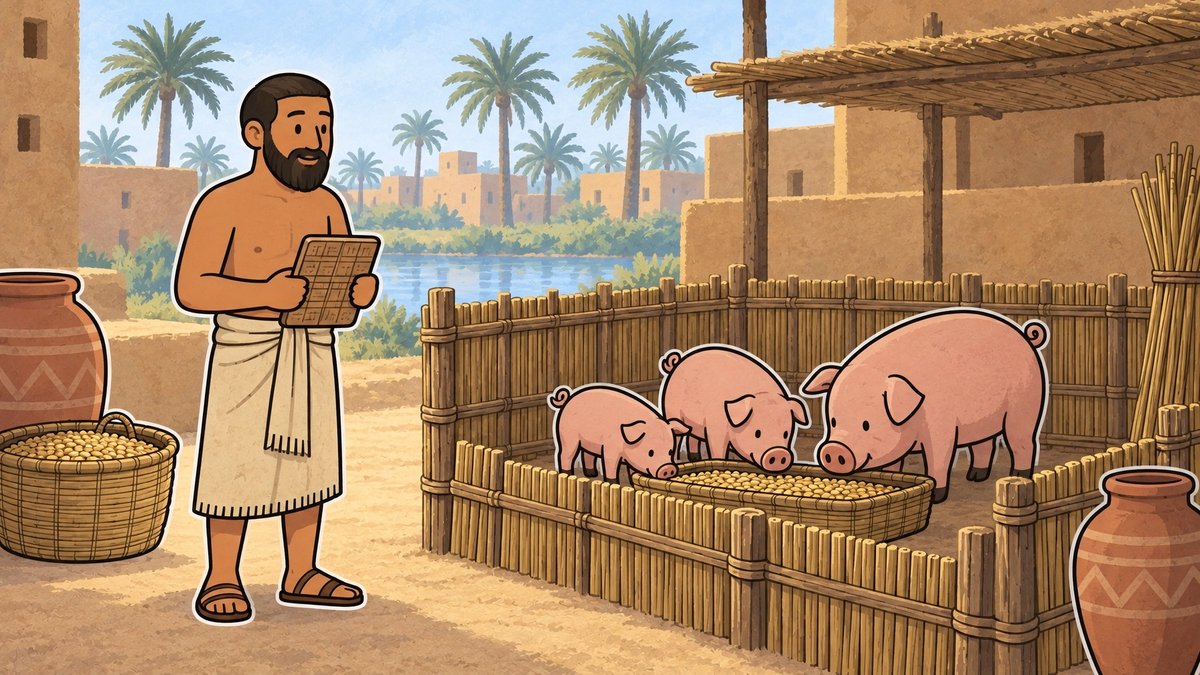
That doesn’t mean they thought the real year had 360 days. Records from at least about 2600 BC show the 360-day year kept beside the calendar people actually lived by: a calendar of moon-months, each running from one new crescent to the next, 29 or 30 days long, with an extra month added now and then to keep up with the seasons.[1] A year holds a little over twelve cycles of the moon’s phases, about 12.4, so twelve moon-months fall short of the seasons. The 360-day year was a convenience for the sums, not a mistake about the sky.
From the ledger to the stars
The tidy twelve-times-thirty year did not stay in the account books. A famous Babylonian star compendium known as MUL.APIN, whose oldest surviving copy dates from 686 BC, uses the ideal year of twelve 30-day months in its astronomical schemes.[1][5]
Later Babylonian astronomers split the full day into twelve “double hours”, each made of thirty units called UŠ. That gave 360 UŠ to a day, each about four of our minutes.[3][4] Then, around the end of the fifth century BC, they did the same to the sky. Along the sun’s yearly path they introduced a uniform zodiac: twelve equal signs of thirty UŠ each, 360 in all, while the old constellations stayed in use. The same word served for a slice of time and a slice of the sky.[3][4]
So where did 12 times 30 in the sky come from? No surviving text tells us. The ideal 360-day year runs straight from the accounts into the astronomy, which makes reusing that familiar division a reasonable guess, but it is only a guess.[1][5] It also helps to know what 360 means for the sun: against the background stars it appears to make one circuit in about 365 and a quarter days, so on average it drifts just under one degree a day. That slow yearly drift is different from the sky’s daily turning.
The Greeks borrow a number
Early Greek writers often expressed angles in other ways. Euclid’s Elements, written around 300 BC, compares angles with right angles. Eratosthenes, measuring the size of the Earth, described his key angle as “a fiftieth of a circle”.[7]
The oldest surviving Greek text that divides the zodiac circle into 360 parts is by Hypsicles of Alexandria, in the second century BC. Historians say his 360 was almost certainly borrowed from Babylonian astronomy.[6][4] The astronomer Hipparchus probably worked in 360 degrees too, and he is credited with the first tables of chords, an early form of trigonometry, though his tables are lost.[8]

Around 150 AD, Ptolemy wrote his great astronomy book, the Almagest, in 360 degrees. He split each degree into sixty parts, and those into sixty again. In Latin these became the “first small parts” and “second small parts”: our minutes and seconds.[8] Through Greek, Arabic, Persian and Latin astronomy, the Almagest and its degrees became a standard for well over a thousand years, and Indian astronomers worked in degrees too. Even our word comes along for the ride: “degree” comes, through Old French, from the Latin gradus, a step.
Other ways to cut a circle
360 was never the only option. Ancient Chinese astronomers divided the sky’s circuit into about 365 and a quarter units called du, so that the sun moved about one du a day.[9]
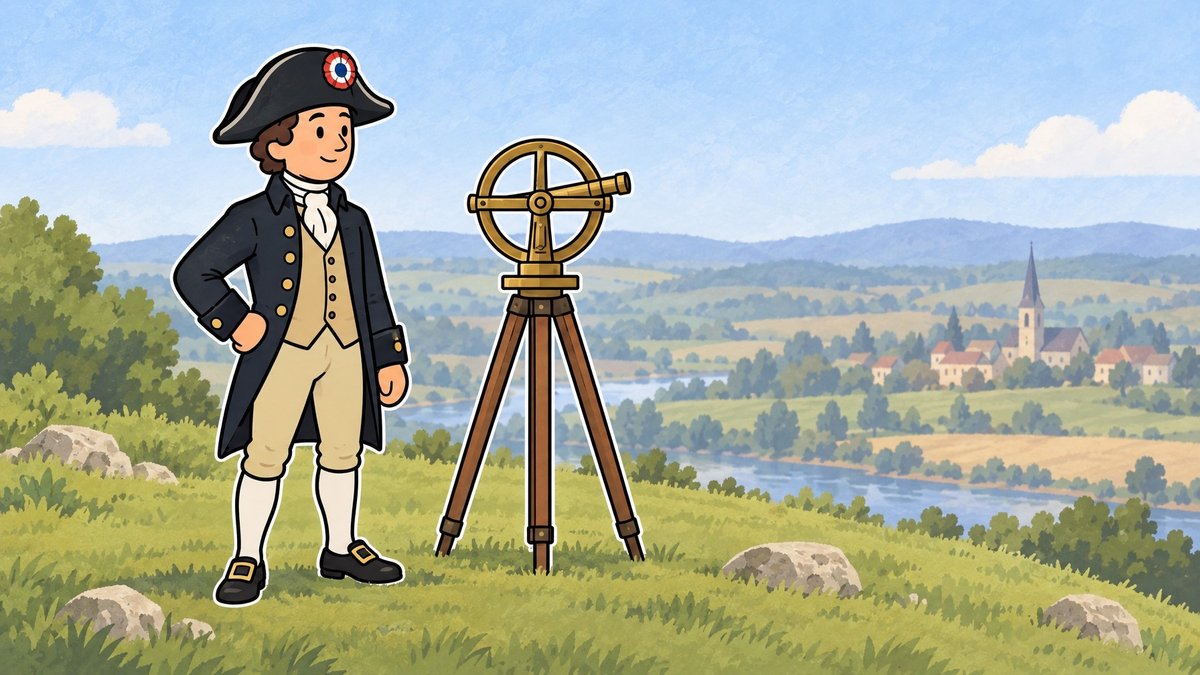
In the 1790s, Revolutionary France, busy inventing the metric system, split the quarter circle into 100 grades, making 400 to a full turn. That unit, later called the gon, is still used in surveying, mainly in Europe, and many scientific calculators still offer it.[10]
Mathematicians prefer yet another unit, the radian: the angle whose arc is as long as the circle’s radius. A full turn is two pi radians, about 6.28, and the formulas of calculus come out simplest that way.[10]
Why 360 stuck
360 has one obvious strength. It has 24 divisors and divides evenly by every whole number from 1 to 10 except 7. That means halves, thirds, quarters, fifths, sixths, eighths, ninths and tenths of a circle all come out as whole numbers of degrees. By comparison, 100 has just nine divisors.
That may have helped it survive, along with the plain cost of changing: sailors, astronomers and mapmakers had centuries of tables and charts in degrees. But neither reason explains how 360 was chosen in the first place, and rival units did win in some fields.[5]
What we really know
Put the evidence together and it tells a trail, not a single moment of invention. The 360 was useful long before it measured a turn: first in the ledgers, as twelve months of thirty days, then in the Babylonian day and the sun’s path, then in Greek astronomy, which almost certainly borrowed it, and finally in every circle we draw.[1][3][6]
The very first choice is still a mystery. No surviving ancient explanation tells us why the sky was cut into 12 times 30. But the next time you turn a full 360, remember that this number was useful for calculating rations long before it measured a turn.
Sources
- Brack-Bernsen, L. (2007). The 360-Day Year in Mesopotamia. In J. M. Steele (ed.), Calendars and Years: Astronomy and Time in the Ancient Near East.
- Englund, R. K. (2011). Accounting in proto-cuneiform.
- Steele, J. M. (2007). Celestial measurement in Babylonian astronomy. Annals of Science 64.
- Steele, J. M. (2019). Geminos and Babylonian astronomy.
- Ronan, M. (2020). Why a circle has 360 degrees. History Today.
- Bulmer-Thomas, I. Hypsicles of Alexandria. Dictionary of Scientific Biography.
- Heath, T. L. (1921). A History of Greek Mathematics, vol. 2.
- Toomer, G. J. Hipparchus and Ptolemy (Oxford Classical Dictionary; Dictionary of Scientific Biography).
- Wu Shouxian and Liu Ciyuan. Ancient Chinese astronomical observations related to the stellar background (IAU symposium).
- Wikipedia. Gradian; Radian; Repeating circle; Nautical mile.