
Why Roman Concrete Lasts So Long (and Why It Isn’t Simply Better)
Stand in the Pantheon in Rome and look up. Above you is a concrete dome about 1,900 years old. It has cracks. It has no steel inside. And it is still the largest unreinforced concrete dome on Earth.[7][12] Some modern marine concrete deteriorates within decades.[3]
It is tempting to conclude that the Romans had a better recipe that we lost. The real story is more interesting, because by the usual engineering measure Roman concrete was not stronger than ours. Roman mixes generally gained strength more slowly, and were weaker when squeezed, than typical modern structural concrete.[3][5] To understand why so much of it survives, you have to follow what happens after concrete cracks.
Prefer to watch? The animated version tells the same story, from the Pantheon’s dome to a building site frozen in time at Pompeii.
Rubble, lime and volcanic ash
The Romans called their material opus caementicium. Confusingly for modern readers, caementa did not mean cement. It meant rubble: rough, broken stones.[12]
The glue was lime. Burn limestone in a kiln and you get quicklime, white lumps that get fiercely hot when water touches them. Add water and sand, and the mix slowly hardens.[1]
What made Roman concrete special was the volcanic ash the builders added. The best-known came from around Pozzuoli on the Bay of Naples. Mixed with lime and water, it reacts to form a hard binder.[3][12] Engineers still name this kind of material after the town: a pozzolan. The architect Vitruvius wrote that piers made with this ash would set hard even under water.[9]
Roman concrete was not poured like a modern mix. Builders laid it in layers of rubble and mortar and packed it down by hand. From about 150 BC its use became widespread.[12]
The Pantheon: shape does the heavy lifting
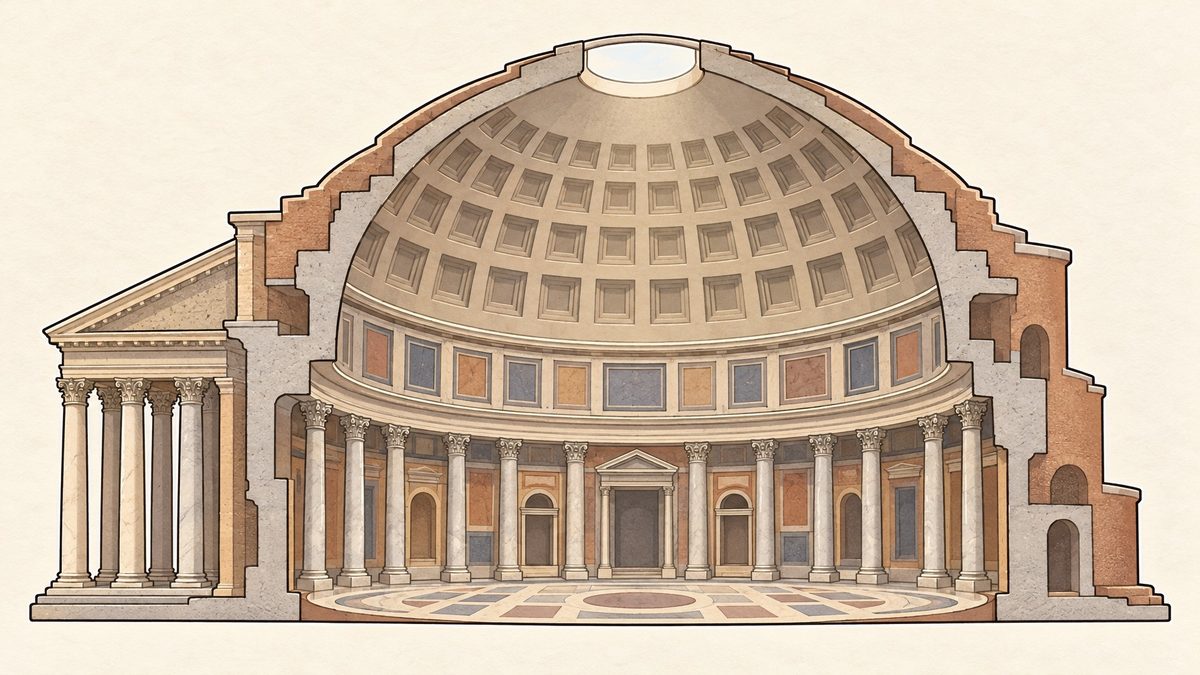
The Pantheon shows how far Roman builders pushed the material. Rebuilt under the emperor Hadrian, it was probably dedicated around AD 126.[12] Inside, the dome is about 43 metres across, and the height from the floor to the opening at the top is the same, so a giant ball would fit inside it perfectly.[12]
The builders were careful about weight. Near the bottom they used heavy stone in the mix; higher up they switched to lighter rock, including pumice. The dome also thins toward the top, where an opening about nine metres wide lets in sun and rain.[7][12]
The dome is not flawless. Its cracks probably opened early in its life.[8] But a dome carries its weight mainly by squeezing, which concrete handles well, while the massive walls around it resist the outward push.[7][8] It was also lucky. In 609 it became a church, so people have used it and looked after it ever since.[12]
The sea that made it stronger
The strangest Roman concrete is in the sea. Roman engineers built wooden enclosures in the water and filled them with mortar and rubble.[6] They shipped volcanic ash a long way to do it: King Herod’s harbour at Caesarea, in what is now Israel, used ash from the Bay of Naples, about 2,000 kilometres away.[6]
Writing in the first century AD, Pliny the Elder claimed that this harbour concrete became a single stone mass, impregnable to the waves and every day stronger.[9] That sounds like boasting. Salt water attacks many building materials, and for concrete with steel inside, the sea is bad news.
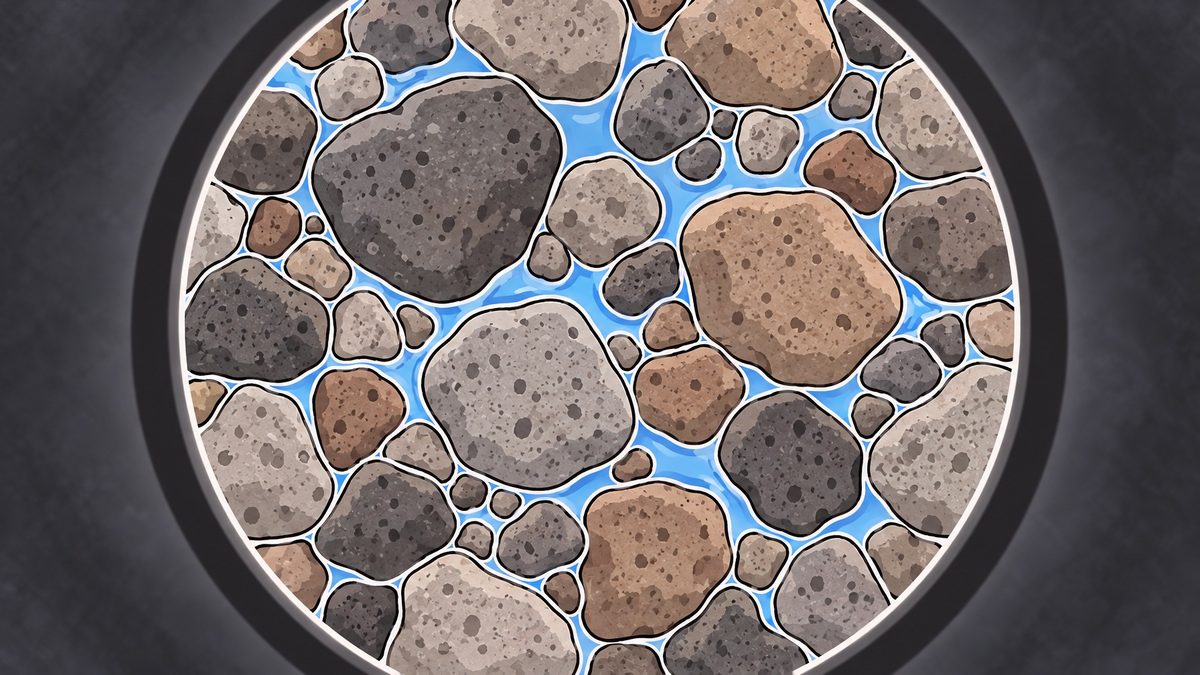
In 2017, geologist Marie Jackson and her colleagues looked inside cores drilled from Roman harbours. Sea water had seeped through the concrete and slowly dissolved parts of the volcanic ash. New minerals grew in the pores. One of them, aluminous tobermorite, forms interlocking plate-like crystals that may help the concrete resist cracking.[3][4] The first reaction between lime and ash was probably largely over within years, but these new minerals kept forming long after the concrete had hardened.[3] Some Roman harbour blocks still stand in the sea today.[6]
The white lumps that were not mistakes
On land there was another puzzle. Break open Roman concrete and you will often find small white lumps of lime, a few millimetres across. For a long time they were treated as a sign of sloppy work: lime that had not been mixed in properly.[1]
In 2023 a team led by Admir Masic at MIT studied samples from an ancient city wall in Italy and argued that the lumps came from “hot mixing”: adding quicklime directly to the mix, sometimes alongside lime already soaked in water.[1] To test the idea, they made a modern, Roman-inspired mix with and without quicklime, cracked the samples and ran water through the thin cracks. In the quicklime mix, new mineral filled the crack and within a few weeks the flow of water almost stopped. The other sample kept leaking.[1]
The proposed mechanism is simple. Water dissolves calcium from the lumps, and that calcium can form solid calcium carbonate inside the crack, a little repair kit built into the wall. Sealing a crack is not the same as making the concrete strong again, but stopping water matters a great deal for durability.[1]
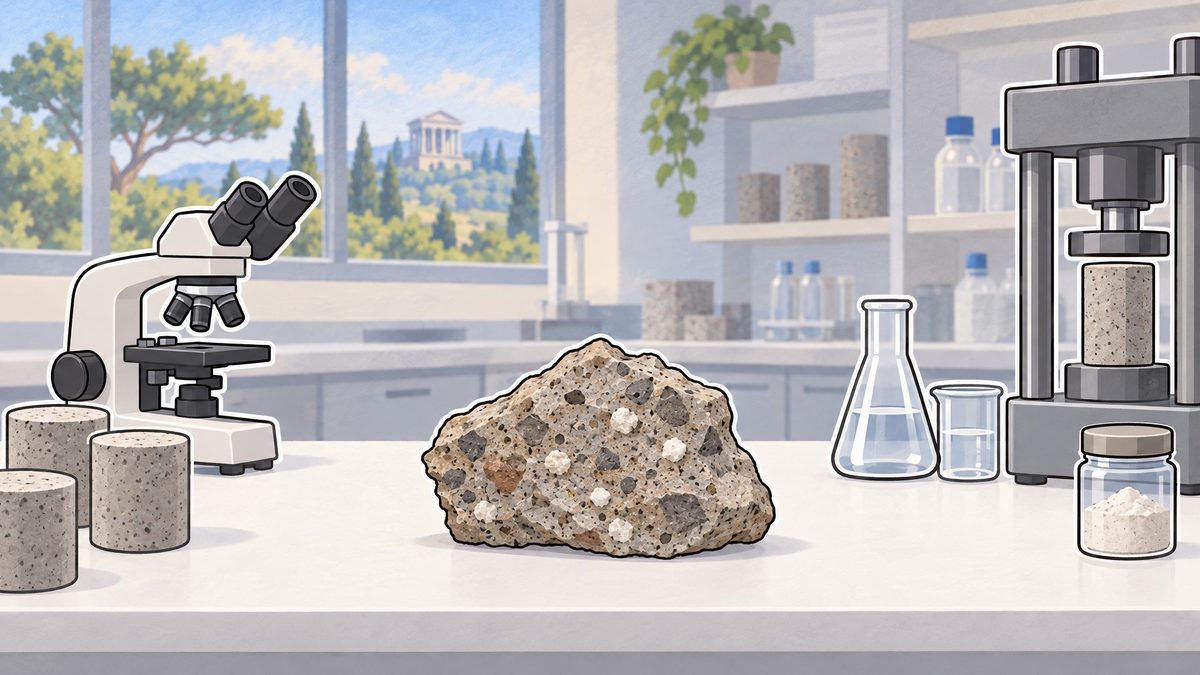
In 2025 the same team reported a building site at Pompeii that was still being worked on when Vesuvius erupted in AD 79. A dry heap of raw material held lumps that point to quicklime, and the researchers called it the clearest evidence yet for hot mixing.[2] Still, it is one site. A 2026 study of concrete from Hadrian’s Villa found cracks filled with calcite without direct proof of hot mixing.[5] Rome had more than one recipe.
Strength is not everything
Concrete of any kind is excellent at being squeezed but poor at being pulled or bent. Roman builders worked with that limit, carrying loads mostly by compression in thick walls, arches, vaults and domes. Without steel, they could not build a long, flat bridge deck or the floors of a skyscraper.[12]
Modern concrete took a different road. In 1824 a bricklayer from Leeds, Joseph Aspdin, patented Portland cement.[12] Modern Portland cement is fired at higher temperatures than Roman lime.[4] Concrete made with it generally gains strength faster.[3] Later in the nineteenth century, builders began putting iron and then steel into concrete. Steel is strong when pulled, so concrete takes the squeeze and steel takes the pull. That partnership gave us thin floors, long bridges and tall towers.
When the steel rusts
Steel has a weakness. When it rusts, the rust takes up several times more space than the steel it came from, and inside concrete that acts like a slowly growing fist.[10] Concrete normally protects its steel because it is very alkaline, but salt from the sea or from winter roads can break that protection, and carbon dioxide from the air slowly wears it down.[10] This is one of the main reasons reinforced concrete cracks and sheds chunks, especially near salt. Roman concrete had no steel to rust.
A design life is not an expiry date, either. Seventy-five years is a common design target for American highway bridges, but real lifespans depend on how a structure is built and looked after.[10] Well-designed modern concrete can last a long time: Hoover Dam, poured in the 1930s, is still holding back a lake.[12]
We should also be fair to modern engineers. The Roman concrete we admire is the concrete that survived. Many Roman buildings fell, were shaken by earthquakes or were taken apart for their stone. The Pompeii site itself was partly repairing damage from the earthquake of AD 62.[2] And the recipe was never simply lost: copies of Vitruvius’s book were made throughout the Middle Ages. Surviving books do not prove that practical building expertise continued without interruption.[9]
What engineers are borrowing
Engineers are already borrowing Roman ideas. Many modern mixes replace some cement with fly ash from coal-fired power stations, blast-furnace slag from ironmaking, or natural volcanic ash.[10] Researchers, including the MIT team, are developing concrete that can help seal its own small cracks, inspired by those white lumps.[1]
There is also the climate. Making cement produces roughly eight percent of the world’s carbon dioxide emissions, and copying Roman recipes with today’s factories does not automatically fix that.[11] Masic has cautioned against copying Roman concrete wholesale.[2]
So why does Roman concrete last?
Across Rome’s survivors we find clever shapes that carry loads mainly in compression, durable chemistry that keeps working long after the concrete hardens, and no reinforcing steel to rust. Continued use and care helped buildings like the Pantheon. Modern concrete gives us different possibilities, and different vulnerabilities. The best concrete of the future may borrow a little from both.
Sources
- Seymour, L. M., Maragh, J., Sabatini, P., Di Tommaso, M., Weaver, J. C. and Masic, A. (2023). Hot mixing: mechanistic insights into the durability of ancient Roman concrete. Science Advances 9.
- Vaserman, E., Weaver, J. C., et al. and Masic, A. (2025). An unfinished Pompeian construction site reveals ancient Roman building technology. Nature Communications. MIT News release, 9 December 2025.
- Jackson, M. D., et al. (2017). Phillipsite and Al-tobermorite mineral cements produced through low-temperature water-rock reactions in Roman marine concrete. American Mineralogist 102.
- Jackson, M. D., et al. (2013). Unlocking the secrets of Al-tobermorite in Roman seawater concrete. American Mineralogist 98.
- Zhu, X., et al. and Monteiro, P. J. M. (2026). Mineralized carbonates contribute to the millennial durability of Roman concrete. Science Advances 12.
- Oleson, J. P., Brandon, C., Hohlfelder, R. L. and Jackson, M. D. The Roman Maritime Concrete Study (ROMACONS).
- Mark, R. and Hutchinson, P. (1986). On the structure of the Roman Pantheon. The Art Bulletin 68.
- Masi, F., Stefanou, I., Maffi-Berthier, V. and Vannucci, P. (2018). On the origin of the cracks in the dome of the Pantheon in Rome. Engineering Failure Analysis.
- Vitruvius. De architectura, books II and V. Pliny the Elder. Natural History, book 35. British Library. Harley MS 2767, a ninth-century manuscript of Vitruvius.
- US Federal Highway Administration. Reports on corrosion of reinforcing steel in concrete bridges, and on supplementary cementitious materials. AASHTO. LRFD Bridge Design Specifications.
- Chatham House (2018). Making Concrete Change: Innovation in Low-carbon Cement and Concrete. 2025 life-cycle assessment of Roman-style concrete (PMC12432445).
- Wikipedia. Pantheon, Rome; Roman concrete; Joseph Aspdin; Hoover Dam.