
What Was a Normal Day Like in the Stone Age? The Work the “15-Hour Week” Left Out
Picture dawn in a camp of grass shelters, somewhere in Africa tens of thousands of years ago. You are a forager. There’s no office, no commute and no clock. So how much of your week will be work?
You may have heard a famous answer: about fifteen hours a week. That famous fifteen-hour week came from food-getting estimates in one Ju/’hoansi camp in 1964. Back at camp, the nuts still needed cracking. Follow the whole day and the picture changes, and the part worth envying turns out not to be the short hours.
Prefer to watch? The animated version follows the same evidence, from the food trip to the night fire.
How can we know anything about a Stone Age day?
Nobody recorded a Stone Age day. Archaeology gives us objects and bones, not an hour-by-hour time budget. For hours, sleep and conversation, researchers turn to studies of hunter-gatherers living in the twentieth and twenty-first centuries.
Those people are not copies of our ancestors. They are modern peoples with long histories of trade, contact, schools and markets, and land loss has shaped many of their lives.[10] Their days show how a foraging life can work; they can’t give us an ancient timetable. So every number below keeps its people, its place and its decade.
Where “fifteen hours” came from
From July to early August 1964, the anthropologist Richard Lee kept daily records in one Ju/’hoansi camp at Dobe, in Botswana’s Kalahari. He noted who went out to hunt or gather each day, and he weighed the food they brought home.[1]
Using the days adults spent getting food and an estimated six-hour working day, Lee reported roughly twelve to nineteen hours a week of food-getting in that sample. Popular retellings rounded it to fifteen.[1][4]
He kept daily records of camp membership and food-getting. The count left out much of the work back in camp, such as processing food and making and mending tools, and it was not a full count of childcare.[4]
Out for food
Among the Hadza of Tanzania, women often go out in groups with the children to dig up tubers, pick berries and gather baobab fruit. Men often go alone or in pairs, with bows, and collect honey.[10] In one 1980s study, older Hadza women averaged about seven hours a day on foraging trips, more than younger women.[5] In another study, Hadza men walked about eleven kilometres a day and women about six.[9]
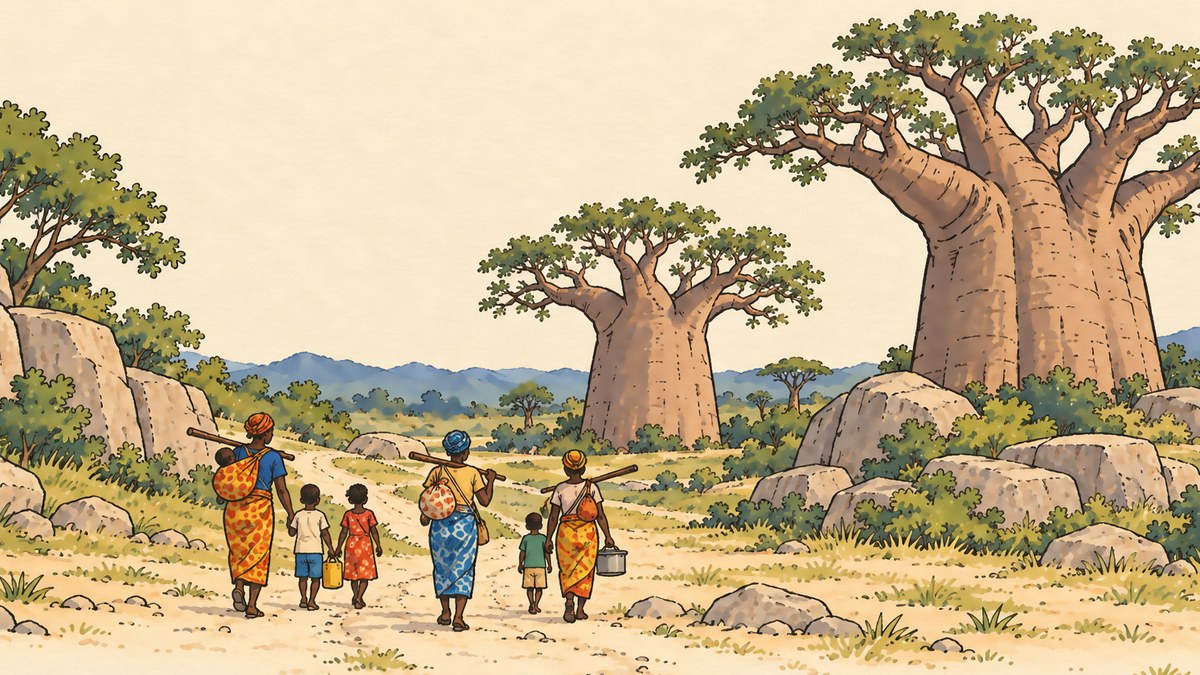
For honey, some Hadza have a partner: a small wild bird, the greater honeyguide, which leads people to bees’ nests while they answer it with whistles and calls.[10]
The Ju/’hoansi Lee studied mostly hunted with small bows and poisoned arrows. The poison works slowly, so the hunter tracks the wounded animal, sometimes for many hours.[2] Some peoples also chased animals on foot until they tired, but that was one method among many.[11] In many documented foraging societies men did most big-game hunting, yet women hunted too, including Agta women in the Philippines.[12][31]
Aché men in Paraguay, on forest treks in the 1980s, spent over six hours a day getting food.[8] A 2021 comparison that also counted preparing food, repairing tools, fetching water and firewood, and even eating, found food-related work of about 2.6 to 7 hours a day across foraging societies.[13] Different definitions give very different-looking workdays.
The work the short week left out
Back in a Ju/’hoansi camp, the food is home. Done? Not even close. Mongongo nuts, a staple there, were commonly roasted before being cracked, one by one. One estimate put the cracking alone at about fifty minutes for every kilogram of nuts collected.[7] Then come butchering, cooking, fetching water, gathering firewood, and fixing arrows, digging sticks and shelters. Children need care too. They learn by watching and joining in, and some skills take years to master.[15]
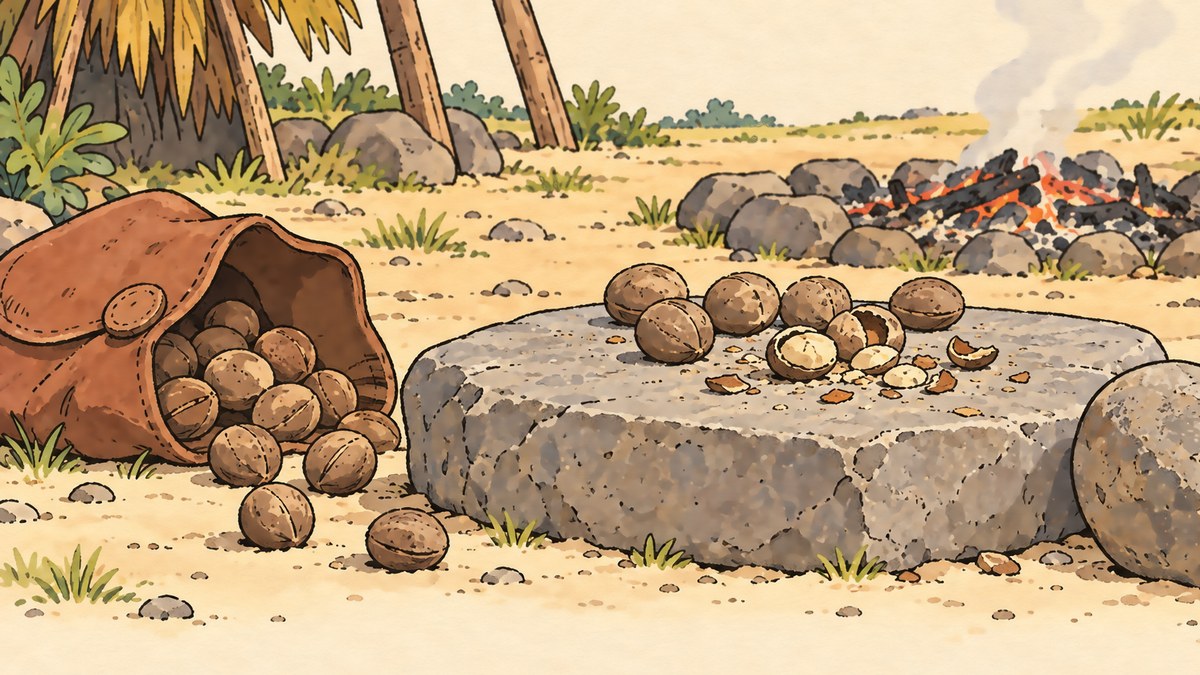
When Lee added tool making and housework to food-getting, his broader count came to about forty hours a week for women and about forty-four and a half for men.[2][4] A separate 1980s Hadza study recorded four kinds of daytime work: foraging trips, processing food, household upkeep, and making or repairing things. Adult groups averaged about forty-four to fifty hours a week across those activities.[6]
In the United States, forty hours is the overtime threshold for covered, nonexempt workers under federal law.[30] Paid-work hours leave out the cooking, cleaning and shopping at home. These studies count different things, so they can’t settle who works more. But they do show one thing clearly: the idea that these people barely worked doesn’t hold up.[4][13]
Work and company
What stands out is how work and company fit together. People talk while they work and make things while they rest; among the Agta, most leisure happened near another adult.[14]
Across thirty-two studied foraging societies, the average adult lived in a camp with about twenty-eight adults, plus children. Most adult campmates weren’t close genetic relatives, and camp membership was flexible.[16] Over a lifetime, a Hadza man is estimated to watch about four hundred different men make tools.[17]
Food is shared widely. If your hunt fails today, you may eat from someone else’s kill, so sharing works a bit like insurance, and refusing to share can be costly.[2][32] Among the Ju/’hoansi, a hunter who brings home a big animal may hear that the meat is too thin. The teasing may help keep successful hunters from acting like bosses.[3]
And there was free time. In a 2014 study of Agta camps in the Philippines, about a third of daylight was leisure. Husbands and wives had about the same amount, and adults over fifty had more. In the 2014 Agta sample, women in camps doing more farming and other non-foraging work had less daytime leisure: in the camps most involved in farming, about half as much as in camps that only foraged.[14]
Things left in the ground
For the deep past, objects have to speak. Shell beads with holes for stringing, from Bizmoune Cave in Morocco, are at least 142,000 years old.[18] At Blombos Cave in South Africa, wear on tiny shells about 75,000 years old suggests people strung and wore them.[19] In Germany, a flute made from a griffon vulture’s wing bone is more than 35,000 years old,[20] and a hand stencil on Muna Island, Indonesia, has a reported minimum age of about 67,800 years.[21] Objects can’t measure free time, but they show skilled hands, shared styles and music.
Stories by the fire, and a sleep surprise
Fire gave people a place to gather after dark. In 1974, the anthropologist Polly Wiessner took notes on long group conversations among the Ju/’hoansi. Stories dominated about six percent of the sampled daytime conversations, but about four in five of those around the night fire. About a third of the daytime conversations concerned complaints, criticism or disputes.[22]
You may also have heard that before electric light, people slept in two halves with a long waking spell in the middle of the night. A study published in 2015 used wrist monitors with Hadza, San and Tsimane participants; the Tsimane combine foraging with horticulture. On average they fell asleep about three hours after sunset, slept about six to seven hours, usually woke before sunrise, and generally didn’t have a regular long waking spell in the middle of the night.[23] The two-sleeps idea comes from old European records and a lab study with fourteen-hour nights;[33][34] neither tells us how Stone Age people slept.
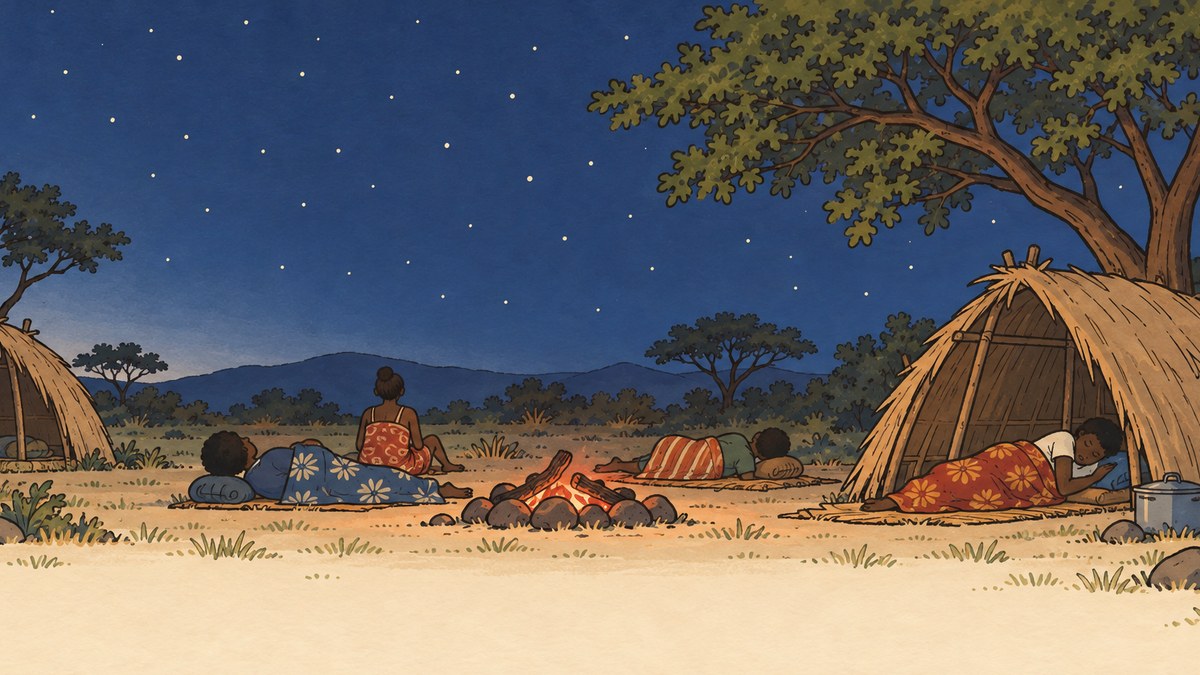
And in one Hadza camp, across twenty nights, wrist monitors scored all the monitored participants asleep at the same time for just eighteen minutes in total.[24]
Not paradise
None of this makes it a paradise. In recent hunter-gatherer groups, only a bit more than half of children lived to fifteen, which is a big reason average life expectancy looks so low. In a broader sample that included small-scale farmers, most deaths came from illness, and violence and accidents took a real share. Yet many adults lived into their sixties and seventies.[25]
About twelve thousand years ago, people in Southwest Asia slowly began to farm, over many generations, and farming began separately in other parts of the world.[26] In many regions, early farmers were somewhat shorter and had more tooth decay and signs of childhood stress and infection than the foragers before them, though there are exceptions.[27] One model suggests early cereal farming probably yielded no more calories per hour of work than foraging,[28] but farming could feed many more people from the same land.[29]
So what filled the day?
Finding food, carrying it home, preparing it, fetching water, fixing tools and caring for children. A count of food trips leaves much of that out. The famous fifteen hours described food-getting in one camp in 1964; it never measured a whole Stone Age week.
What the studies also show is work mixed with company: food shared, talk over chores and stories around a fire. Those are patterns in particular communities, not one timetable for everyone. If there’s a part of that day worth envying, it isn’t the short hours. It’s the company.
Sources
- Lee, R. B. (1968). “What hunters do for a living…” In Lee & DeVore (eds.), Man the Hunter.
- Lee, R. B. (1979). The !Kung San: Men, Women and Work in a Foraging Society. Cambridge University Press.
- Lee, R. B. (1969). “Eating Christmas in the Kalahari.” Natural History 78(10).
- Kaplan, D. (2000). “The darker side of the ‘original affluent society’.” J. Anthropological Research 56(3).
- Hawkes, K. et al. (1989). “Hardworking Hadza grandmothers.” In Comparative Socioecology.
- Hawkes, K. et al. (1997). “Hadza women’s time allocation…” Current Anthropology 38(4).
- Blurton Jones, N. G., Hawkes, K. & Draper, P. (1994). “Foraging returns of !Kung adults and children…” J. Anthropological Research 50(3).
- Hawkes, K. et al. (1987). “Ache at the settlement…” Human Ecology 15(2).
- Pontzer, H. et al. (2012). “Hunter-gatherer energetics and human obesity.” PLoS ONE 7(7).
- Marlowe, F. W. (2010). The Hadza: Hunter-Gatherers of Tanzania. University of California Press.
- Liebenberg, L. (2006). “Persistence hunting by modern hunter-gatherers.” Current Anthropology 47(6).
- Anderson, A. et al. (2023). “The myth of man the hunter…” PLOS ONE 18(6).
- Kraft, T. S. et al. (2021). “The energetics of uniquely human subsistence strategies.” Science 374.
- Dyble, M. et al. (2019). “Engagement in agricultural work is associated with reduced leisure time among Agta…” Nature Human Behaviour 3.
- Lew-Levy, S. et al. (2017). “How do hunter-gatherer children learn subsistence skills?…” Human Nature 28(4).
- Hill, K. R. et al. (2011). “Co-residence patterns in hunter-gatherer societies…” Science 331.
- Hill, K. R. et al. (2014). “Hunter-gatherer inter-band interaction rates…” PLoS ONE 9(7).
- Sehasseh, E. M. et al. (2021). “Early Middle Stone Age personal ornaments from Bizmoune Cave…” Science Advances 7(39).
- Henshilwood, C. et al. (2004). “Middle Stone Age shell beads from South Africa.” Science 304.
- Conard, N. J., Malina, M. & Münzel, S. C. (2009). “New flutes document the earliest musical tradition…” Nature 460.
- Oktaviana, A. A. et al. (2026). “Rock art from at least 67,800 years ago in Sulawesi.” Nature.
- Wiessner, P. W. (2014). “Embers of society: Firelight talk among the Ju/’hoansi Bushmen.” PNAS 111(39).
- Yetish, G. et al. (2015). “Natural sleep and its seasonal variations…” Current Biology 25(21).
- Samson, D. R. et al. (2017). “Chronotype variation drives night-time sentinel-like behaviour…” Proc. R. Soc. B 284.
- Gurven, M. & Kaplan, H. (2007). “Longevity among hunter-gatherers…” Population and Development Review 33(2).
- Arranz-Otaegui, A. & Roe, J. (2023). “Revisiting the concept of the ‘Neolithic Founder Crops’…” Veg. Hist. Archaeobotany.
- Mummert, A. et al. (2011). “Stature and robusticity during the agricultural transition…” Economics & Human Biology 9(3).
- Bowles, S. (2011). “Cultivation of cereals by the first farmers was not more productive…” PNAS 108(12).
- Bocquet-Appel, J.-P. (2011). “When the world’s population took off…” Science 333.
- US Fair Labor Standards Act (1938), §7: the 40-hour overtime threshold from 1940.
- Venkataraman, V. V. et al. (2024). “Female foragers sometimes hunt, yet gendered divisions of labor are real…” Evol. Hum. Behav. 45(4).
- Peterson, N. (1993). “Demand sharing…” American Anthropologist 95(4).
- Ekirch, A. R. (2001). “Sleep we have lost…” American Historical Review 106(2).
- Wehr, T. A. (1992). “In short photoperiods, human sleep is biphasic.” J. Sleep Research 1(2).