
Why Does an Hour Have 60 Minutes? The Strange History of Your Hour
Your phone says 7:59. One minute to go: sixty seconds. But why sixty? Why not a hundred? It isn’t a law of nature. Revolutionary France actually tried hundred-minute hours, and gave up within two years.[20]
Stranger still, for thousands of years, people in Egypt, Greece, Rome and medieval Europe used hours whose length changed with the seasons: daytime hours stretched in summer and shrank in winter. And for centuries, most clocks couldn’t show you a minute at all. Nobody sat down and designed the sixty-minute hour. It was built in layers, by people who never met, over about four thousand years.[1]
Prefer to watch? The animated version tells the same story in about eleven minutes.
Twelve hours of night, from a coffin lid
The story of the hour begins, oddly, inside a coffin. About four thousand years ago, Egyptians painted star tables inside wooden coffin lids.[3][4] These tables linked the hours of the night to stars and star groups, now called decans. Thirty-six star groups took turns through the year, each for about ten days, and they helped split the night into twelve parts.[2][4] Exactly how the tables were read is a modern reconstruction, not a certainty.[4]
Why twelve, and not ten? Nobody knows for sure. One popular explanation is that on short summer nights, about twelve of these star groups rose in the dark.[2]
Daytime got twelve parts too. One Egyptian shadow-clock design marked ten daytime divisions, plus a twilight hour at each end.[5] Twelve for the night and twelve for the day: that is the ancestor of your twenty-four-hour day.[1][2]
When hours stretched
There was a catch. Those hours split the daylight into twelve, however long the daylight lasted.[1] So on long summer days, every daytime hour got longer, and in winter every daytime hour got shorter. Night hours did the opposite: a long winter night meant long night hours. In one place or another, people counted hours like this for thousands of years, from Egypt to the Greeks, the Romans and medieval Europe.[6][14]
Try it in London. Split midsummer daylight into twelve and each hour lasts about eighty minutes. At midwinter, each one lasts about forty. That’s simple arithmetic, not a historical record.
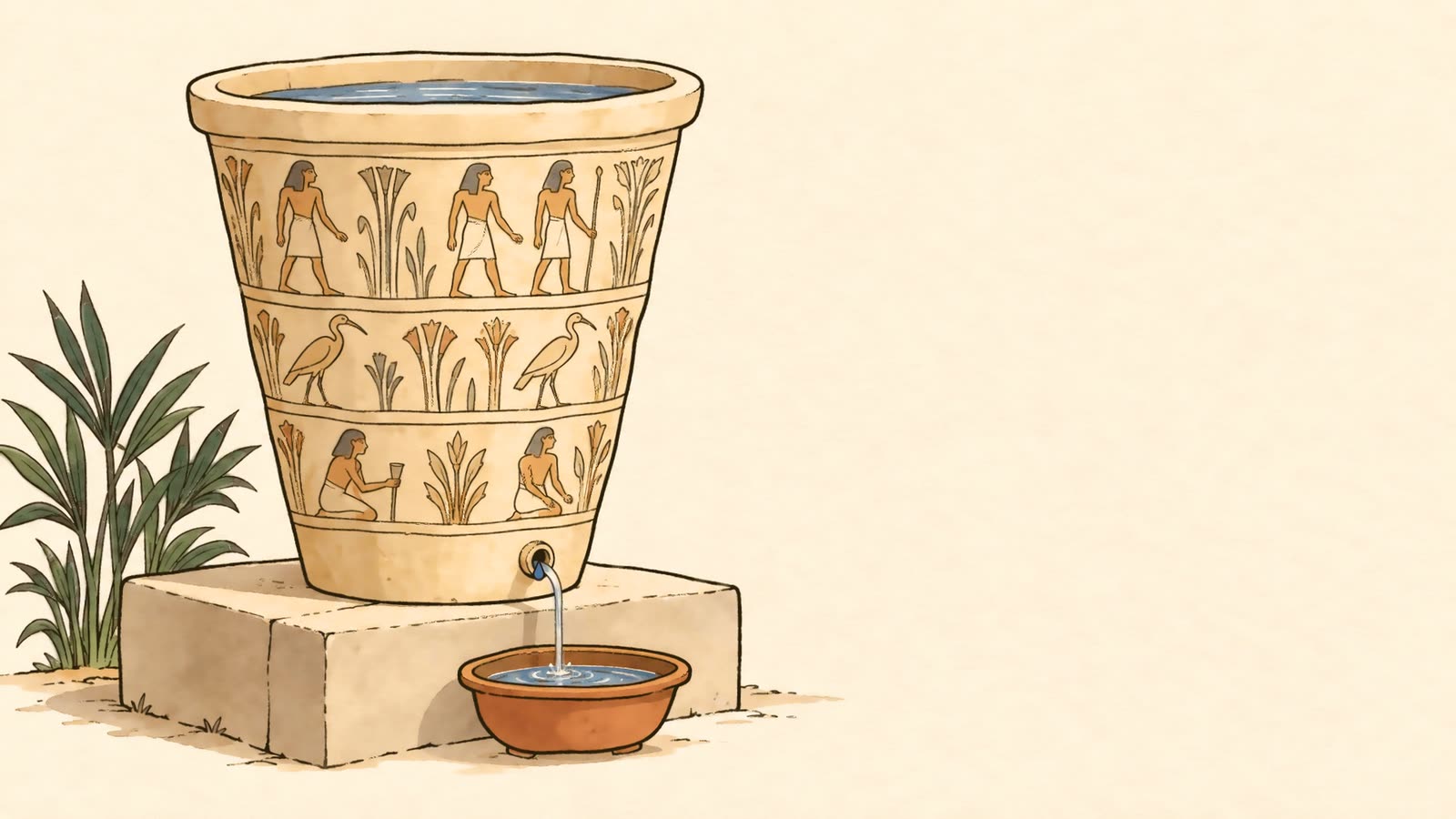
Egypt even built water clocks for the changing night hours. One of the oldest that survives, from Karnak and the reign of Amenhotep III about 3,400 years ago, let water trickle out of a small hole near the bottom of a stone vessel. Inside are twelve sets of hour marks, one for each month, because the hours kept changing size through the year.[4]
Daytime hours were counted from sunrise, and a word you use every day still carries a trace of that. “Noon” comes from the Latin nona hora, the ninth hour after sunrise, which fell in the middle of the afternoon. Over the centuries, the word slid back to midday. Nobody is quite sure why.[8]
Not everyone loved hours. In an old Roman comedy quoted by Aulus Gellius, a hungry character curses the man who first set up a sundial in town: before that, his stomach told him when to eat.[7]
Why sixty?
So where does sixty come from? In ancient Mesopotamia, largely in today’s Iraq, scribes used base sixty for calculations, much as we use base ten.[9]
Sixty has a useful advantage: it’s easy to share. It splits evenly into halves, thirds, quarters, fifths, sixths, tenths and twelfths. Try sharing a hundred coins between three friends: one coin is left over. With sixty coins, each friend gets twenty. Four friends get fifteen each, and five friends get twelve.
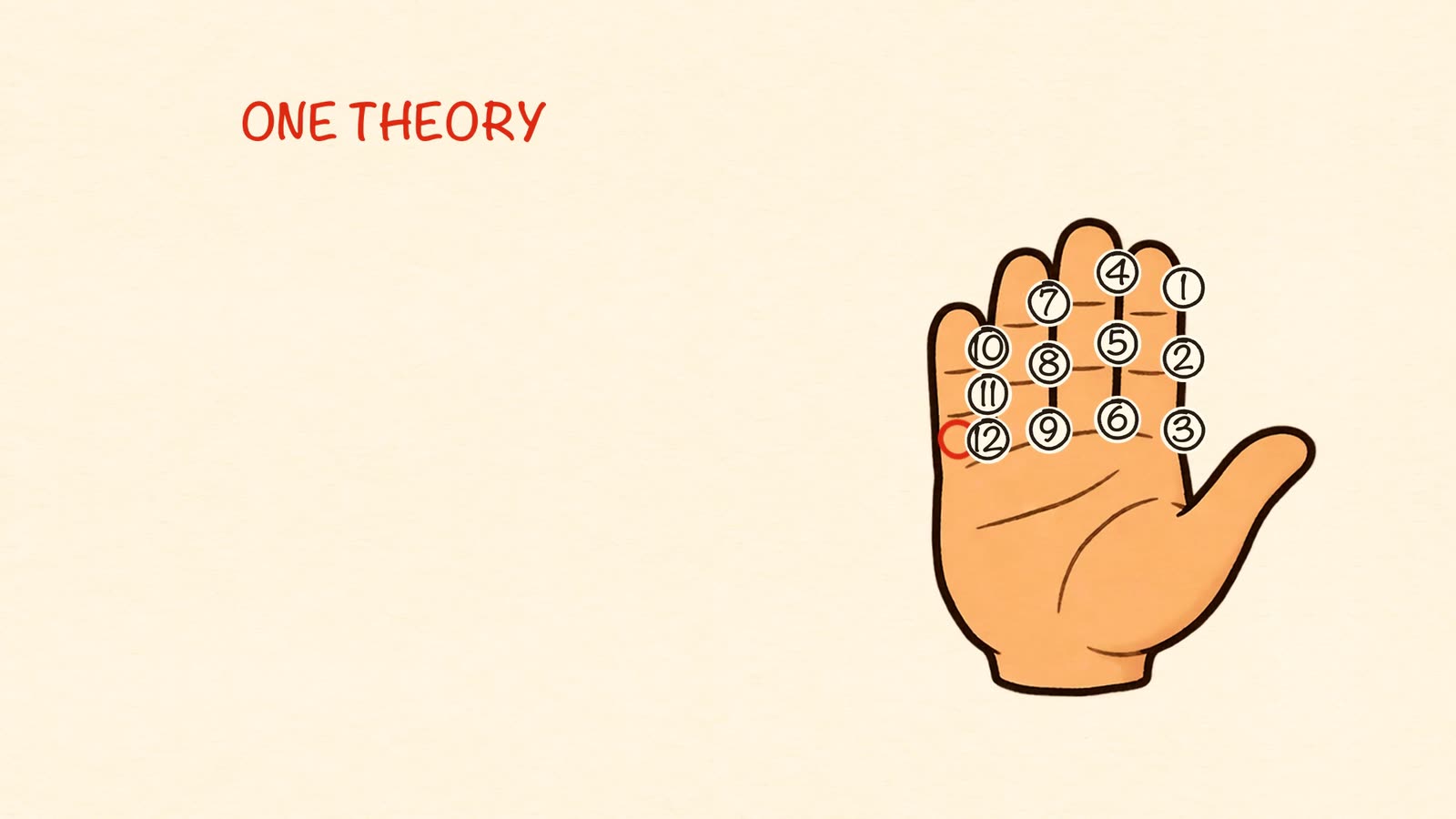
But did anyone pick sixty because it’s handy? Honestly, nobody knows.[2] One theory is finger counting. Use your thumb to tap the three sections of each of the four fingers on one hand: that’s twelve. Then keep track of the twelves on the five fingers of your other hand. Five twelves make sixty. It’s a neat trick, but there’s no proof anyone in ancient Mesopotamia counted this way.
Whatever the reason, sixty stuck. For thousands of years, astronomers used it for fractions, the way we use decimals.[2] Even so, Babylonian astronomers had no sixty-minute hour: they split the day into twelve “double hours” of thirty parts each.[10]
Equal hours, for astronomers
Astronomers had a problem with stretchy hours. To time an eclipse, you need an hour that is the same length in June and in December. Egypt’s twelves and Mesopotamia’s sixties came together in Greek astronomy. Greek astronomers learned Babylonian methods, including fractions in sixties and a circle of 360 degrees.[2][11] Astronomers like Hipparchus, more than two thousand years ago, used equal hours: the whole day and night cut into twenty-four equal parts.[1] These are called equinoctial hours, after the equinox, when day and night are about equal.
Here’s the twist. In everyday life around the Mediterranean and in Europe, stretchy hours carried on for well over a thousand years more.[1][14]
Where “minute” and “second” come from
Almost nineteen hundred years ago, around 150 CE, the astronomer Ptolemy wrote a giant book of astronomy in Alexandria, later known as the Almagest. To measure the sky precisely, he split each degree of a circle into sixty parts, then split each of those into sixty again.[11] He wrote in Greek, so he called them “first sixtieths” and “second sixtieths.”
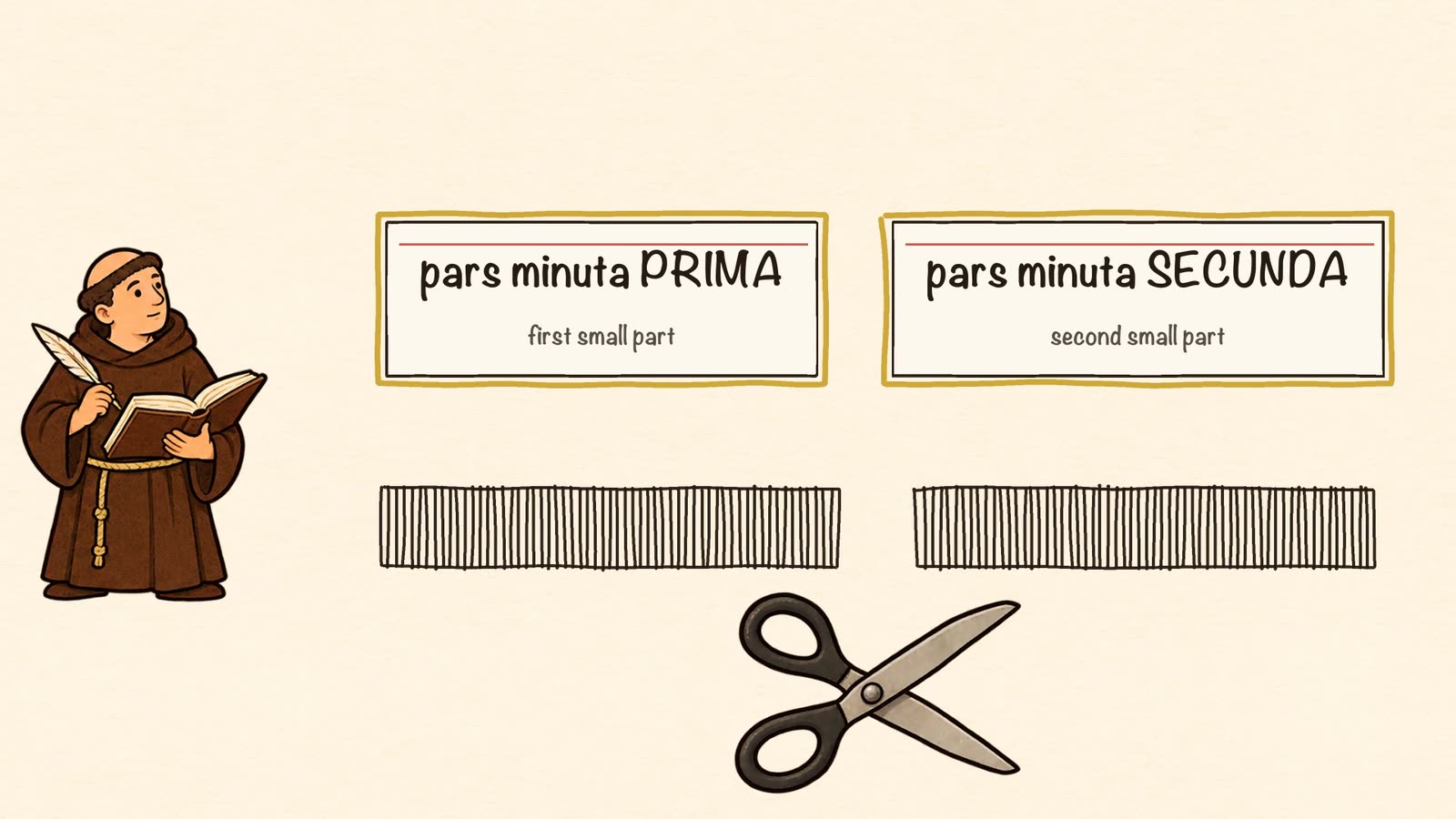
In medieval western Europe, his book became widely known through translations from Arabic into Latin; Gerard of Cremona translated it from Arabic into Latin by 1175.[11] In Latin, the first small parts were called pars minuta prima and the second small parts pars minuta secunda. Those phrases became your “minute” and your “second.”[1][8] So a second really is the second cut.
Meanwhile, people were cutting up the hour itself. In the 700s, the English monk Bede even split an hour into forty “moments.”[6] Around the year 1000, the scholar al-Biruni applied those sixtieth-cuts to hours: minutes, seconds, thirds and fourths, dividing by sixty again and again.[12] And by 1391, the poet Geoffrey Chaucer was writing about minutes of an hour in his Treatise on the Astrolabe.[13]
Clocks with no minute hand
The maths was ready. But could anyone actually see a minute tick by? For centuries, hardly ever. Europe’s first mechanical clocks appeared around seven hundred years ago, and many had no face at all. They simply rang a bell.[5][14] Salisbury Cathedral in England still has a clock like that.[16] Those bells even gave clocks their name: “clock” goes back to a medieval word for “bell.”[8]
In Milan in 1336, the clock in the tower of the church of San Gottardo struck every hour: one stroke for the first hour, and so on up to twenty-four.[14] A machine like that can’t easily stretch its hours with the seasons. So public striking clocks helped spread equal hours through European towns.[14][15]
Early clocks could still drift by many minutes a day. Most everyday clocks showed only the hours, and minute hands were rare.[17]
The swing that changed time
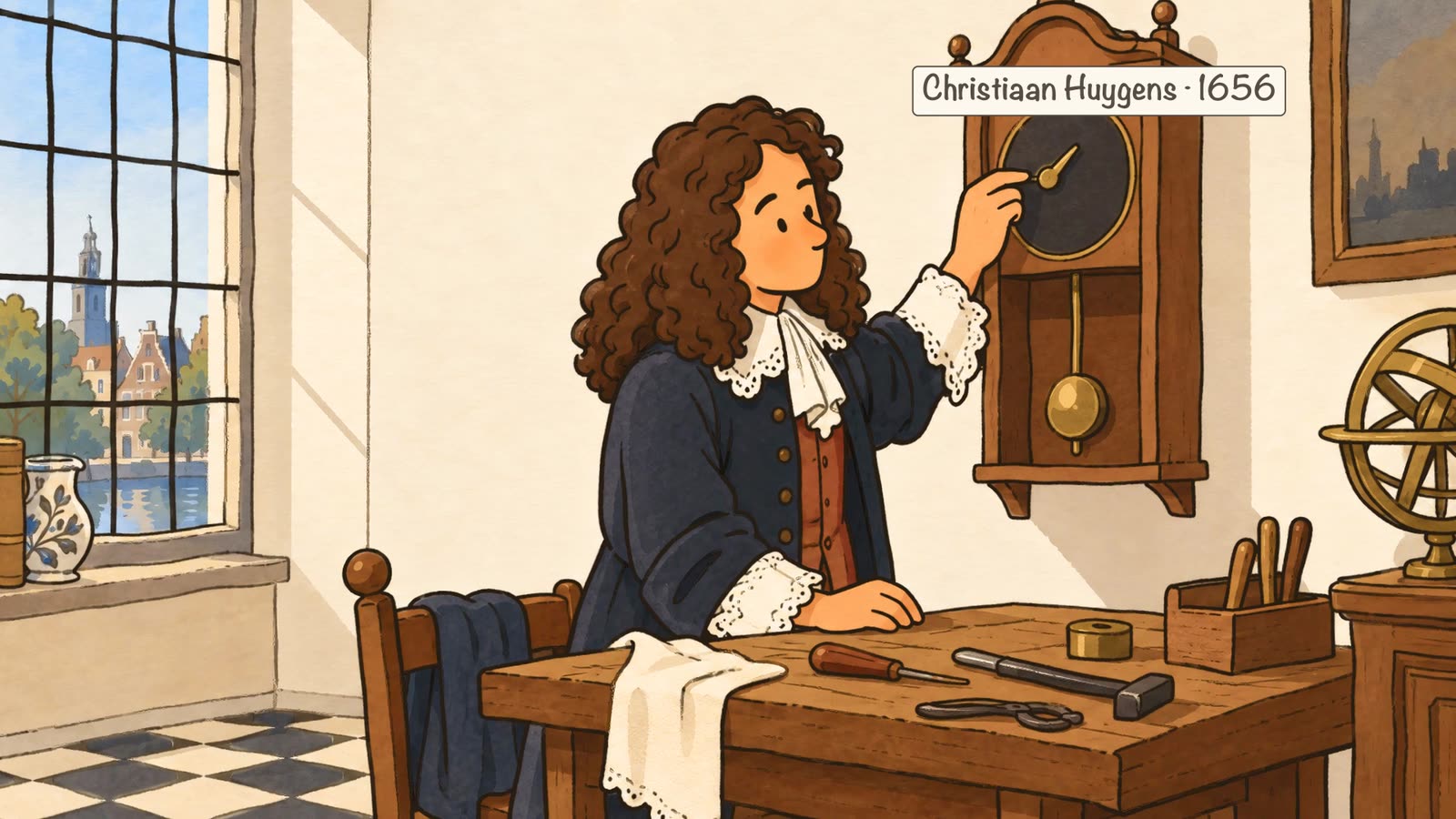
Around 1600, the Italian scientist Galileo noticed that a swinging pendulum keeps a remarkably steady beat.[18] Then, in 1656, the Dutch scientist Christiaan Huygens designed a clock kept in time by a pendulum.[5][19] His early clock was off by less than a minute a day, and later pendulum clocks got that down to less than ten seconds a day.[5] It was such a leap that many older clocks were rebuilt with pendulums.[15]
Now a minute was worth showing. Minute hands, once rare, spread in the late 1600s, and a new kind of spring did the same for pocket watches.[5][17] Ptolemy’s sixtieths waited about fifteen hundred years to reach an ordinary clock face.
Could we still switch to a hundred?
France tried. In 1793, Revolutionary France made decimal time law: ten hours a day, a hundred minutes an hour and a hundred seconds a minute. Each decimal hour lasted two of our hours and twenty-four minutes, and a decimal minute lasted 86.4 seconds, almost a minute and a half.[20] Clocks needed changing, and people had to learn new habits and new maths. Compulsory use was suspended in 1795, within two years.[20]
Even today, map coordinates often come in degrees, minutes and seconds, such as 51° 30′ 26″ N.[21]
Your hour today
Today the hour is built from the bottom up. Since 1967, the second has been defined by caesium atoms: it lasts 9,192,631,770 cycles of a particular microwave signal that caesium-133 atoms respond to.[21] Sixty seconds make a minute and sixty minutes an hour, by definition. Now and then, world time (UTC) has slipped in an extra “leap second” just before midnight, to stay in step with Earth’s spin. Timekeepers have now agreed: no more leap seconds from 20 May 2027.[21][22]
So look at 7:59 again. The twenty-four hours are Egypt’s twelve for the night and twelve for the day. Hours that stay the same size came from Greek astronomers, and then from medieval clock towers. The sixty is Mesopotamian maths, the same family of sixties behind the 360 degrees of a circle. The words “minute” and “second” are the first and second small parts. And the minute hand? Pendulum clocks helped make it common.
Next time someone says “just a second,” you’ll know exactly which cut they mean.
Sources
- Lombardi, M. A. (2007). “Why is a minute divided into 60 seconds, an hour into 60 minutes, yet there are only 24 hours in a day?” Scientific American.
- Neugebauer, O. (1969). The Exact Sciences in Antiquity, 2nd ed. Dover.
- Neugebauer, O. & Parker, R. A. (1960–1969). Egyptian Astronomical Texts, vols. I and III. Brown University Press.
- Symons, S. Ancient Egyptian Astronomy database: diagonal star tables; water clock WCO 1 (Amenhotep III, Karnak). McMaster University.
- National Institute of Standards and Technology (NIST). “A Walk Through Time”: Early Clocks; Revolution in Timekeeping.
- Bede. The Reckoning of Time, ch. 3. Trans. F. Wallis (1999). Liverpool University Press.
- Aulus Gellius. Attic Nights 3.3.5.
- Merriam-Webster and the Online Etymology Dictionary: “noon”, “clock”, “minute”, “second”.
- Friberg, J. (2019). “Three thousand years of sexagesimal numbers in Mesopotamian mathematical texts.” Archive for History of Exact Sciences 73.
- Steele, J. M. (2013). “Shadow-Length Schemes in Babylonian Astronomy.” SCIAMVS 14: 3–39.
- Toomer, G. J. (trans.) (1984). Ptolemy’s Almagest. Duckworth.
- al-Bīrūnī. The Chronology of Ancient Nations. Trans. C. E. Sachau (1879).
- Middle English Dictionary, “minute” (n.), sense 1a (Chaucer, A Treatise on the Astrolabe, 1391).
- Dohrn-van Rossum, G. (1996). History of the Hour: Clocks and Modern Temporal Orders. University of Chicago Press.
- Landes, D. S. (1983). Revolution in Time: Clocks and the Making of the Modern World. Harvard University Press.
- Salisbury Cathedral, visitor information on the medieval cathedral clock.
- Leopold, J. H. & Vincent, C. “Seventeenth-Century European Watches.” Heilbrunn Timeline of Art History, The Metropolitan Museum of Art.
- Galilei, G. (1638). Two New Sciences.
- Huygens, C. (1658). Horologium.
- Fondation de la Haute Horlogerie. “Decimal hour.” Encyclopedia glossary.
- BIPM: The International System of Units (SI Brochure), Table 8; 13th CGPM (1967), Resolution 1 (the caesium second); CGPM (2026), Resolution 5 (continuous UTC from 20 May 2027).
- NIST. Leap seconds.