
Why Are There 7 Days in a Week? The Surprising History of the Seven-Day Week
It’s Sunday night. You set Monday’s alarm and wish it were still Saturday. That small ritual hides a puzzle. Your day comes from Earth spinning. Your month comes from the Moon, and your year from the Sun. But no cycle in the sky decides how long your week is.[1]
So why seven, and how did it survive two governments that tried to replace it? The answer has two roots: one on the ground and one in the sky.
Prefer to watch? The animated version tells the same story in about eleven minutes.
Is it the Moon?
The Moon is the obvious suspect; Monday is even named after it. From one full moon to the next takes about 29 and a half days.[17] A quarter of that is about 7.4 days: close to seven, but not quite.
Four seven-day weeks add up to 28 days, a day and a half short of the Moon’s cycle. So within a couple of months, the full moon lands on a different weekday. The Moon may have suggested the number seven. But the week we use today ignores the Moon completely, and that turns out to be its great strength.
Did Babylon invent the week?
You may have read that the ancient Babylonians invented the week. What survives is a rulebook, copied for an Assyrian king’s library, that marks five unlucky days in each month: the 7th, 14th, 19th, 21st and 28th.[4] On those days the king must not eat meat cooked over coals, change his clothes or ride his chariot. These were rules for the king and a few specialists, not a day off for all.
Here’s the catch: the count started over with every new crescent Moon.[4] Our week never starts over. Theirs was a month with bookmarks. Babylon loved seven, but its calendars show no week that keeps rolling on, and no days named after planets.[1] The verdict: not proven.
Root one: a day of rest
The first root is found in the Hebrew Bible: six days of work, then a day of rest, for everyone. That rest day is the Sabbath. The Bible gives two reasons for it. One is that God rested on the seventh day of creation. The other is freedom: the people are reminded that they were once slaves in Egypt, so the rest must include children, servants, foreigners and even the donkey.[2]
How old is the Sabbath? Nobody can give it a birthday. But by about 2,500 years ago, Jews living on Elephantine, an island in the Nile, were already writing it into everyday notes scratched on broken pottery.[3]
That explains a seven-day rhythm of rest, but not how a planet got into your Saturday.
Root two: a sky full of wanderers
Ancient sky-watchers saw seven lights drifting against the fixed stars: the Sun, the Moon and the five planets you can see without a telescope. “Planet” comes from the Greek word for “wanderer”, so to them all seven counted as planets. They ranked them from farthest to nearest, as they believed: Saturn, Jupiter, Mars, the Sun, Venus, Mercury, the Moon.[5]
Seven planets, seven day names. But the week doesn’t follow that list. It runs Saturday, Sunday, Monday: Saturn, Sun, Moon. About 1,900 years ago, the Greek writer Plutarch asked exactly why. His answer is lost; only the question survives.[6]
One ancient explanation does survive, written down by the Roman historian Cassius Dio.[5] Give each hour of the day to one of the seven, in order, starting with Saturn. Whichever planet rules the first hour gives the day its name. A day has 24 hours: three full rounds of seven, with three hours left over. So Saturn rules hour 22, Jupiter hour 23 and Mars hour 24, and the first hour of the next day goes to the Sun.
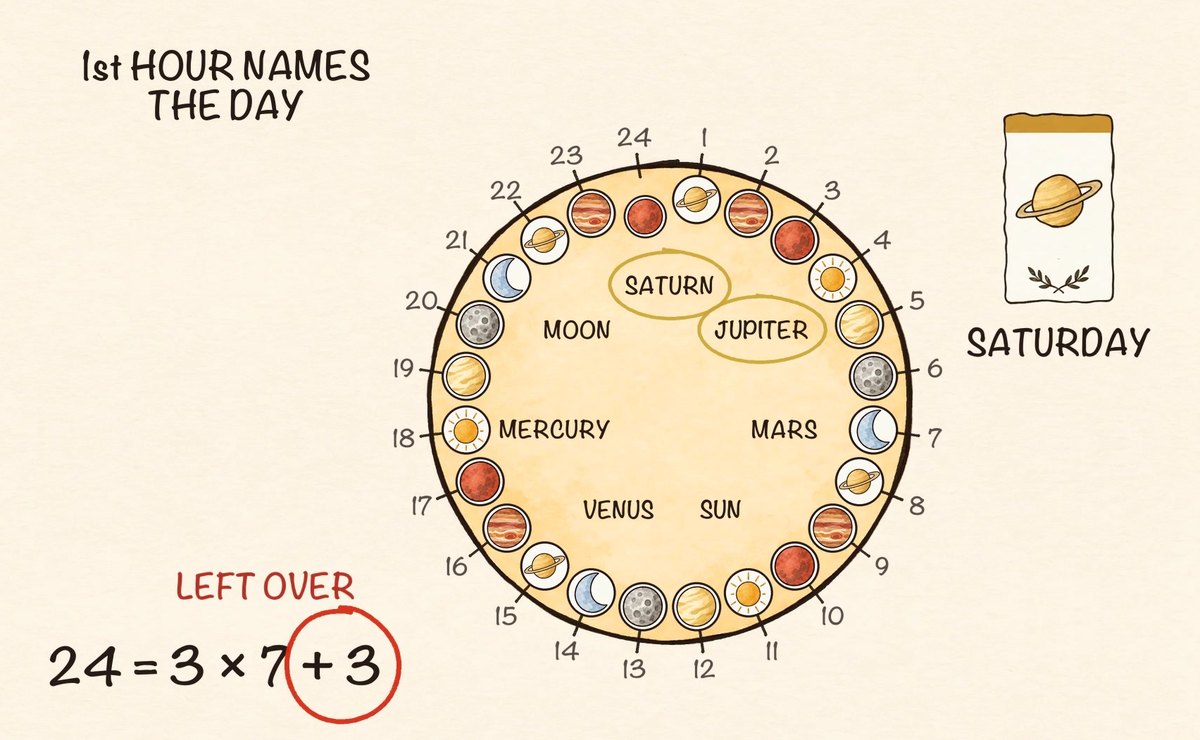
So each new day starts three places further along the list, giving Saturn, Sun, Moon, Mars, Mercury, Jupiter, Venus. That is your week. Was this how the order was really chosen, or a clever explanation added afterwards? Historians still don’t agree.[1]
Rome runs two weeks at once
Both seven-day weeks, one for rest and one for the planets, turn up in the Roman world. But Rome already had a week of its own: eight days long, built around market day. Under Augustus, Rome’s first emperor, stone calendars show an eight-day column next to a seven-day one.[1]
The Roman planet week started on Saturday, Saturn’s day. And here the two roots meet: in the Roman world, Saturn’s day and the Jewish Sabbath fell on the same day. Some Romans guessed that the Sabbath was for the god Saturn. It wasn’t.[1]
Who first chose seven for the planet week? Ancient writers credited the Egyptians,[5] but the oldest evidence we have comes from Italy, around the time of Augustus.[1]
How Sunday got the day off
By around the year 100, Christians were meeting on Sunday, which they called “the Lord’s day”, because they believed Jesus rose from the dead on a Sunday. For more than two centuries it was a day of worship, not a day off.[1]
Then, in 321, Emperor Constantine ordered judges, city people and craftsmen to rest on “the venerable day of the Sun”. Farmers could keep working.[7] He did not invent the week, which was centuries older, and he never moved the Sabbath or touched Saturday.[1]
What your day names give away
English kept only three planet names: Sunday, Monday and Saturday. For the other four Roman gods, English swapped in gods from northern Europe. Tuesday is Tiw’s day, standing in for Mars. Wednesday is Woden’s, for Mercury, and that silent “d” in Wednesday is Woden, still hiding in the spelling. Thursday is Thor’s, for Jupiter, and Friday is Frig’s, for Venus.
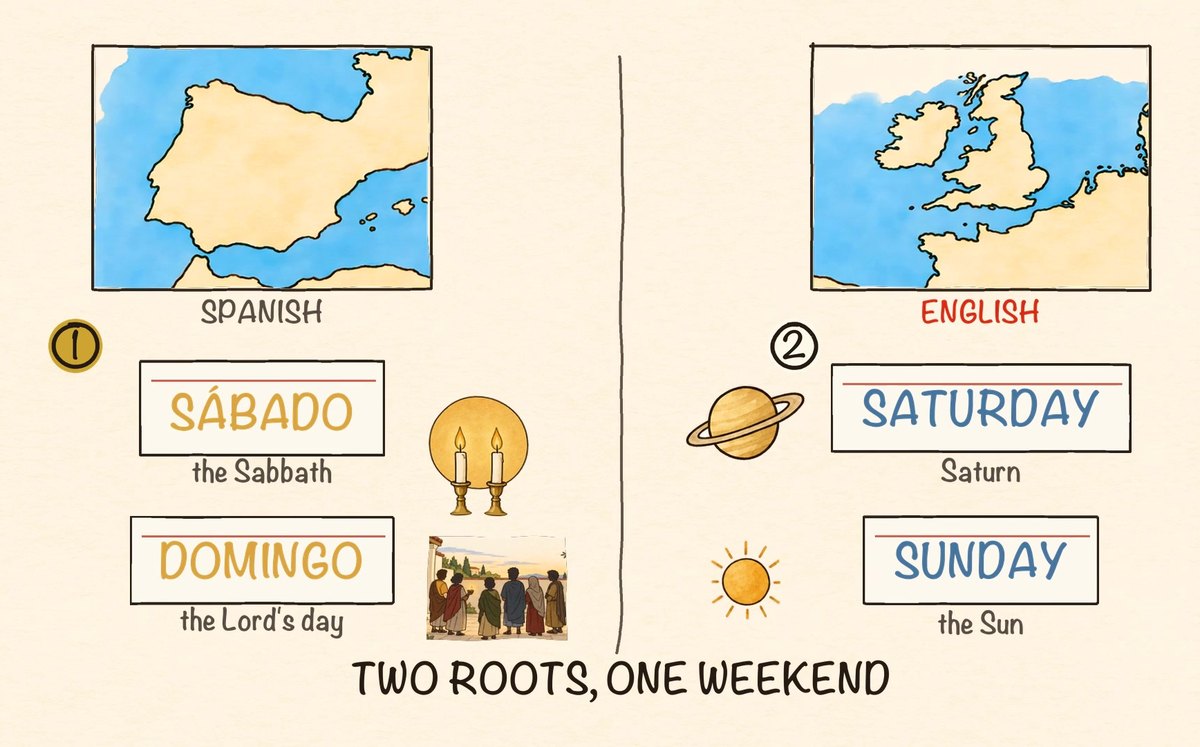
Saturday shows both roots. In English it’s named after Saturn. But in Spanish it’s sábado and in French samedi, and both come from “Sabbath”. So a Spanish weekend, sábado and domingo, is named for the Sabbath and the Lord’s day, while an English one is named for Saturn and the Sun.[1] Two roots, one weekend.
The planet week even reached Japan, where Tuesday is “fire day”, and in Japanese, Mars is the “fire star”. So Japan’s Tuesday belongs to Mars too: the same planet week, in disguise.[8]
France deletes the week
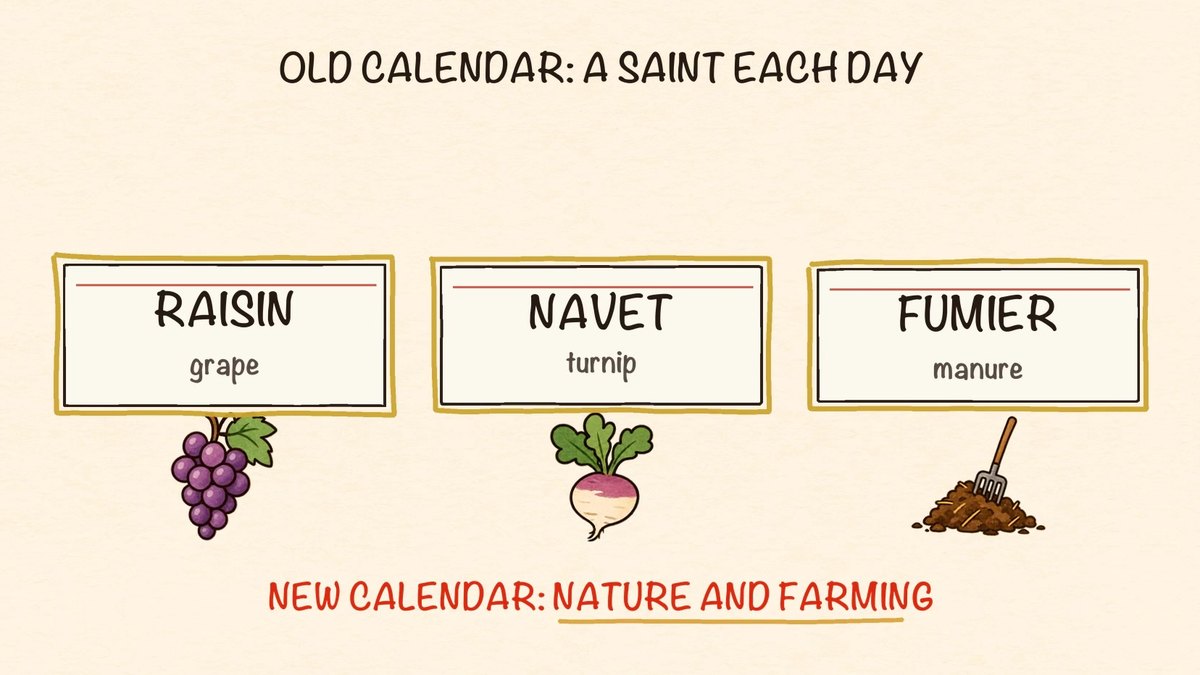
In 1793, revolutionary France abolished the seven-day week. Every month became three ten-day weeks, with rest on the tenth day.[9] That meant nine working days in a row. The old calendar gave each day a saint; the new one named most days after nature and farming, such as grape, turnip and manure. Christmas Day in 1793 became “Dog”.[10]
In 1794, one man was reported to the authorities for saying that men and animals can’t work nine days straight. Many people quietly kept Sunday anyway.[11] Sunday rest came back in 1802.[11] The calendar itself was scrapped from 1 January 1806.[9]
The Soviet nonstop week
In 1929, the Soviet Union tried the opposite: a shorter, “nonstop” week. Workers were split into five colour-coded groups. Each group worked four days and rested on the fifth, so the factories never had to stop.[13] Workers got about 72 regular days off a year instead of 52 Sundays, with public holidays on top.[13]
They hated it: if your partner was in a different group, you might never share a regular day off. Workers told the newspaper Pravda: “It is no holiday if you have to have it alone.”[12]
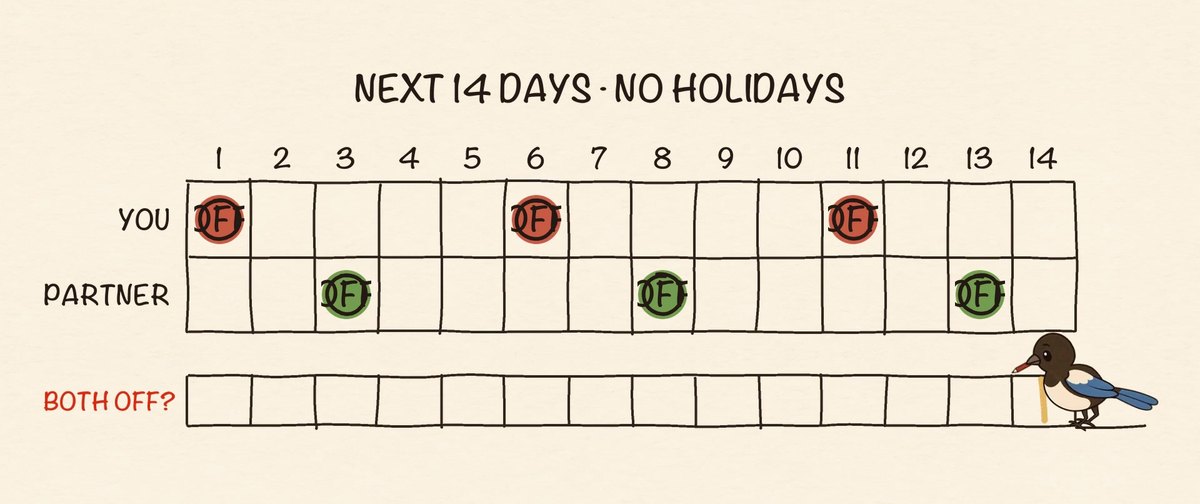
From 1931, most workplaces gave everyone the same day off, usually every sixth day.[13] In 1940, work went back to the seven-day week with Sunday off, as part of a harsh new labour law.[14]
Why seven keeps winning
There’s no single proof, but there are three clues. The first is the Soviet lesson: a week isn’t just for counting days off. It’s for being off together.
The second is a head start. Saturday for Jews, Sunday for Christians and Friday prayers for Muslims all sit on the same seven-day count.
The third is that the week simply keeps counting. In 1582, the Pope deleted ten days to fix the calendar. In the countries that adopted the reform that October, Thursday 4 October was followed by Friday 15 October; others switched later. The dates skipped ten, but the weekdays didn’t skip one.[18] As far as historians can tell, the seven-day count hasn’t broken since Roman times.[1] Because the week chases nothing in the sky, it never needs fixing.
The weekend is much younger
Your two-day weekend is a newcomer by comparison. In the early 1800s, many British workers skipped Mondays, jokingly calling it “Saint Monday”. During the 1800s, more workers got Saturday afternoons off.[15] In 1926, the car maker Ford made the five-day working week famous.[16]
So on Sunday night, when you set Monday’s alarm and wish it were Saturday, you’re not counting alone. Your week grew from a day of rest and a sky full of wanderers, and it has outlasted two serious attempts to replace it.
Sources
- Bultrighini, I. & Stern, S. (2021). “The seven-day week in the Roman Empire: origins, standardization, and diffusion.” In S. Stern (ed.), Calendars in the Making. Brill.
- Hebrew Bible: Exodus 20:8–11; Deuteronomy 5:12–15.
- Sabbath ostracon from Elephantine (TAD D7.16), Académie des Inscriptions et Belles-Lettres, Paris (catalogue record).
- Webster, H. (1916). Rest Days: A Study in Early Law and Morality.
- Cassius Dio, Roman History 37.18–19 (the planetary hours).
- Plutarch, Table Talk (Quaestiones convivales) 4.7.
- Codex Justinianus 3.12.2 (Constantine’s law of 321).
- Kotyk, J. (2022). “Astronomy and Calendrical Science in Early Mikkyō in Japan: Challenges and Adaptations.” Religions 13(5): 458.
- Assemblée nationale, “Convention nationale et calendrier républicain”.
- Fondation Napoléon, “The names of the days of the Republican calendar”.
- Shaw, M. (2001). “Reactions to the French Republican Calendar.” French History 15(1): 4–25.
- “The Continuous Working Week in Soviet Russia.” International Labour Review 23(2), 1931.
- Wood, T. (2016). “Labor Days.” Cabinet 61.
- Decree of 26 June 1940 (Seventeen Moments in Soviet History).
- Tiratelli, M. (2022). “The Working Week in the Long Nineteenth Century: Evidence from the Timings of Political Events in Britain.” Social Science History 46(2): 291–313.
- The Henry Ford, “Ford Motor Company Chronology”.
- U.S. Naval Observatory, astronomical glossary (the synodic month).
- U.S. Naval Observatory, Julian Date Converter, notes (the 1582 change: ten dates skipped, no weekday skipped).